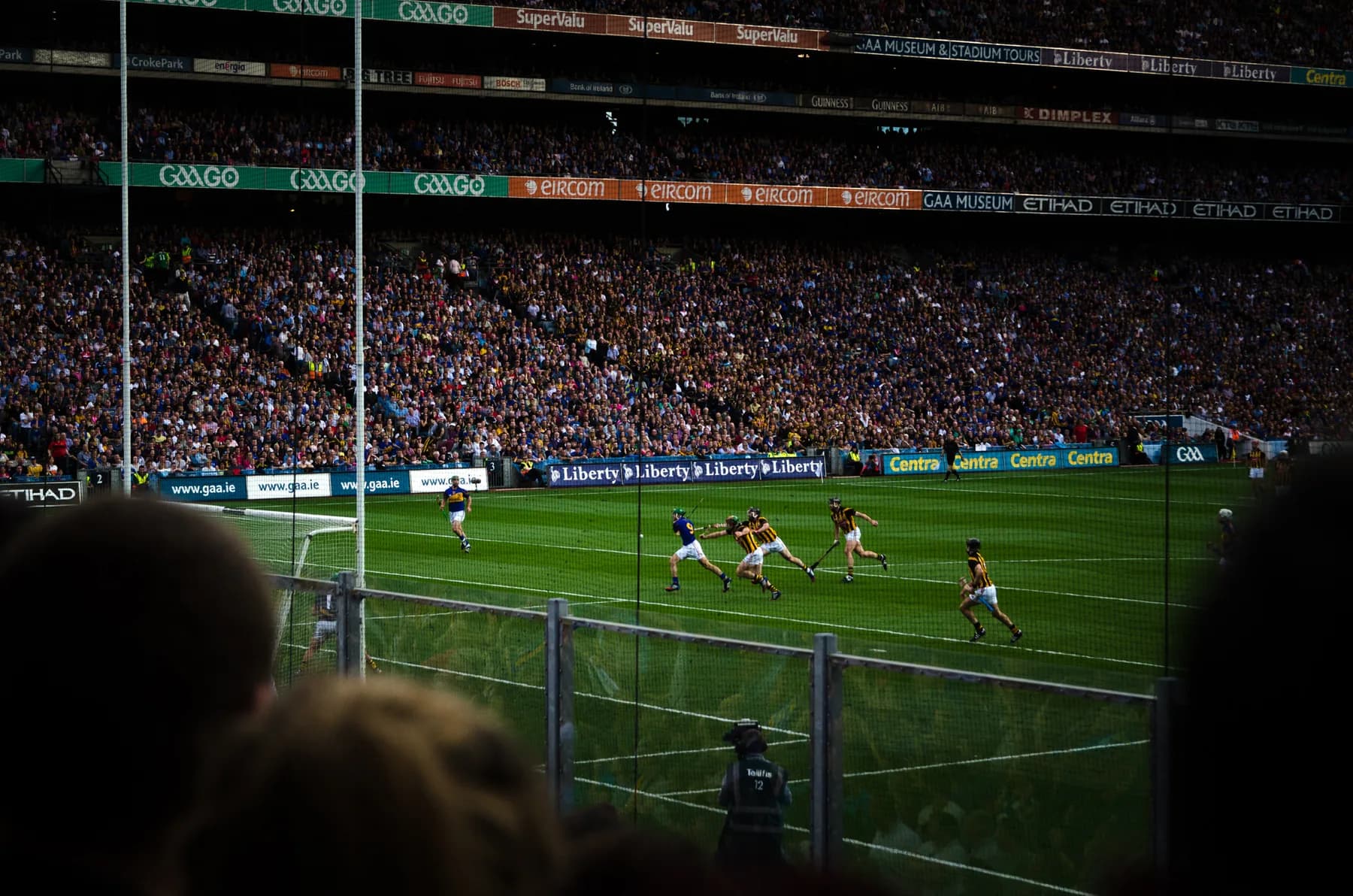
Sport in Ireland
Gaelic games, rugby, and the tribal loyalties that shape an Irish summer
To understand Ireland, it helps to understand what it does on a Sunday. Sport here is intensely local and fiercely tribal, built on county and parish loyalties that go back generations. The two biggest games, hurling and Gaelic football, are ones most visitors have never seen, played by amateurs in front of enormous crowds. Add rugby, soccer, and a national devotion to horses, and you have the country's real social calendar.
You do not need to follow any of it to enjoy Ireland, but knowing the basics unlocks a lot: the flags on the houses in July, the pub gone silent at throw-in, and why a stranger's first question is sometimes which county you are from.
The GAA
The Gaelic Athletic Association, the GAA, is the beating heart of Irish sport and one of the largest amateur sporting bodies in the world. It organises the native Gaelic games through more than 2,000 clubs, one rooted in almost every parish in the country. Crucially, nobody is paid: the county stars filling 82,000-seat stadiums go to work on Monday like everyone else, which is central to how the games are loved.
The structure is county-based. You support the county you are from, for life, and club rivalries between neighbouring parishes run just as deep. The GAA's home is Croke Park in Dublin, which holds 82,300 and ranks among the largest stadiums in Europe.
Hurling
Hurling is the one to see. Often called the fastest field sport in the world and among the oldest, it is played with a wooden stick (the hurley or camán) and a small hard ball (the sliotar) that players strike through the air at ferocious speed, catch in the hand, and balance on the stick while running. It is skilful, brutal, and beautiful, and it is unlike anything else in world sport.
The women's version is called camogie, played to almost identical rules. Hurling is strongest in a band of southern and eastern counties, Kilkenny, Tipperary, Cork, Limerick, Galway and Clare among them, where it is closer to religion than pastime.
Tips
- •If you see one live Irish sporting event, make it a big hurling match. Nothing else compares.
- •The ball is the sliotar, the stick is the hurley. Getting the words right earns a nod.
Gaelic Football
Gaelic football is the GAA's other code, and the more widely played of the two across the country. It is a fast, physical field game somewhere between soccer and rugby: you can carry the ball, but must bounce or 'solo' it every few steps, and you score by kicking or fisting it over the bar for a point or into the net for a goal. The same county-and-parish loyalties apply.
Scoring in both games uses the same system, which confuses newcomers: a goal (into the net) is worth three points, and a point (over the bar) is worth one, so scores are written as, for example, '2-14', meaning two goals and fourteen points, or twenty in total.
The Championship and Croke Park
The inter-county championships run through the summer and build to the All-Ireland finals, the biggest days in the Irish sporting year. Under the current 'split season', those finals are now held in July rather than the traditional September, drawing capacity crowds to Croke Park and huge television audiences. Winning captains lift the Sam Maguire (football) or the Liam MacCarthy (hurling) cups, and the county celebrates for weeks.
In the run-up you will see county colours everywhere: flags on cars, bunting across village streets, jerseys on children. If a match is on and you are in a pub in the relevant county, you are about to see the place at its most passionate. Just do not talk through the throw-in.
Tips
- •Tickets for early-round county matches are cheap and easy; All-Ireland final tickets are gold dust.
- •Watching a big match in a pub in the competing county is an experience in itself, and free.
Rugby, Soccer, and the Rest
Rugby is the other national passion, and unusually the Ireland team represents the whole island, both the Republic and Northern Ireland, playing in the Six Nations each spring and at the Rugby World Cup. Below the national side, four provincial teams, Leinster, Munster, Ulster and Connacht, carry deep regional loyalty and play in European and cross-league competitions. A Munster match in Limerick is a proper day out.
Soccer is popular too, though many follow English clubs as closely as the home League of Ireland; note that soccer is one sport where the Republic and Northern Ireland field separate national teams. And running underneath all of it is horse racing, a genuine national obsession, with festivals like Galway and Punchestown that are as much social events as sporting ones.