Northern Ireland and the Republic
Two jurisdictions, one island: the border, the currencies, and what actually changes when you cross
One of the first things to get straight about Ireland is that it is one island with two countries on it. The Republic of Ireland is an independent state and a member of the European Union. Northern Ireland is part of the United Kingdom. The two share an open, invisible border, but they use different money, different measurements, and different phone networks, and a trip that crosses between them needs a little planning.
This page is the practical primer for visitors moving between the two: what differs, what to watch for when you cross, and a note on doing so respectfully. It is not a history lesson, and it deliberately keeps clear of taking sides.
Two Jurisdictions, One Island
The Republic of Ireland (often just 'Ireland' or 'the South') covers roughly five-sixths of the island and is governed from Dublin. Northern Ireland ('the North') is six counties in the north-east, part of the UK and governed from Belfast and, for UK matters, London. Both are easy, welcoming places to visit, and many trips take in both: Dublin and the west in the Republic, Belfast and the Causeway Coast in the North.
You will hear 'Ireland' used loosely to mean the whole island, the Republic alone, or the national rugby team that represents both. Context usually makes it clear. When it matters, 'the Republic' and 'Northern Ireland' are the precise terms.
The Open Border
The border is open and unmarked. There are no checkpoints, no passport control, and no barrier; you can drive from Dublin to Belfast without stopping. This arrangement, the Common Travel Area between Ireland and the UK, predates the EU and was preserved through Brexit. For a visitor already in one, crossing to the other involves no formality at all.
In practice, the only sign that you have crossed is that the road signs change units: speed limits switch between kilometres per hour in the Republic and miles per hour in the North, and place names may appear in different styles. Blink and you will miss the moment you changed country.
Tips
- •You do not need to show a passport at the land border, but carry your ID and check your own visa or entry rules for each of Ireland and the UK before you travel.
- •The change from km/h to mph (or back) is often the only clue you have crossed. Watch the speed signs.
Money and Phones
The Republic uses the euro; Northern Ireland uses the pound sterling. If your trip crosses the border you will want access to both, or a card that handles each without heavy fees. Businesses right on the border sometimes accept the 'other' currency, but usually at a poor rate, so it is not something to rely on. Cards and contactless work throughout both.
Phones need a moment's thought too. Near the border your mobile can silently latch onto a mast on the other side, switching you between an Irish (+353) and a UK (+44) network and potentially triggering roaming charges. Check your plan's coverage for both jurisdictions, and keep an eye on which network your phone is showing when you are close to the line.
Tips
- •Carry or have card access to both euro and sterling if you are crossing.
- •Watch for your phone roaming onto the 'other' network near the border; it can cost you.
- •Emergency services answer 112 or 999 on both sides of the border.
Driving Across
Crossing by car is straightforward. Speed limits are the main practical difference: the Republic posts limits in km/h (120 on motorways, 100 on national roads, 80 on regional roads and 60 on rural local roads, the last of these cut from 80 in February 2025) and Northern Ireland in mph (60 on single carriageways, 70 on motorways). Your hire car's speedometer will show one or both; know which unit the signs are using so you read them correctly.
If you are hiring a car, confirm at the desk that your insurance covers cross-border driving, as most Irish and UK hire cars do; the requirement for a separate insurance 'green card' to cross was removed in 2021. Fuel is sold in litres on both sides, and priced in the local currency.
Crossing Respectfully
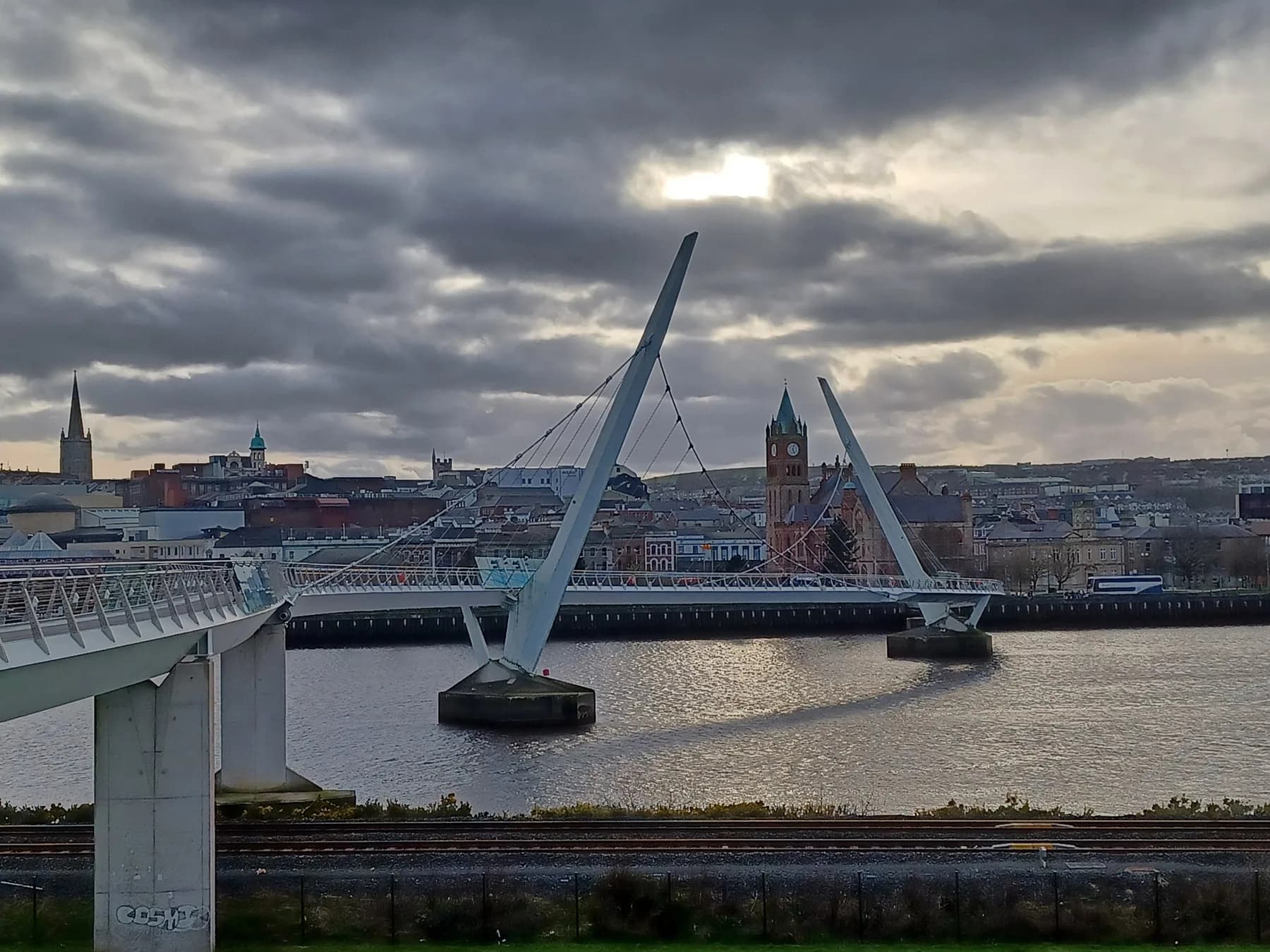
Northern Ireland is a friendly, rewarding place to visit, and most of the time politics is simply not part of a tourist's day. That said, it has a complicated recent history, and a little sensitivity goes a long way. Names can carry meaning: the North's second city is called Derry by some and Londonderry by others, and 'Derry' is the safe, widely used everyday choice. Flags, murals, and painted kerbstones signal community identities; they are fine to look at and photograph, but not a topic to wade into with strong opinions.
The simplest approach is the traveller's usual one: be curious, be courteous, and let locals lead the conversation. Ask questions if you are genuinely interested, listen more than you talk, and avoid assuming or announcing where anyone stands. Do that and you will find people generous, funny, and proud to show the place off.
Do
- ✓Use 'Derry' as the neutral everyday name for the city.
- ✓Be curious and courteous; let locals steer any conversation about politics or history.
- ✓Enjoy Belfast, the Titanic Quarter, the Causeway Coast, and the Derry walls.
Don't
- ×Do not arrive with strong opinions on the politics or start debates.
- ×Do not assume 'Ireland' and 'Northern Ireland' are interchangeable; the distinction matters to people.
- ×Do not treat murals or flags as a photo backdrop for jokes; read the room.