Eating in Ireland
The chipper, the fry, the carvery, and the small rituals of a country that takes its food personally
Irish food is not fussy, but it is particular. It runs on good raw ingredients treated plainly: dairy that tastes of grass, spuds cooked six different ways, seafood pulled from cold clean water, and bread baked without yeast and eaten the same day. You will not find a national obsession with tasting menus. You will find people who have firm opinions about which chipper does the best batter and which pub does a proper carvery.
This page is the country-level primer. Each town page has its own eating-out section with named, verified venues for the final mile.
The Chipper
The chip shop, universally 'the chipper', is the backbone of Irish takeaway. The classic order is fresh fish in a light batter (cod, haddock, or in coastal towns ray or whiting) with a bag of thick-cut chips, salt and vinegar shaken on at the counter. It is best eaten walking, from the paper, ideally somewhere with a sea view and a stiff breeze.
The modern chipper has grown a second menu: the spice bag (chips, shredded fried chicken, peppers, and a house spice mix, a genuinely Irish invention from the 2010s), garlic cheese chips, and the battered sausage. None of it is subtle. All of it is the point.
Tips
- •Ask for your fish 'fresh' if you want it cooked to order; some chippers keep a warm batch going at peak times.
- •Curry sauce or taco chips are regional loyalties; try the local default before you judge it.
- •A chipper near a harbour usually has the freshest fish. Follow the queue of locals, not the signage.
The Full Irish
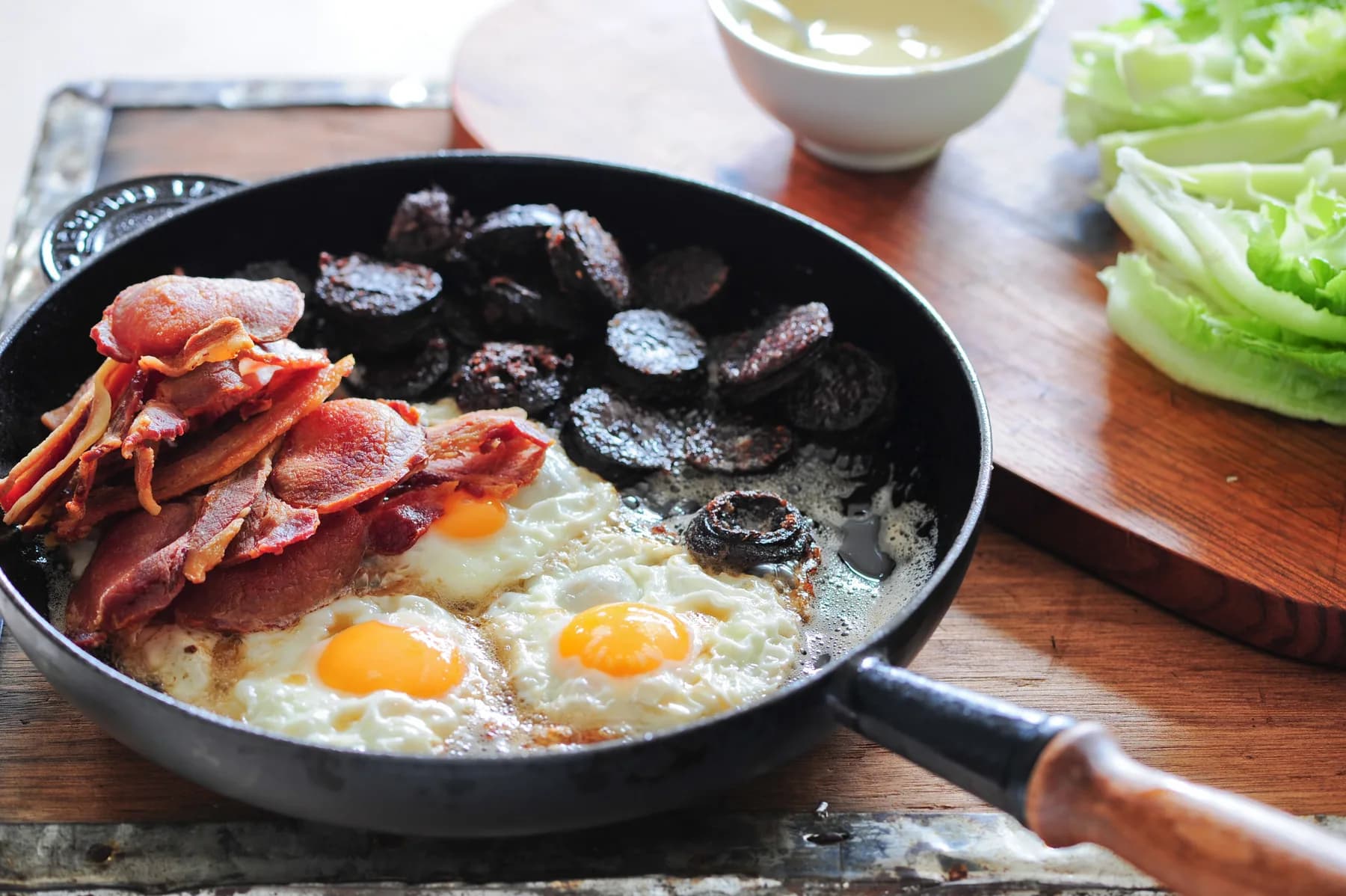
The full Irish breakfast is a fried plate built to carry you through a working morning: back-bacon rashers, pork sausages, a fried egg, grilled tomato, mushrooms, and the two puddings. Black pudding is a blood sausage bound with oats; white pudding is its milder, blood-free cousin, oatmeal and pork and spice. Brown soda bread or toast mops the plate. Tea, not coffee, is the traditional partner.
You will meet it everywhere: hotel buffets, greasy-spoon cafes, gastropubs doing a weekend brunch. The good versions use a named local butcher for the sausages and pudding. Baked beans and hash browns are common add-ons but are not strictly part of the canon; nobody will stop you.
Tips
- •If the puddings are new to you, try both. White is the gentle introduction; black is worth the leap.
- •A 'small Irish' trims the plate to the essentials. Ask if the full version looks like a lot; it is a lot.
Chowder and Brown Bread
On any coast, seafood chowder is the reliable lunch: a creamy broth heavy with smoked and fresh fish, mussels, and often a bit of bacon, served with a thick slice of brown soda bread and butter. It is a full meal, not a starter, and every harbour town has a pub or cafe locals will point you to.
The bread matters as much as the soup. Irish brown soda bread is leavened with bicarbonate of soda and buttermilk rather than yeast, so it is dense, faintly tangy, and made fresh daily because it stales fast. Regional loaves are worth seeking out: the soft white Waterford blaa, the sweet fruited barmbrack, and the batch loaf sold sliced thick.
The Carvery
The carvery is the great value lunch of Irish pub culture and one of the easiest wins for a visitor. You queue at a hot counter where roast meats (beef, turkey and ham, sometimes lamb) are carved to order, then you point at the sides: roast and mashed potato, a mound of vegetables, stuffing, and gravy over the lot. One fixed, honest price.
It runs weekday lunchtimes, roughly 12:30 to 2:30, in pubs and hotels across the country, with Sunday being the big sit-down version of the same idea. It is not refined and it is not trying to be. It is a hot, generous, cheap plate of dinner in the middle of the day, and it is deeply Irish.
Tips
- •Go before 1pm on a weekday; the good dishes run down and the queue builds.
- •Two potato types on one plate is not greedy here, it is expected.
Seafood and Oysters
Cold Atlantic water gives Ireland exceptional shellfish: Dublin Bay prawns (langoustines, the real thing, not scampi), mussels, crab, and oysters. Native flat oysters have a defined season, roughly September to April, while the plumper Pacific rock oyster is available most of the year. Eat them where they land, on the west and south coasts especially.
The calendar event is the Galway International Oyster and Seafood Festival, held on the last weekend of September and running since 1954, which makes it the world's oldest oyster festival. It marks the opening of the native season with shucking championships, tastings, and a great deal of stout.
Tips
- •Oysters are traditionally taken with a squeeze of lemon and a half-pint of stout, not much else.
- •If you are inland, a good fishmonger counter or a harbour restaurant beats a supermarket every time.
Tea Culture
Tea is not a beverage in Ireland so much as a reflex. The country drinks more of it per head than almost anywhere on earth, second only to Turkey, and 'will you have a cup of tea' is less an offer than the opening line of most indoor social interactions. It is taken strong, with milk, often with sugar, and at any hour.
The two tribes are Barry's, blended in Cork and favoured in the south, and Lyons, favoured in Dublin and the east. People hold these loyalties more firmly than you might expect. If you are staying with anyone, learn which one lives in the house and do not suggest the other.
Tips
- •In a cafe, 'a pot of tea' comes with milk on the side; add it to taste.
- •'A builder's tea' means strong, milky, and no ceremony. It is the safe default order.
The Everyday Classics
Beyond the headline dishes, a few homely plates are worth trying where they are done well. Irish stew is slow-cooked lamb or mutton with potato, onion, and carrot, plain and warming. Bacon and cabbage is the older Sunday dinner, often with parsley sauce. Coddle is a Dublin one-pot of sausage, bacon, onion, and potato, unglamorous and much loved in the city.
For the potato itself, learn the words: colcannon is mash with kale or cabbage and butter; champ is mash with spring onion; boxty is a potato pancake, part grated and part mashed. None of this is restaurant food exactly. It is what the country actually eats, and the best versions are in pubs and homes, not on tasting menus.