The Irish Language and Place Names
A quick guide to Gaeilge: the words you'll meet, the signs you'll read, and what the place names mean
You can travel all of Ireland in English and never hit a language barrier. But Irish, Gaeilge, is everywhere once you start noticing it: on every road sign, on the front of buses, in the names of the government, and woven through place names that suddenly make sense once you know a handful of words. A little curiosity goes a long way, and locals are warmly encouraging of any visitor who has a go.
This is not a language course. It is the practical bit: what Irish's status actually is, where it is spoken as a living daily language, the words you will genuinely encounter, and how to decode the map.
Where Irish Stands
Irish is the first official language of the Republic under the constitution, with English the second; in practice English is the everyday language of most of the country, and Irish is a cherished but minority tongue. In the 2022 census, about 40 percent of people said they had some ability to speak it, while a smaller core, around 72,000 people, use it daily outside the education system. Since January 2022 Irish has also been a full official and working language of the European Union.
Almost everyone learns Irish at school, so most people know at least some, even if they are rusty. It is a Celtic language, related to Scottish Gaelic and more distantly to Welsh, and it sounds nothing like English, which is part of what makes the place names so puzzling until they click.
The Gaeltacht
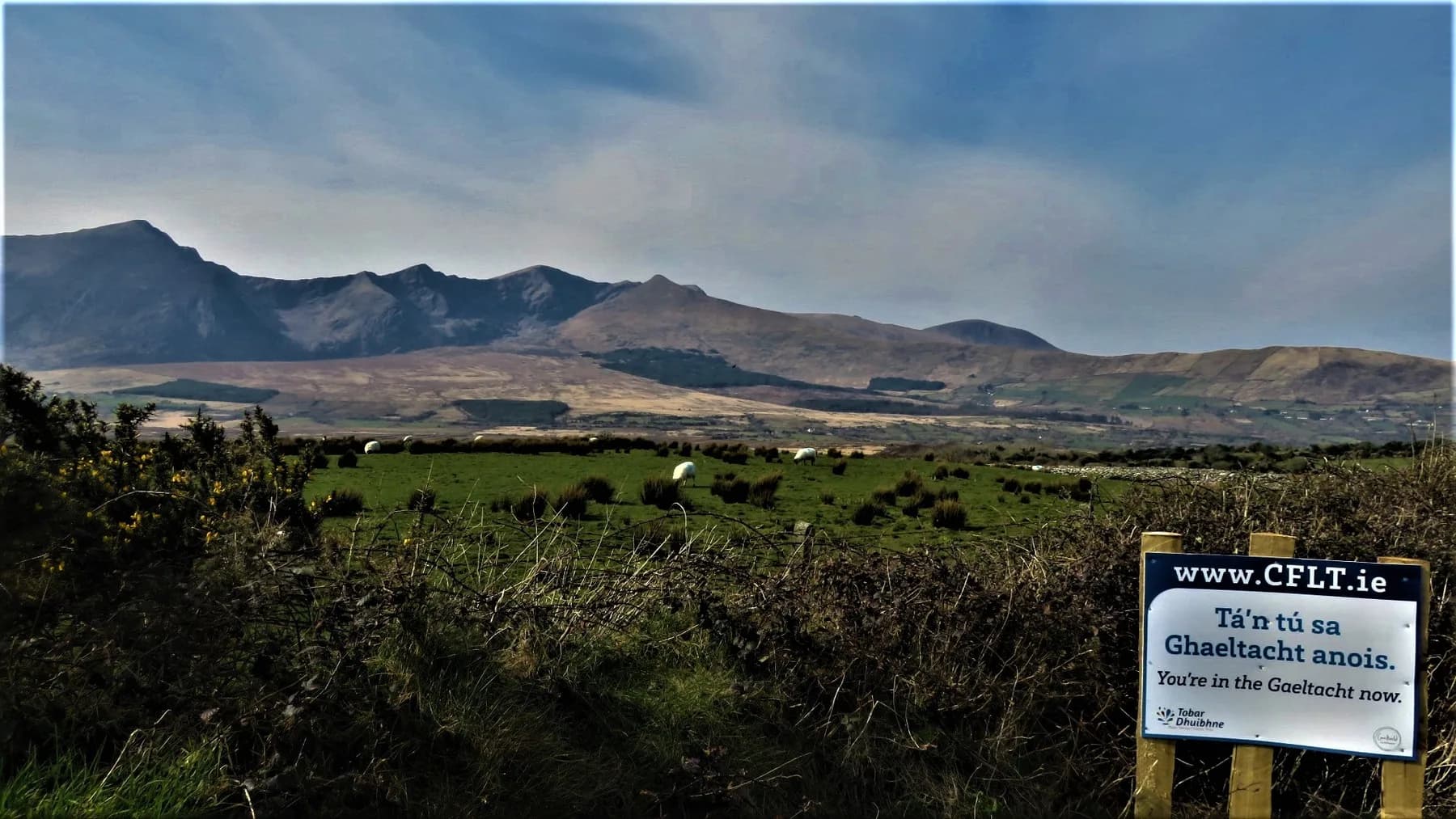
The Gaeltacht is the collective name for the regions where Irish is still the community language, spread across parts of seven counties: Donegal, Mayo, Galway, Kerry, Cork, Waterford and Meath. The strongest and largest is Connemara in County Galway, followed by the Donegal and Kerry Gaeltachtaí. These are ordinary places to visit, but Irish is the living language of the shop, the school, and the pub.
One practical thing to know: in the Gaeltacht, official road signs are often in Irish only, with no English translation. So the town you are looking for as 'Dingle' will be signed as 'An Daingean', and 'Spiddal' as 'An Spidéal'. It is worth noting both names before you set off.
Tips
- •In the Gaeltacht, learn the Irish form of your destination; the English name may not appear on signs.
- •A cúpla focal (a few words) of Irish is genuinely appreciated here, however badly pronounced.
Words You'll Actually Meet
A few words turn up constantly. Fáilte means welcome (you will see 'Céad Míle Fáilte', a hundred thousand welcomes). Sláinte, literally 'health', is the toast you raise with a drink. Go raibh maith agat is thank you; Slán is bye; Dia dhuit is hello. None of these are essential, but dropping a sláinte in a pub or a go raibh maith agat to a barman lands well.
You will also meet Irish on the toilet doors: Fir for men, Mná for women. Getting those two the wrong way round is a rite of passage for visitors, so commit them to memory now.
Tips
- •Sláinte is pronounced roughly 'slawn-cha'. Raise the glass, make eye contact, and you are set.
- •Fir = men, Mná = women. When in doubt, wait and watch who goes where.
Irish in Official Life
The state runs partly in Irish, so its institutions keep their Irish names even in English conversation. The prime minister is the Taoiseach (pronounced 'tee-shuck') and the deputy is the Tánaiste; parliament is the Dáil; a member of it is a TD (Teachta Dála). The police are the Garda Síochána, universally 'the Gardaí' or 'the Guards'. The president lives in Áras an Uachtaráin.
The one that catches out every visitor on public transport is An Lár. When a Dublin bus shows 'An Lár' as its destination, it simply means the city centre. It is not a place on the map; it is where you are probably trying to go.
Reading the Place Names
Most Irish place names are anglicised spellings of Irish words describing the landscape, and once you know the building blocks, the map starts to talk. Baile (anglicised as 'Bally') means a town or settlement; Dún is a fort; Cill ('Kil' or 'Kill') is a church; Loch ('Lough') is a lake; Cnoc ('Knock') is a hill; Áth is a ford; Ros is a wood or headland; Inis ('Innish' or 'Ennis') is an island; Gleann ('Glen') is a valley.
So Knockmore is simply 'big hill', Kilkenny contains a church, and Dublin itself comes from Dubh Linn, 'black pool', though its official Irish name is the entirely different Baile Átha Cliath, 'the town of the hurdled ford'. Half the fun of driving around Ireland is quietly translating the signposts as you pass them.
Do
- ✓Call the language 'Irish' or 'Gaeilge'.
- ✓Try the place-name elements; they unlock hundreds of names.
- ✓Have a go at a word or two; effort counts far more than accuracy.
Don't
- ×Do not call it 'Gaelic'; that more often refers to Scottish Gaelic or to Gaelic football.
- ×Do not assume the Irish and English versions of a place name are similar; sometimes they are unrelated.