The Nations of Britain
One country, three nations, and a lot more to tell them apart than a flag.
The United Kingdom is a single sovereign state, but it is not one uniform place. This guide covers three of its nations, England, Scotland, and Wales, which sit together on the island of Great Britain (the fourth nation, Northern Ireland, shares a different history and is covered separately, alongside Ireland, elsewhere on this site).
Understanding that Britain is one country made up of distinct nations will save you from a few easy mistakes and help you get more out of your trip. Each nation has its own character, its own story, and its own way of doing things, and a visitor who notices the difference tends to have a warmer welcome than one who assumes it is all the same.
One State, Three Nations
The United Kingdom of Great Britain and Northern Ireland is a single country in the sense that matters for travel: one currency, one passport control at the border, one set of immigration rules. But it is made up of nations with their own long histories, and England, Scotland, and Wales each have a strong sense of identity that predates the union by centuries.
Scotland and Wales each have their own devolved government, which handles many day to day matters such as health, education, and much of transport and local policy. The Scottish Parliament sits at Holyrood in Edinburgh, and the Senedd sits in Cardiff. England does not have an equivalent devolved parliament of its own. Some powers, including defence, foreign affairs, and immigration, remain with the UK Parliament at Westminster in London, which governs the whole country.
None of this needs to complicate your trip. It simply means that as you move between the three nations, you may notice different signage, different institutions, and a genuine sense of crossing into somewhere with its own identity, even though you have not left the country and nothing changes at the border.
What Actually Differs as You Travel
Most of the practical differences between England, Scotland, and Wales are small and easy to navigate once you know they exist. None of them will trip up a prepared visitor, but they are worth knowing before you arrive.
- •Scotland has its own legal system, distinct from the system used in England and Wales, and its own separate education system.
- •Scottish banks issue their own sterling banknotes. They are not legal tender anywhere in the UK, including Scotland itself, but they are genuine currency and widely accepted; some smaller businesses further south may be less familiar with them.
- •Prescription charges differ: prescriptions issued and dispensed in Scotland or Wales are free, while a standard charge usually applies in England and to English prescriptions dispensed in Scotland or Wales.
- •Wales is officially bilingual, with Welsh and English both used on road signs, official documents, and public announcements. Scotland has its own indigenous languages too, Scottish Gaelic, spoken by a small number of people mainly in parts of the Highlands and Islands, and Scots, a language closely related to English with a long literary history.
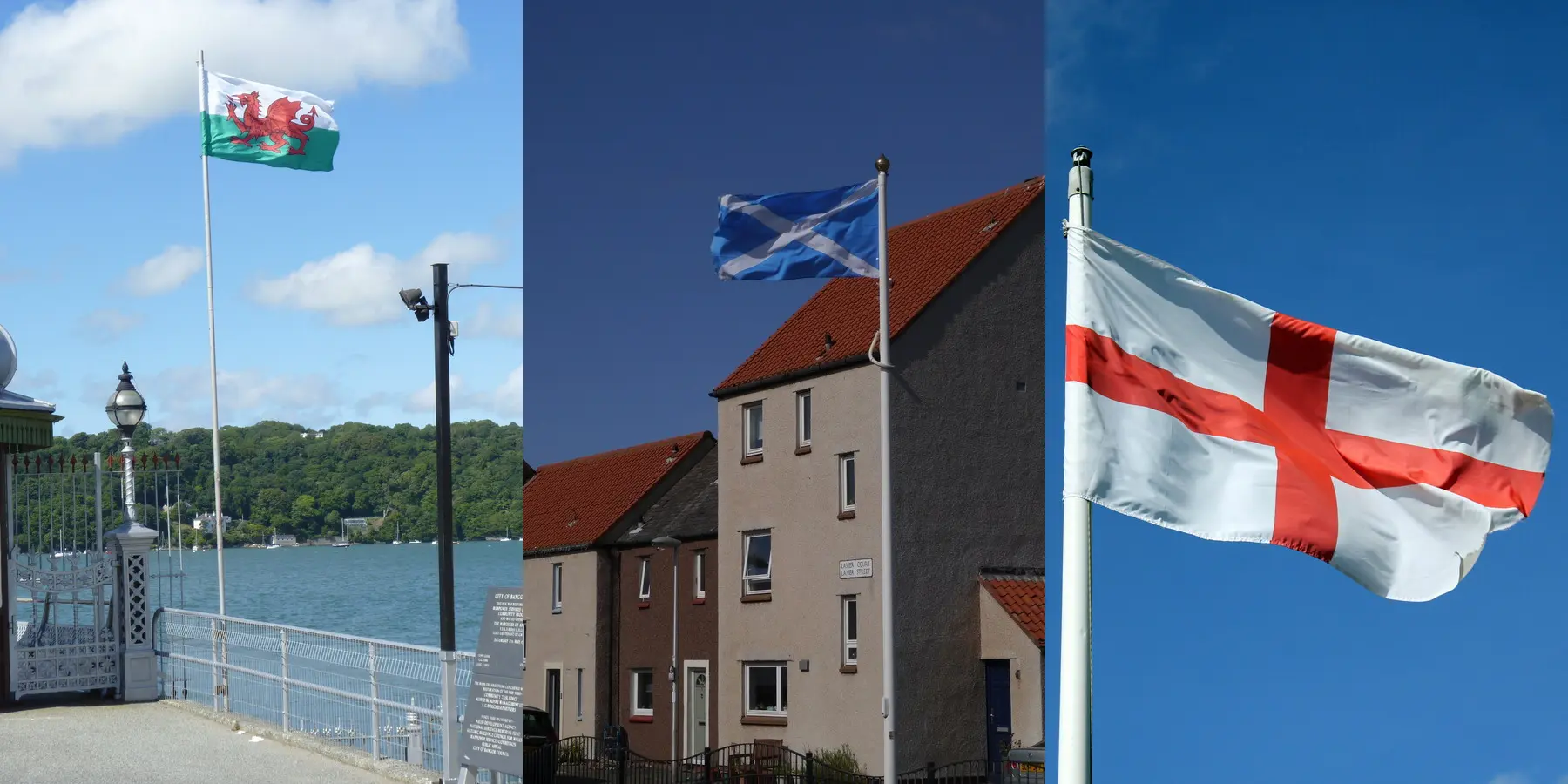
- •National symbols and flags differ: England's flag is the St George's Cross, Scotland's is the Saltire (St Andrew's Cross), and Wales flies the Welsh Dragon, Y Ddraig Goch.
- •Sport is often organised on a national basis rather than a UK-wide one. England, Scotland, and Wales each field their own national football team and their own national rugby team, and matches between them, particularly in rugby's Six Nations, are followed with real passion.
Identity and Respect
The single most useful thing to understand before you travel is this: many people in Scotland and Wales do not consider themselves English, and some do not particularly think of themselves as British either, preferring Scottish or Welsh as their primary identity. "British" is the umbrella term that covers everyone in the United Kingdom. "English" refers specifically to England and its people.
This is not a political statement, and getting it right is simply a matter of courtesy. Calling a Scottish or Welsh person English is one of the most common mistakes visitors make, and it is usually taken as a sign of not having paid attention rather than any real offence, but it is easy to avoid.
Devolution and questions about independence are live topics of debate in both Scotland and Wales, and opinions vary widely within each nation. As a visitor, the safest and most respectful approach is simply to listen with curiosity if the subject comes up, rather than to offer a strong opinion of your own.
Do
- ✓Use "British" when referring to people from anywhere in the UK collectively.
- ✓Use "Scottish" or "Welsh" specifically when you know that is where someone is from.
- ✓Show an interest in local history, language, and culture. It is almost always warmly received.
- ✓Expect and enjoy some friendly rivalry, especially around sport.
Don't
- ×Do not refer to a Scottish or Welsh person as English.
- ×Do not assume everyone you meet identifies primarily as British.
- ×Do not assume Scotland and Wales are simply regions of England.
- ×Do not push a strong opinion on independence or devolution; these are genuinely debated topics within each nation.
Travelling Between Them
Moving between England, Scotland, and Wales could not be simpler in practical terms. There are no borders, no passport checks, and no customs stops. You will not notice the moment you cross from one nation into another beyond perhaps a welcome sign or a change in the language on the road signs.
The currency does not change either: pound sterling is used throughout, whether the banknotes in your pocket were issued in London, Edinburgh, or elsewhere. The main things that shift as you travel are the ones already covered here, bilingual signage in Wales, some differences in how services like healthcare are run, and a distinct national flavour to sport and culture.
Rather than treating these differences as complications, treat them as part of the appeal. England, Scotland, and Wales each reward being met on their own terms, and a little awareness of what makes each one distinct will make your journey through Britain much richer.