Eating in United Kingdom
From the fry-up to the curry house, Britain eats better than its old reputation suggests.
British food carries a reputation that has not caught up with reality. Decades ago, visitors left with stories of grey meat and boiled vegetables, and some of that criticism was fair at the time. That world has largely gone. What you find now across England, Scotland, and Wales is a genuinely rich, often comforting food culture built on strong regional traditions, excellent produce, and one of the most diverse restaurant scenes in Europe, all sitting alongside dishes that have barely changed in a century because they never needed to.
This primer covers the meals and rituals you will actually encounter: the cooked breakfast that fuels a slow morning, the chippy supper eaten from paper, the Sunday roast that books up weeks in advance, the cream tea argued over in the West Country, and the curry houses that are as central to British eating out as any pub. There are real differences between England, Scotland, and Wales worth knowing before you order, and we have flagged them where they matter.
The Cooked Breakfast
The full cooked breakfast, known simply as a fry-up, is one of the most reliable pleasures on offer. The core plate is fairly consistent: bacon, sausage, eggs (usually fried), baked beans, toast or fried bread, a grilled tomato, and mushrooms, often with black pudding on the side. It began as a hearty start to a working day and has since become something people eat at any hour, particularly at weekends, when it shades into brunch.
The name and the details change as you cross the country. In England it is the full English. In Scotland, the full Scottish typically adds a tattie scone (a soft potato scone) and often swaps the standard sausage for a Lorne sausage, a square, sliced patty rather than a link. In Wales, a traditional version can include laverbread, a seaweed puree, sometimes served with cockles, alongside the usual bacon and eggs. All three variations lean on the same idea: a properly hearty, savoury start to the day.
The classic setting for this meal is the greasy spoon, an unpretentious cafe serving generous plates at fair prices, usually with strong tea in a mug rather than a pot. These caffs have become less common in some cities as brunch menus have spread, but they remain a genuine slice of everyday British life and are well worth seeking out over a hotel buffet.
Tips
- •Order tea, not coffee, if you want the full local experience; a proper caff usually does tea far better.
- •Ask for beans on toast or a bacon roll if a full plate feels like too much; most places will happily do a smaller version.
- •In Scotland, try to sample a Lorne sausage and tattie scone even outside a full breakfast; both turn up in rolls as quick snacks.
Fish and Chips
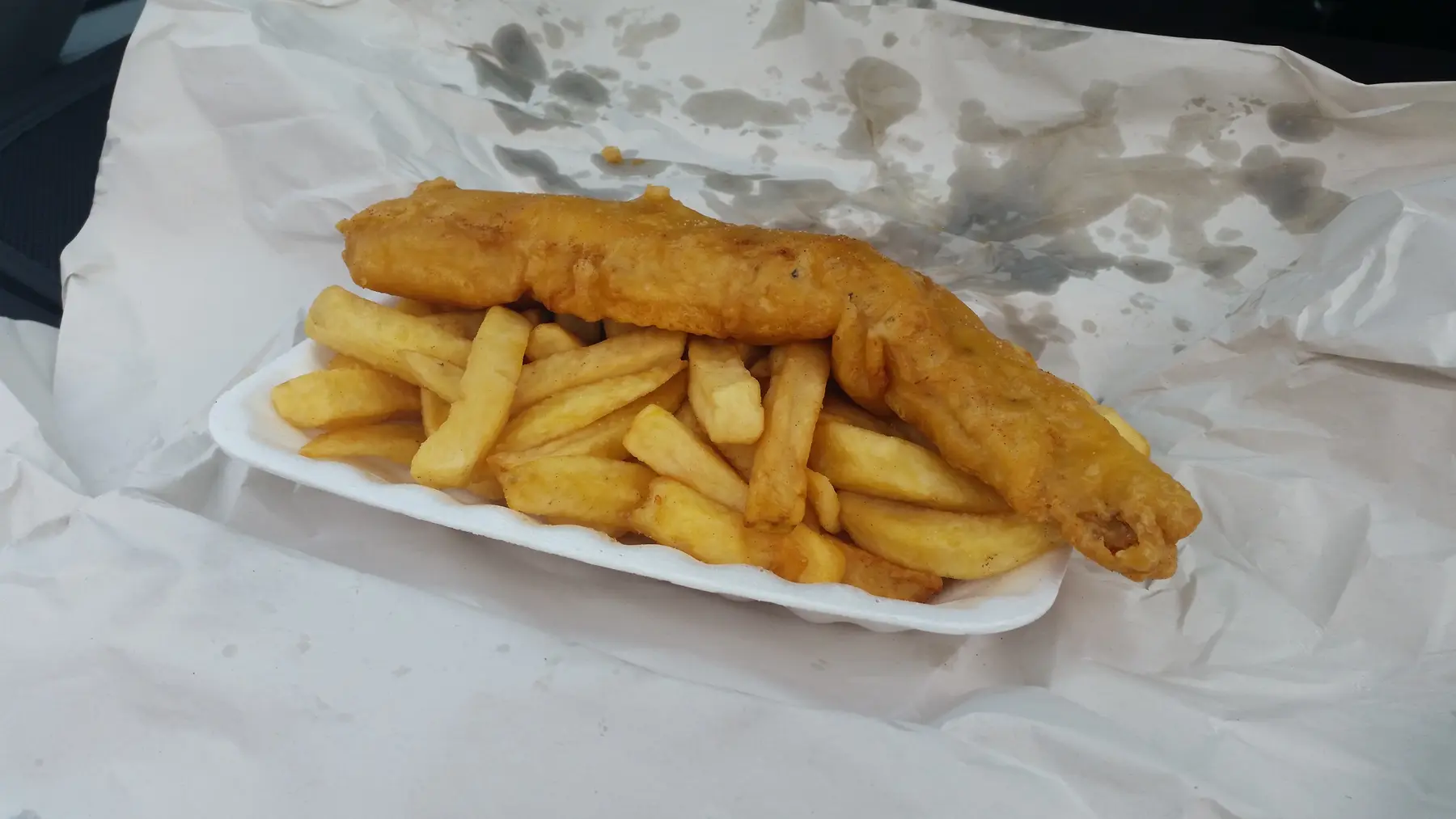
Fish and chips is Britain's most famous export dish and still one of its best value meals. White fish, usually cod or haddock, is dipped in batter and deep fried until crisp, served alongside thick cut chips. It began as an affordable meal for industrial workers in the nineteenth century and has never really lost that role: a proper chippy still feeds you generously for not very much money.
The classic accompaniment is mushy peas, and many chip shops also offer curry sauce or, in parts of the north, gravy for dipping your chips into. Regional habits vary on exactly what goes on top, from salt and vinegar to a splash of brown sauce, and it is entirely normal to have opinions about it.
The tradition is tied closely to the seaside. Coastal towns across England, Scotland, and Wales built their identity around the chip shop, and eating your fish and chips straight from the paper, sitting on a harbour wall or a bench looking out at the water, is one of the simplest and most satisfying things you can do on a British holiday.
The Sunday Roast
The Sunday roast is closer to a national ritual than a simple meal. Roast meat, usually beef, chicken, lamb, or pork, is served with roast potatoes, seasonal vegetables, a rich gravy, and, if beef is on the table, a Yorkshire pudding, a puffed batter case that despite the name is eaten right across the country, not only in Yorkshire.
While the roast began as a meal cooked at home, eating it out at a pub has become just as central to the tradition, and it is worth planning for. Good pub roasts are genuinely popular locally, not just with visitors, and tables for Sunday lunch often need to be booked in advance, sometimes a week or more ahead for well-regarded places.
It is a slow, unhurried meal by design, meant to be eaten with family or friends over a couple of hours, ideally followed by a walk. If you only have one Sunday in Britain, spending it over a proper roast in a village pub is time well spent.
Afternoon Tea and the Cream Tea
Afternoon tea is the more formal cousin of the cooked breakfast: a tiered stand of finger sandwiches, small cakes, and scones, served with a pot of tea, traditionally taken in the late afternoon. Grand hotels have turned it into something of an occasion, but simpler, warmer versions are served in tea rooms all over the country.
The simplest and most beloved version is the cream tea: a scone, split and topped with clotted cream and jam, alongside a pot of tea. It is a speciality of the West Country in particular, and it comes with a long running, entirely good natured argument between Devon and Cornwall over which goes on first. The Devon method spreads clotted cream first, then jam on top; the Cornish method spreads jam first, then a dollop of clotted cream. Neither side is going to concede, and asking a local which is correct is a reliable way to start a friendly debate.
Curry and Modern British Cooking
Britain's love of Indian and South Asian food runs deep and goes back generations, shaped by long-standing communities from India, Pakistan, and Bangladesh who opened restaurants across the country from the mid twentieth century onward. The curry house became, and remains, a genuine British institution, often the place people go on a Friday night out. Chicken tikka masala, a mild, creamy tomato based curry, is frequently cited as one of the nation's most popular dishes, developed by South Asian chefs cooking in Britain rather than imported from South Asia itself. Birmingham has its own well-known contribution in the Balti, a dish cooked and served in a flat bottomed pan of the same name, closely associated with the city's Balti Triangle of restaurants.
That same appetite for other cuisines runs right through Britain's bigger cities, where you will find long-established Chinese, Caribbean, Turkish, Polish, Italian, and West African food alongside everything else, often within a few streets of each other. It reflects decades of migration and settlement, and it means eating out in London, Birmingham, Manchester, Glasgow, or Cardiff can take you around the world without much effort.
Alongside all this, home-grown cooking has genuinely raised its game over the past few decades. A wave of chefs pushed British food towards better sourced, more carefully cooked versions of traditional dishes and modern reinterpretations of them, and that quality has filtered down from smart restaurants to ordinary pubs and cafes. The old jokes about British food being bland or overcooked increasingly describe a country that no longer quite exists.
Regional Specialities Worth Seeking Out
Beyond the national staples, England, Scotland, and Wales each have their own well-known local dishes, many tied closely to a specific town or region. Trying a few of these as you travel is one of the best ways to taste the country's regional character rather than a single, flattened idea of British food.
- •Cornish pasty: a pastry parcel traditionally filled with beef, potato, swede, and onion, originally a portable miner's meal from Cornwall.
- •Melton Mowbray pork pie: a cold, hand-raised pork pie with a distinctive bowed shape, from the town of Melton Mowbray in Leicestershire.
- •Bakewell tart and Bakewell pudding: a pastry case with jam and almond frangipane filling, from the town of Bakewell in Derbyshire; locals are particular about the difference between the tart and the older, custard-based pudding.
- •Eccles cake: a small, flaky pastry filled with currants, named after the town of Eccles near Manchester.
- •Yorkshire pudding: a savoury baked batter dish traditionally served with roast beef and gravy, from Yorkshire but eaten nationwide.
- •Haggis: a savoury pudding of sheep's offal, oatmeal, and spices, Scotland's best-known dish, traditionally served with neeps and tatties (swede and potato).
- •Cullen skink: a thick, smoked haddock and potato soup from the fishing town of Cullen on Scotland's northeast coast.
- •Shortbread: a rich, buttery biscuit strongly associated with Scotland, traditionally made with just butter, sugar, and flour.
- •Welsh cakes: small, griddle-cooked cakes studded with currants, dusted with sugar, sold warm in markets across Wales.
- •Cawl: a hearty Welsh broth of lamb or beef with leeks, potatoes, and other root vegetables, often considered a national dish.
- •Bara brith: a Welsh fruit loaf made with tea-soaked dried fruit, traditionally sliced and buttered.