The Metal Man, the Sea Horse, and the two things Tramore gets wrong
Five beacon towers, one twelve-foot cast-iron sailor, a wreck that killed hundreds, and a pair of stories about all of it that the documents do not support.
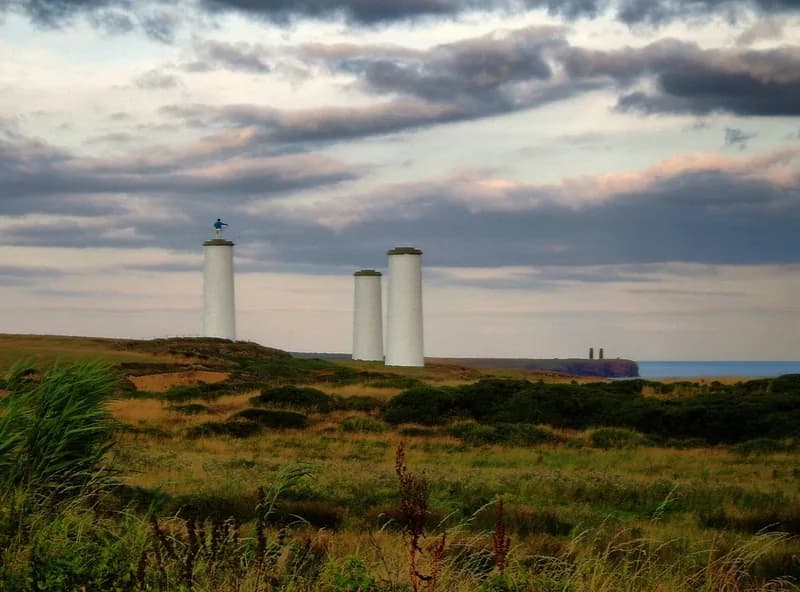
Stand on the Doneraile Walk on a clear day and look out at the mouth of Tramore Bay. There are three white pillars on the headland to the west and two on the headland to the east. On the middle of the three stands a twelve-foot cast-iron sailor with his right arm out, pointing at the open sea. Everyone in Tramore calls him the Metal Man. Almost everything you will be told about him in a pub is wrong, and the true version is better.
Why the bay is a trap
Start with the problem. Tramore Bay is a shallow bight with no useful shelter. There is an inland current that draws vessels in once they are inside its influence, and from seaward the bay can be mistaken for the entrance to Waterford Harbour a few miles east. Get that wrong in a southerly gale and you are embayed on a lee shore with nowhere to go.
On 30 January 1816 the troop transport Sea Horse was driven into the bay. She was carrying men of the 59th Regiment of Foot home from the Napoleonic Wars, along with their wives and children. The commonly cited death toll is 363; the local historians who have gone through the records put it at around 350. About thirty people, all adult men, were pulled alive out of the surf by people from the town. There is a memorial on the Doneraile Walk and another out on the promenade end.
What did not happen next
The story you will hear is that Lloyd's of London, appalled at the loss, paid for five beacon towers and the statue. It is on tourist boards and in guidebooks. The local history blog Tramore of Yore has gone through the Ballast Board minutes, the Trinity House correspondence and the public accounts, and there is no documentary trace of Lloyd's anywhere in it. Lloyd's was an insurance market, not a builder of navigation marks, and the early nineteenth century was not an era of corporate philanthropy on that scale.
What did happen
In May 1818 a group of Waterford merchants petitioned the Corporation for Preserving and Improving the Port of Dublin, known as the Ballast Board, which since 1810 had been responsible for lighthouses and beacons along the whole Irish coast. They wanted the small channel at Rineshark marked with buoys so ships could shelter there. The Board sent its engineer George Halpin to look, and he came back with the opposite advice: the entrance to Rineshark is barred by sharp rock too shallow for a loaded vessel, so marking it would kill people rather than save them. What was needed instead was to mark the headlands, so that Tramore Bay could be told apart from Waterford Harbour and ships would know to stay well out.
Trinity House in London agreed in December 1818. The Lord Lieutenant authorised the work in 1820. Land negotiations with the landowners on both headlands dragged on until 1822. The contract went to Edward Saunders at the lowest of nine tenders, and the towers were built of hewn ashlar stone, sixty-one feet tall, capped with granite. In May 1822 two masons fell thirty-seven feet from one of the Newtown Head towers when a badly spliced rope gave way; one of them, John Byrne from Wexford, died in the Leper Hospital in Waterford some months later, and when the parish rector applied to the Board of Works and to the Chamber of Commerce for relief for his widow and three children he was told neither body's funds could be used for it, so a newspaper appeal was got up instead. The towers are a piece of public infrastructure with a body under them, like most public infrastructure of that period.
The man himself
The statue was designed by Thomas Kirk, a sculptor born in Cork whose best-known work was the Nelson figure on the Dublin pillar that was blown up in 1966. The Ballast Board originally planned four of these cast-iron sailors for beacons around the coast. The first went to Sligo, where a Metal Man still stands on a pedestal out on Perch Rock. Two were cast for Tramore and both went missing between the foundry and the headland, with nothing in the Board's minutes to explain how. The figure that ended up here was the one originally intended for the Shannon.
The Commissioners of Irish Lights describe him precisely: twelve feet of cast iron, a sailor of the period with his right arm extended pointing out to sea and his head turned to follow it, white trousers, blue jacket with yellow buttons, red waistcoat, black hair and shoes, pink face and hands. He was landed at Waterford on 19 September 1823 and set on the middle of the three towers at Great Newtown Head.
The second thing everyone gets wrong
He does not point at Waterford Harbour. He points away from the coast, out to open water, which is the entire purpose of the thing: keep off. A Waterford newspaper reported in September 1823 that the statue was going to Brownstown Head to direct shipping towards Waterford Harbour. The following edition corrected it and said plainly that he was for the middle tower at Newtown Head, arm extended as a warning to keep off a dangerous shore. Two hundred years later the correction has still not caught up with the error.
Going to see him
Great Newtown Head is reached on foot from the Newtown Cove end of the Cliff Road. There is no parking at the head; park at Newtown Cove and walk out. This is open, unfenced clifftop with no barrier and a genuine drop, so keep back from the edge, keep dogs on a lead, and do not go in high wind.
There is a local tradition that a woman who hops three times around the pillar on one leg will have a proposal of marriage inside the year. Nobody has ever produced the figures.
Keep Reading
Walking the Doneraile and the Cliff Road to the coves
The 5km clifftop walk that runs west out of Tramore to the Guillamene and Newtown Cove, what you pass on the way, and where it stops being easy.
ActivitiesLearning to surf in Tramore, and when to come back for the waves
Who teaches, what a lesson costs, why autumn beats summer for surf, and how to read Tramore strand before you get in.
Planning a trip?
Explore restaurants, activities, accommodation, and more.