Learning to surf in Tramore, and when to come back for the waves
Who teaches, what a lesson costs, why autumn beats summer for surf, and how to read Tramore strand before you get in.
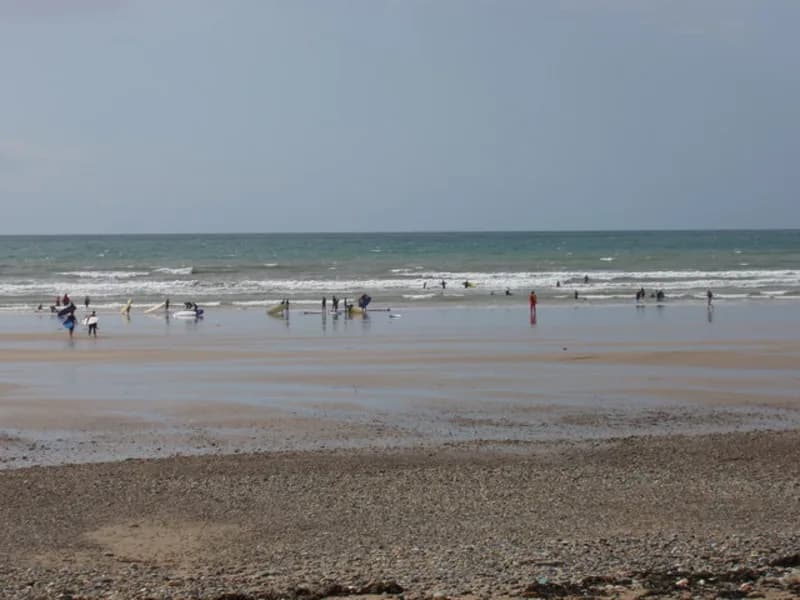
Tramore Bay faces south, the beach is long and shallow and the waves break slowly, which is the combination that makes a beginner's surf beach. That is why there are three separate operations working the same stretch of sand, and why half the learners you see in the water on a July afternoon have never stood on a board before. It is also why the good surfers here are mostly out in September and October instead.
The first lesson
Tramore Surf School works out of the Pavilion units at the eastern end of the promenade, with the surf shop next door and a webcam pointed at the break. Its public lesson runs at two o'clock every day through the summer and at weekends the rest of the year. The session lasts about two hours, of which fifty minutes is guaranteed in the water; the rest is instruction on the sand and the business of getting in and out of a wetsuit, which takes longer than beginners expect. Groups are eight students to one Irish Surfing Association approved instructor. Prices start around 40 euro a head, and wetsuit and board are included. Boots, gloves and hoods are extra and worth it from October onwards.
All you need to bring is a towel and something to wear under the wetsuit. Do not bring a packed lunch and eat it beforehand. Book the day before in July and August; the two o'clock fills.
Freedom Surf School takes a different approach, working from a centre off the Riverstown Road at the back of the beach rather than from the sand itself. It has indoor rooms, changing rooms, hot showers and a coffee bar, which matters a great deal more in April than it sounds. It runs school tours, group and family bookings, birthday parties, stand-up paddleboarding and bodyboarding, and a full Irish-language programme that is genuinely bilingual rather than a label. If you are organising a group or a family rather than turning up as two adults, ring them first.
When to actually come
Summer is when the lessons run and when the beach is busy, and it is the worst time of year for waves. The Atlantic low pressure systems that make September and October uncomfortable for everything else are exactly what puts organised swell into the bay, and the sea is at its warmest of the year through September, after a whole summer of warming up. The air gets colder, the water does not, not yet.
So: learn in July if you are here in July, by all means. But if you have a choice and you already have some idea what you are doing, come in autumn. The line-up is emptier, the waves are better, and the surf schools are still running weekend lessons.
Reading the beach
The town end of the strand, in front of the prom, is where the schools work and where the lifeguards patrol through the summer season. Lifeguards cover the flagged area only, and only in season. The further east you walk along the spit towards the dunes, the further you are from help, and there is rip current activity out towards the end. If you are not with a school, swim and surf at the town end.
Tide matters here more than it does on a steeper beach. At low water the sand goes out a long way and the break moves with it, which is a long carry on a foam board. The surf school's own webcam and the tide tables are both worth ten seconds before you commit to a session.
Hiring rather than learning
Both schools hire out boards and wetsuits by the session if you can already surf. Tramore Surf Shop is in the same Pavilion block as the school and sells and rents softboards, wetsuits, boots and package deals. This is the cheap way to do a Saturday if there are two or three of you and one of you knows what they are doing.
The other water
Surfing is not the only way into the sea in Tramore, and the other two are worth knowing about while you are here. Under the cliffs to the west, the Guillamene and Newtown Cove are deep-water swimming coves with steps and handrails, run by a club that has been at it for over seventy-five years and swims year round. There is no lifeguard at either. That is a swimmers' place rather than a surfers' one, and it is not somewhere to go in a swell.
And when the sea is blown out entirely, Splashworld up at Railway Square is open 360 days a year, with a wave pool and slides. A sixty-minute public swim is 11 euro for an adult and 9 for a child, with two adults and two children at 33 euro as listed in September 2026. Everything must be pre-booked, online, on the app or by phone, and swim caps are compulsory and sold at reception for about 2.50 euro. Turning up on a wet August afternoon without a booking does not work.
Getting here without a car
The 360 bus from Waterford runs about every twenty minutes through the day and takes around twenty-five minutes, and the stop in the town centre is a five-minute walk from the Pavilion. On a hot summer weekend that is genuinely faster than driving, because the promenade car parks fill by late morning and there is nowhere else near the sand to put a car.
Keep Reading
Walking the Doneraile and the Cliff Road to the coves
The 5km clifftop walk that runs west out of Tramore to the Guillamene and Newtown Cove, what you pass on the way, and where it stops being easy.
History & CultureThe Metal Man, the Sea Horse, and the two things Tramore gets wrong
Five beacon towers, one twelve-foot cast-iron sailor, a wreck that killed hundreds, and a pair of stories about all of it that the documents do not support.
Planning a trip?
Explore restaurants, activities, accommodation, and more.