About Mumbles
The history, geography, and character of Mumbles.
Mumbles is the headland at the western end of Swansea Bay and the seaside village that has grown behind it, on the old parish of Oystermouth. It is part of the City and County of Swansea, about 6km from the city centre, and the start of Gower. These pages cover the village, the headland and the bays round it as far as Langland.
History & Heritage
Mumbles, Oystermouth, Mwmbwls, Ystumllwynarth
Mumbles (Mwmbwls in Welsh) is strictly the headland: the two islands off its tip, with the lighthouse on the outer one, are generally thought to have given the place its name, possibly from French sailors' les mamelles, though nobody has proved it. Oystermouth (Ystumllwynarth) is the old village and parish, with All Saints' Church and the castle. The two have long since merged along Mumbles Road. Buses are still signed Oystermouth, while most people who live there say they live in Mumbles, and since 2022 the electoral ward has been called Mumbles too.
The castle above the square
Oystermouth Castle was founded by the Normans soon after 1106, burned by the Welsh more than once, and rebuilt in stone by the de Braose lords of Gower in the thirteenth century, when it became their main home. Edward I stayed briefly in December 1284. By the seventeenth century it was described as a decayed ruin. Swansea Council looks after it now, with the Friends of Oystermouth Castle, and opens it from spring to the end of October.
The train that is now a path
The Oystermouth Railway was built under an Act of 1804 to carry limestone and coal, and from 1807 it carried paying passengers as well, which is why the Dylan Thomas trail calls it the first passenger railway in the world. It went from horses to steam to electric trams before closing in January 1960. The line round the bay is now the shared walking and cycling path, and Mumbles still calls it the Mumbles train.
The pier and the lifeboat
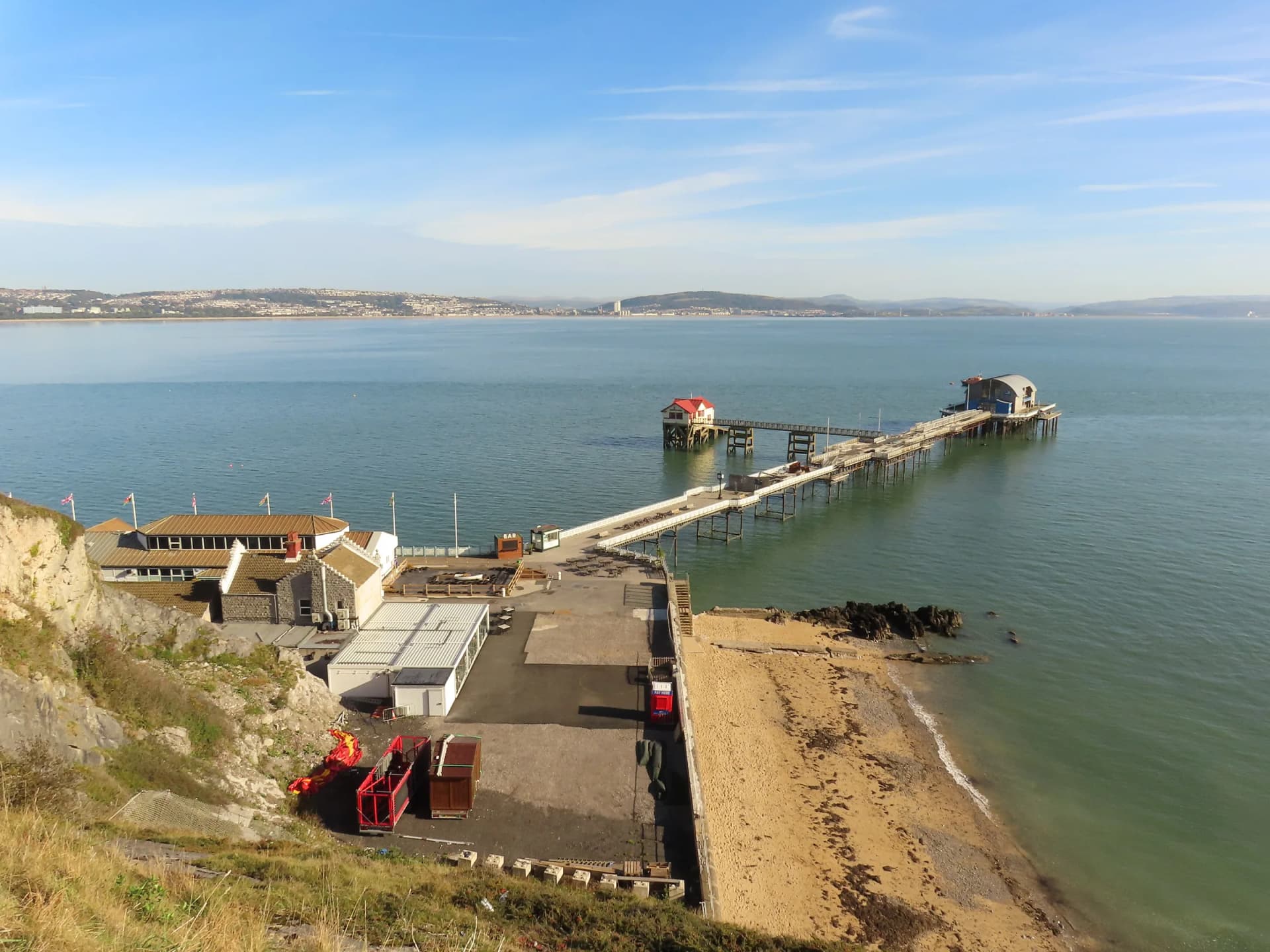
The pier opened on 10 May 1898 at the end of the railway and is Grade II listed. Lifeboats have been stationed at Mumbles for more than 180 years, and the RNLI says 18 Mumbles volunteers have died trying to save others. The modern boathouse at the end of the pier housed the all-weather lifeboat until 2023, when the RNLI removed it over the condition of the privately owned pier; through 2025 the boat was moored offshore and crews reached it by boarding boat. A fire on 31 August 2022 destroyed the restaurant and nightclub buildings at the base of the pier; Copperfish has since reopened.
The new prom
Swansea Council's Mumbles coastal defence scheme, about £26.5m of construction with 85 per cent from the Welsh Government, rebuilt the sea wall and widened the promenade. It opened officially in July 2025, with tide-inspired public art by the Swansea artist Catrin Jones set into the new walls.
The headland and the tide
Round the point from the pier the coast changes completely: Bracelet Bay, Limeslade, Rotherslade and Langland face the open Bristol Channel rather than the sheltered bay. The islands off Mumbles Head can be reached on foot at low water, and people are regularly cut off on them. Swansea Coastguard has dealt with groups stranded on Middle Head, and the Mumbles lifeboat has had to pick them up. Watch from Bracelet Bay.