About Liverpool
The history, geography, and character of Liverpool.
History & Heritage
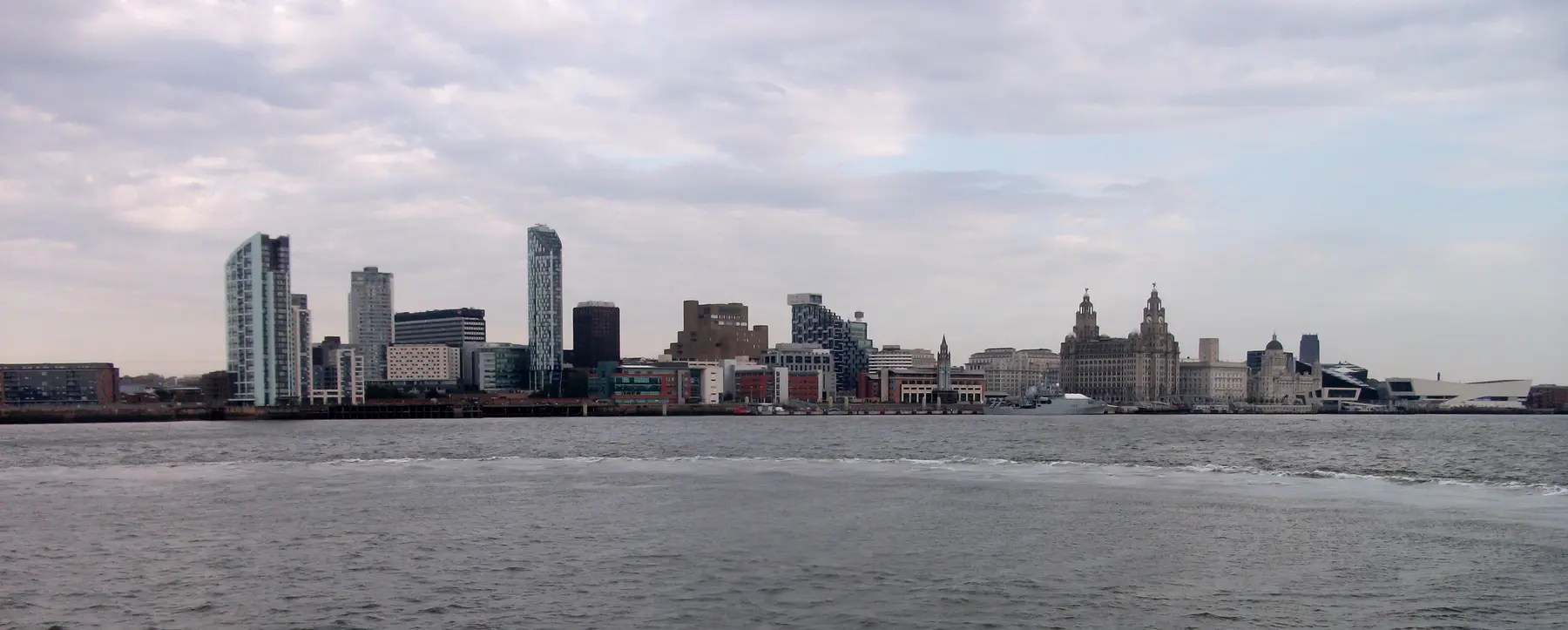
The waterfront and the Three Graces
The Pier Head's skyline, the Royal Liver Building, the Cunard Building and the Port of Liverpool Building, is known locally as the Three Graces, and it remains one of Britain's most recognisable waterfronts. The Royal Liver Building (1911) carries the two Liver Birds on its clock towers, copper cormorant-like figures that have become the city's emblem; local tradition holds that if they ever fly away, Liverpool will cease to exist. The Cunard Building (1917) once housed the Cunard Line's booking hall, from which generations of transatlantic passengers, including emigrants bound for New York, departed. The Port of Liverpool Building (1907) is the oldest of the three. Behind them, the Royal Albert Dock, engineered by Jesse Hartley and opened in 1846, was the first dock structure in Britain built entirely from cast iron, brick and stone with no structural timber, making it the world's first non-combustible warehouse system. The wider waterfront, including the Pier Head, the Albert Dock and the Stanley Dock warehouse complex further north, was inscribed as a UNESCO World Heritage Site in 2004. It was removed from the list in 2021, the third site ever delisted worldwide, after UNESCO's committee judged that new waterfront development, including Liverpool Waters and the new Everton stadium at Bramley-Moore Dock, had caused an irreversible loss of the attributes that justified the original listing. The delisting remains a genuinely contested decision in the city: supporters of the new developments argue a working, growing waterfront was always more valuable than a preserved one, while heritage bodies maintain something real was lost. Either way, the buildings themselves are unchanged, and the view from the water is still one of the best in Britain.
The Beatles, without the cliché
Liverpool's Beatles heritage is dense enough to reward going past the obvious stops. The Cavern Club on Mathew Street, where the band played nearly 300 times between 1961 and 1963, was demolished in the 1970s and rebuilt on the original site using around 15,000 bricks salvaged from the first club; the original 1957 entrance survives separately, a few doors along the same street, easy to miss. The National Trust's Beatles Childhood Homes tour goes inside Mendips, where John Lennon grew up with his Aunt Mimi, and 20 Forthlin Road, Paul McCartney's family home, where the two wrote many of their earliest songs; both are furnished as they were in the 1950s, and the tour is capped at 15 people. Penny Lane, a real street in the Mossley Hill area rather than a themed attraction, and Strawberry Field, the former Salvation Army children's home in Woolton whose gates inspired the song, both sit south of the city centre and are best combined with the childhood homes tour rather than visited as isolated photo stops. Beyond the Beatles, Liverpool's music identity runs much wider: the city produced more UK number-one hit acts than any other, from Gerry and the Pacemakers and Cilla Black through Echo and the Bunnymen and the La's to Frankie Goes to Hollywood, and the Royal Liverpool Philharmonic, based at the Philharmonic Hall on Hope Street, is one of Britain's oldest orchestras, founded in 1840.
Two cathedrals, a generation apart
Hope Street runs between Liverpool's two cathedrals, and the half-mile walk between them is one of the best short architectural contrasts in Britain. The Anglican Cathedral of Christ Church, at the street's southern end, was designed by Giles Gilbert Scott, who won the competition in 1903 at the age of 22, and built in stages between 1904 and 1978; it is the largest cathedral in Britain and among the largest in the world, built in a Gothic Revival style out of local sandstone. At the street's northern end stands the Metropolitan Cathedral of Christ the King, Liverpool's Roman Catholic cathedral, consecrated in 1967 to Frederick Gibberd's circular modernist design after an earlier, far grander scheme by Edwin Lutyens was abandoned unfinished during the Second World War, its surviving crypt now open beneath the present building. The two cathedrals, one Gothic and built in stone across seven decades, one modernist and built in concrete inside a single decade, sum up a city that has never been precious about doing things one way.
A city of two football clubs
Liverpool FC and Everton FC both trace their roots to the same ground, Anfield, before a boardroom dispute in 1892 saw Everton leave for Goodison Park and Liverpool FC formed to fill Anfield in their place; the two clubs have played in the same city, a few hundred metres from each other's old grounds, ever since. Liverpool FC's Anfield, now holding just over 61,000, sits in a genuinely residential neighbourhood a few miles north of the centre, and match days there reshape the surrounding streets for hours either side of kick-off. Everton moved into the new Hill Dickinson Stadium at Bramley-Moore Dock, part of the waterfront redevelopment that contributed to the UNESCO delisting, having left Goodison Park after well over a century there. Both clubs run stadium tours and museums on non-match days, and both fixture lists shape the city's hotel occupancy and restaurant bookings as much as any single festival on the calendar; checking the match schedule before booking a stay is a genuinely practical piece of Liverpool planning advice.
The slave trade and the International Slavery Museum
Liverpool's eighteenth-century wealth was built in significant part on the transatlantic slave trade: by the 1740s the city had become Britain's leading slaving port, its ships carrying an estimated 1.5 million enslaved Africans across the Atlantic over the course of the trade, and the profits helped finance the docks, warehouses and civic buildings that still define the city centre. The International Slavery Museum, at the Royal Albert Dock and free to enter, addresses this history directly, covering West African life before enslavement, the Middle Passage, the economics of the trade, and its long legacy in racism and inequality, alongside the contemporary history of Liverpool's Black community, one of Britain's oldest, dating to at least the eighteenth century. It is a serious, sometimes difficult museum, and a more honest starting point for understanding the waterfront's wealth than the Three Graces' postcard view alone.
Wildlife & Nature
Marine Life
Grey seals
Grey seals are occasionally seen in the Mersey estuary and off the North Wirral coast, though sightings from the city waterfront itself are uncommon.
Any time of year, most reliably from the Wirral shore rather than the city waterfront
Harbour porpoises
Harbour porpoises are recorded in the wider Mersey and Liverpool Bay, part of a slowly recovering estuary environment as water quality has improved since the 1980s.
Occasional sightings year-round in the wider estuary and bay
Birdlife
Wading birds on the Mersey mudflats
The Mersey estuary and its mudflats, particularly around the Wirral shore and further downriver, support significant numbers of wading birds, including redshank, oystercatcher and curlew.
Winter, when numbers are highest
Peregrine falcons
Peregrine falcons nest on several of the city centre's tall buildings, including the Anglican Cathedral tower, preying on the feral pigeon population.
Year-round; most visible around the Anglican Cathedral tower