About Cardiff
The history, geography, and character of Cardiff.
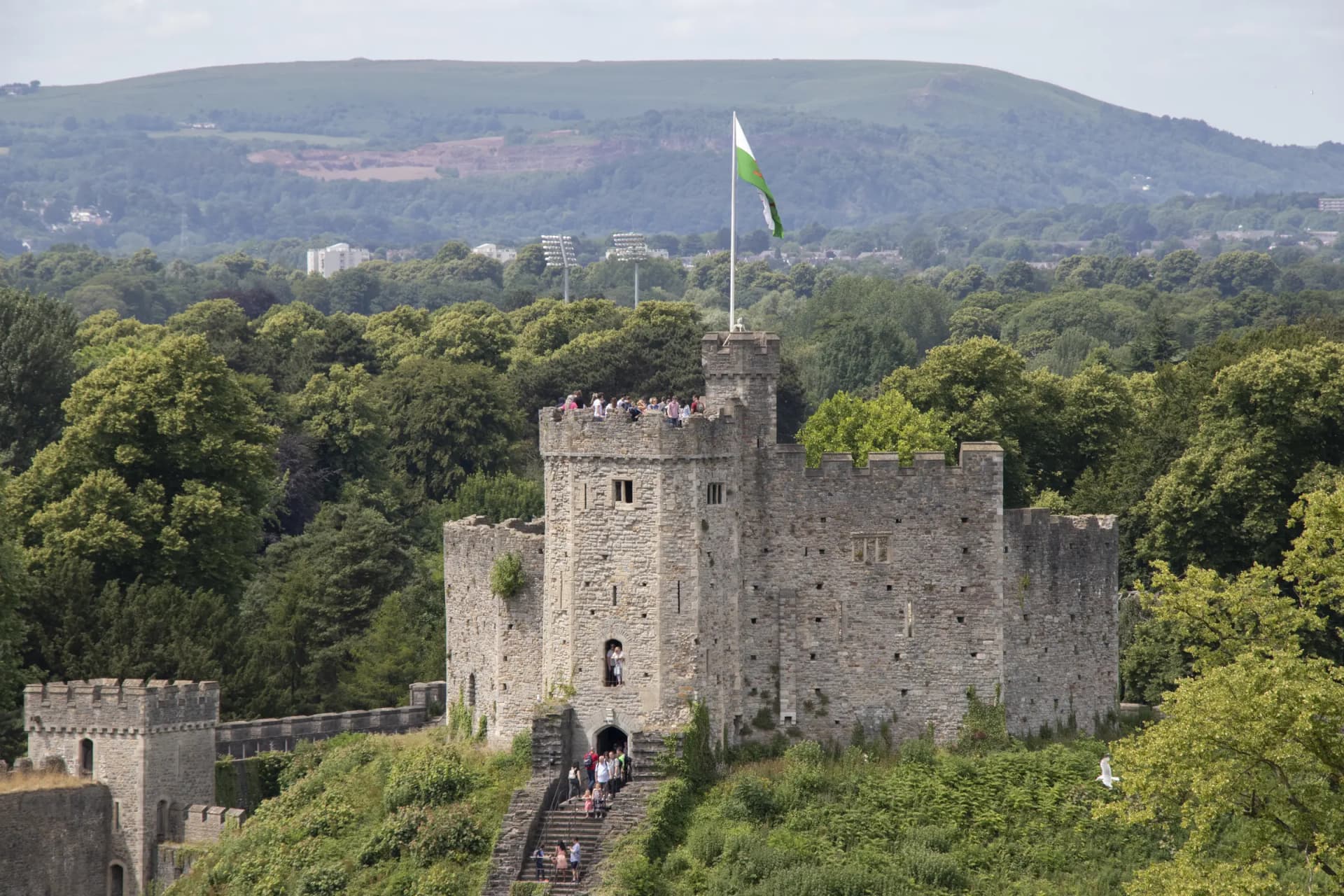
Cardiff, Caerdydd in Welsh, is the capital of Wales and one of Europe's youngest capitals, a city that went from a walled market town of under 2,000 people in 1801 to the world's busiest coal port within a century, and only became a capital at all in 1955. That compressed history explains almost everything a visitor notices: a Roman-and-Norman castle standing in the middle of the shopping streets rather than above them; a Victorian market and six glass-roofed arcades built for a boomtown's shoppers; a grand white civic centre at Cathays Park paid for by coal money; docklands two miles south that shipped that coal to the world and are now the regenerated waterfront of Cardiff Bay, where the Senedd, Wales' parliament, and the Wales Millennium Centre stand on the old Tiger Bay. The city in between stays compact, flat, green and walkable, threaded by the River Taff and its parkland, and bilingual on every sign. Its rhythm is set by rugby: the 73,931-seat Principality Stadium sits inside the city centre itself, and on international days the whole capital becomes the stadium's front room.
History & Heritage
Coal, the Butes and the castle
Cardiff's rise was owned, quite literally, by one family: the Marquesses of Bute, whose docks turned the Taff estuary into the world's greatest coal port. By the early twentieth century the Coal Exchange in Butetown set the world price of coal, and the world's first recorded million-pound deal was struck there in 1904. The third Marquess, said to be among the richest men on earth, spent part of the fortune on the architect William Burges, whose rebuilt Cardiff Castle interiors, all gilded ceilings, astrology, fables and painted animals, are the most extravagant Victorian Gothic rooms in Britain. In 1947 the fifth Marquess handed the castle and its parkland to the people of Cardiff, which is why Bute Park is the city's back garden and the castle its front room.
From Tiger Bay to Cardiff Bay
The docklands community of Butetown, known worldwide as Tiger Bay, was one of Britain's first truly multicultural neighbourhoods, home to sailors and families from more than fifty nations, and the birthplace of Dame Shirley Bassey. When coal collapsed, the docks declined with it, and the barrage completed in 1999 remade the tidal mudflats as a freshwater lake ringed by a new national waterfront: the Wales Millennium Centre with its giant bilingual inscription, the red-brick Victorian Pierhead, and the Senedd. The regeneration is real and so is the debate about it; ask longer-memoried locals about Tiger Bay and you will get the fuller story of what was lost as well as gained.
A young capital, an old language
Wales had no official capital until 1955, when Cardiff won the title, and devolution since 1999 has given the city the institutions to match: the Senedd at the Bay, the national museum at Cathays Park, the national stadium in the centre and the national broadcaster's drama studios at Roath Lock, where Doctor Who was made from the 2005 revival. Welsh is not decoration here: it is on every sign, taught in the city's schools, sung at Tafwyl each summer, and spoken by a growing share of Cardiffians. Learn 'bore da' (good morning) and 'diolch' (thanks, roughly DEE-olch) and use them; nobody expects fluency, and everybody notices the effort.
The City of Arcades
While other British city centres flattened themselves for chain retail, Cardiff kept its Victorian and Edwardian arcades, six glass-roofed passages threading between the main streets, beginning with the Royal Arcade in 1858. They are still where the city's independent life happens: Spillers Records, founded 1894 and claiming the title of the world's oldest record shop; Wally's Delicatessen, feeding Cardiff since 1947; cafes, barbers, vintage dealers and outfitters. Add the 1891 Central Market's iron balcony and you can cross half the city centre under glass, which in a Welsh climate is not a small thing.
Match day
No other European capital puts its national stadium in the middle of the city the way Cardiff does. The Principality Stadium, opened in 1999 and still 'the Millennium' to most locals, backs onto the River Taff a minute from the castle, and on Six Nations Saturdays and autumn internationals the city centre becomes a single event: roads close, 73,931 go inside, tens of thousands more sing outside, and the pubs of Quay Street and Westgate Street do a year's trade in a day. Visitors should know the dates even if they have no interest in rugby, because hotels, restaurants and trains all move to match-day rules.
Wildlife & Nature
Marine Life
Salmon and sea trout in the Taff
The Taff was once one of Britain's most polluted industrial rivers; its recovery since the coal era is good enough that migratory salmon and sea trout now run through the middle of the capital, negotiating the fish pass at Blackweir. Anglers fish within sight of the stadium.
Autumn, when migratory fish move upriver
Grey mullet and eels in the Bay
The impounded freshwater lake behind the barrage supports shoals of mullet and European eels, and the fish pass built into the barrage keeps the river's migratory species connected to the Severn Estuary beyond.
Summer, from the barrage and Mermaid Quay boardwalks
Birdlife
Reed-bed birds at Cardiff Bay Wetlands
The wetlands reserve at the eastern corner of the Bay, created as part of the barrage scheme, holds reed warblers, sedge warblers and wildfowl a few hundred metres from the Senedd. Herons and cormorants work the Taff right through the city centre.
Spring mornings for warbler song; year-round for herons and cormorants
Wildfowl on Roath Park Lake
The lake's quieter northern reaches hold tufted ducks, pochard, grebes and swans, with the busier southern end providing the classic feed-the-ducks shoreline generations of Cardiff children grew up on.
Winter for visiting wildfowl numbers
Flora
Bute Park's champion trees
Bute Park's arboretum, planted from the Bute family era onward, contains one of the best tree collections of any UK public park, including a number of UK champion trees, the largest or tallest recorded of their kind. The park publishes tree trails for finding them.
Spring for blossom, October for colour