Trim's other medieval town: the Yellow Steeple, the Sheep Gate and two cathedrals
Everything in Trim that is not the castle: a broken abbey bell tower, the last surviving town gate, a thirteenth-century cathedral in ruins downriver, and a Burne-Jones window in a church most visitors never reach.
Most people come to Trim for the castle and leave having seen one building. That is a shame, because the castle is only the loudest part of a medieval town that is still standing in pieces all over the place, most of it free, unstaffed and open at all hours. Here is what is out there and how to string it together.
The Yellow Steeple
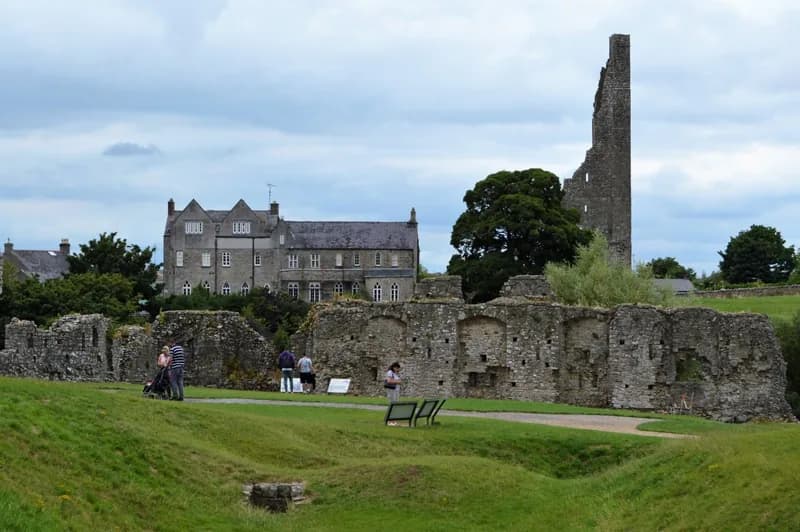
Start with the one you can see from everywhere. The Yellow Steeple is the broken bell tower of St Mary's Augustinian Abbey, standing on the ridge on the north bank directly across the river from the castle. It is the tallest structure in Trim and it is visible for kilometres on the approach roads. Its east face came down in the seventeenth century, which is why it reads as a jagged blade rather than a tower, and the name comes from the colour the stone takes in evening light, which is worth timing a walk around. The tower is closed and cannot be entered or climbed.
The abbey it belonged to was a place of pilgrimage. From 1397 it held a wooden statue known as Our Lady of Trim, which drew pilgrims until the Reformation destroyed it. Immediately beside the steeple stands Talbot Castle, a fifteenth-century fortified house that was later a school, and which is where the town's long association with Jonathan Swift begins. Swift was vicar of Laracor, a couple of miles south, from 1700, and his name is now attached to Jonathan Swift Street, to Swifts Bar out at Knightsbrook, and to the Swift Cultural Centre on High Street, a €9 million arts venue that opened in 2023 in the refurbished shell of St Patrick's Chapel.
The Sheep Gate and the town wall
Trim was a walled town and the Sheep Gate is the only gate left: a single arch standing free in the meadows a few minutes east of the steeple, with a plaque on it and nothing else. Sections of the thirteenth-century wall survive elsewhere in fragments, mostly built into later boundaries near Castle Street and Emmet Street, but the Sheep Gate is the one piece you can walk under. It is easy to miss, and nobody will point it out unless you ask.
Newtown Trim
A mile and a bit downriver, reached along the Porchfields path rather than by road, is the group of ruins Trim people simply call Newtown. The Cathedral of Saints Peter and Paul was begun in the early thirteenth century by the Bishop of Meath and was once the largest church of its kind in Ireland; the nave and chancel skeleton and the Augustinian priory buildings are what stand now. Across the water is the Priory of St John the Baptist, a Crutched Friars hospital house, and between the two runs the medieval bridge, one of the oldest surviving in Ireland and still carrying traffic. No ticket, no barrier and usually nobody else there.
The two St Patrick's
Trim has two churches of St Patrick and locals distinguish them without naming them, which is confusing on arrival. The big spired one is the Catholic parish church. The one worth a detour is the Church of Ireland cathedral on Loman Street, which almost no castle visitor reaches. Its squat battlemented tower is medieval, put up in the fourteenth or fifteenth century and now doing duty as the west porch; the rest was rebuilt in 1803, when Bishop Thomas O'Beirne had the church brought down to its present reduced dimensions, and the east window was enlarged again in 1906. Two things inside repay the walk. The Good Shepherd panel of 1869 is by Sir Edward Burne-Jones, and the parish describes it as the only example of his early work in Ireland. The organ is one of only three in the country by the Yorkshire builder James Jepson Binns. The building was not formally raised to cathedral status until St Patrick's Day 1955, though bishops of Meath had long been enthroned here. Sunday worship is at 11.30am; outside that, access depends on who is about, so contact the parish rather than turning up hoping.
The one that is not medieval at all
At the junction of Wellington Place and the Summerhill road stands a column raised in 1817 to the Duke of Wellington, whose family seat at Dangan lies just outside the town and who represented Trim in the Irish Parliament. It went up before Waterloo had hardened into legend, which makes it an unusually early monument to a living man. Trim treats it as a roundabout landmark.
Stitching it together
All of the above except the cathedral sits on or beside the Porchfields river walk, so the efficient version is one loop: castle grounds, footbridge, Yellow Steeple, Sheep Gate, Porchfields, Newtown, and back. Allow around an hour and a quarter of walking for the there-and-back, more with stops. Add twenty minutes uphill on Loman Street for the cathedral, and a two-minute detour for the Wellington column if you are driving out toward Summerhill anyway. The whole medieval circuit is free. The only thing in Trim you pay for is getting inside the keep.
Keep Reading
Trim Castle: how to actually get inside the keep
The castle splits into two visits: free open grounds that locals walk through daily, and a cruciform keep you can only enter on a guided OPW tour. Hours, prices, timing and the queue the OPW warns about.
WalkingThe Porchfields walk: from Trim Castle out to Newtown
The walk Trim people actually do: castle grounds, footbridge, Yellow Steeple, Sheep Gate, then out along the Boyne through a surviving medieval field system to the Newtown ruins and the medieval bridge.
Planning a trip?
Explore restaurants, activities, accommodation, and more.