About Trim
The history, geography, and character of Trim.
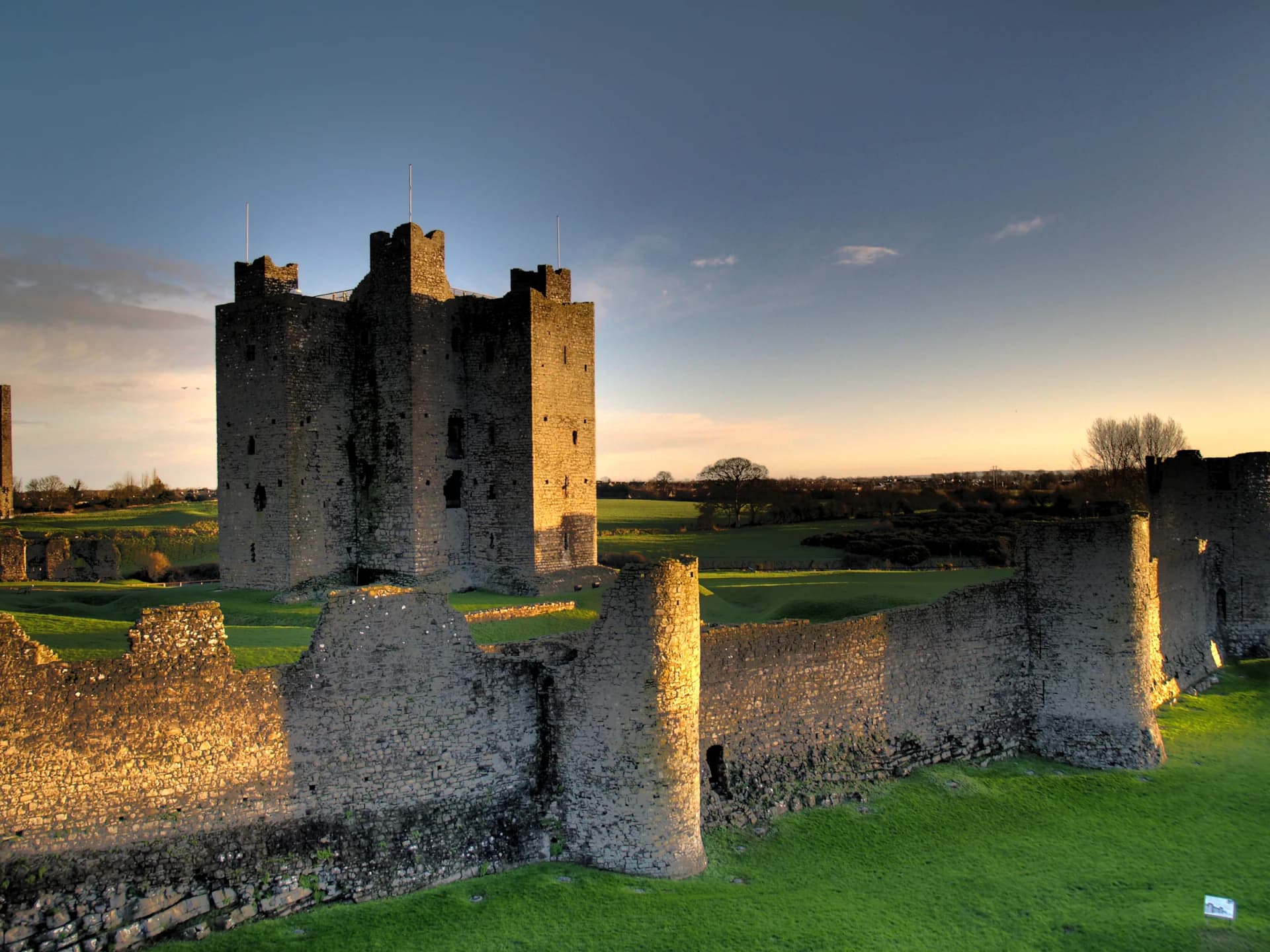
Trim is a market town of about 9,500 people on the River Boyne in south Meath, and it has the largest Anglo-Norman castle in Ireland sitting in the middle of it. That sentence does most of the work, but it also misleads slightly, because the castle is not set apart on a hill or behind a ticket barrier. Its grounds are open, free and cut through daily by people walking dogs, taking a short cut to Castle Street or sitting on the grass with a coffee. The keep is the ticketed part, and even that is modest. What Trim actually feels like is a working Meath town with an extraordinary amount of medieval fabric still standing in it: a broken abbey tower on the ridge across the river, the last of the town gates in a field, a thirteenth-century cathedral in ruins a mile downstream, and one of the oldest bridges in the country carrying a regional road over the Boyne.
History & Heritage
The Normans and the castle
Hugh de Lacy was granted the Kingdom of Meath after the Norman invasion of the late 1160s and put a ringwork fortress on the ridge above the Boyne at Trim. The stone castle that replaced it, begun in the 1170s and largely finished by his son Walter in the following decades, is the largest Anglo-Norman castle in Ireland: a curtain wall and ditch enclosing about three acres, with a twenty-sided cruciform keep at the centre that has no exact parallel anywhere. Trim mattered politically as well as militarily. The castle was considered as a seat for the Irish Parliament, and the future Henry V was held here as a boy while his father campaigned. In 1994 Mel Gibson's production used it as a stand-in for a set of Scottish and English castles in Braveheart, which is still the connection most first-time visitors arrive with, and the interpretive panels at the gate lean into it rather than away from it.
A town made of ruins
Trim was a walled town, and enough of the enclosure survives that you can still read it if someone points it out. The Sheep Gate is the only surviving gate, a single arch standing free in the meadows on the north bank. Fragments of the thirteenth-century wall are built into later boundaries near Castle Street and Emmet Street. Across the river from the castle, the Yellow Steeple is the broken bell tower of St Mary's Augustinian Abbey, the tallest structure in the town and visible for kilometres; its east face came down in the seventeenth century, which is why it reads as a blade rather than a tower. The abbey once held a wooden statue known as Our Lady of Trim that drew pilgrims from 1397 until the Reformation destroyed it. Downriver at Newtown are the Cathedral of Saints Peter and Paul, begun in the early thirteenth century and once the largest church of its kind in Ireland, the Priory of St John the Baptist across the water, and the medieval bridge between them. Between the two clusters run the Porchfields, a medieval open field system that survived into the present because it floods and so was never built on.
Swift, Wellington and the eighteenth century
Two names attach themselves to Trim from later centuries. Jonathan Swift was vicar of Laracor, a couple of miles south of the town, from 1700, and spent enough time in Trim for the connection to be woven through the place: Jonathan Swift Street, Swifts Bar at Knightsbrook, and the Swift Cultural Centre on High Street, a €9 million arts venue opened in 2023 in the refurbished shell of St Patrick's Chapel and run by Solstice Arts Centre for Meath County Council. The Duke of Wellington, whose family seat at Dangan lies just outside the town and who represented Trim in the Irish Parliament, is commemorated by the column raised at the junction of Wellington Place and the Summerhill road in 1817, before Waterloo had settled into legend. Both are treated locally as facts rather than attractions, which is a fair description of how Trim handles most of its history.
The town today
Trim's population was 9,563 at the 2022 census, up about four per cent on 2016 and nearly three times what it was in the 1980s, which makes it a commuter town for Dublin as much as a Meath market town. The centre is Market Street, Emmet Street and High Street, with the castle behind them and the Boyne behind that. It is a bus town rather than a rail one: the railway closed to passengers in 1947 and the nearest station is Enfield, about 19 km away. The visitor economy is real but seasonal and concentrated on the castle, which means the restaurants that face it keep restaurant hours while the daytime rooms on Emmet Street serve the town. Two weekends change the character of the place completely: the Royal Meath Show in the Porchfields on the first Sunday of September, and the Púca Festival at the end of October, when the castle becomes a projection surface and a fire procession moves through the streets.
Wildlife & Nature
Mammals
Otter
The Boyne is designated as a Special Area of Conservation with otter among its qualifying interests, so the population here is protected under the Habitats Directive. Sightings are a matter of luck and early starts rather than of knowing a spot.
Dawn and dusk, year round
Birdlife
Grey heron
Standing sentry in the shallows along the Porchfields stretch of the Boyne, and the bird you are most likely to put up if you walk the river path early. Solitary, patient and reliably in the same few bends.
Year round, most visible early morning and at dusk
Kingfisher
Present on the Boyne through Trim, though seen far less often than heard about. The tell is a flash of blue low and fast over the water rather than a bird sitting still long enough to look at.
Year round, best on still bright mornings
Mute swan
A fixture on the river below the castle and around the footbridge, often with cygnets in early summer. Trim people treat them as furniture; visitors photograph them against the keep.
Year round, with cygnets from late spring
Flora
Porchfields water meadow
The medieval open field system between the Sheep Gate and Newtown is seasonally flooded grassland rather than improved pasture, and Meath County Council has added a wildflower planting along the river walk. It is the reason the field system survived at all: ground that floods does not get built on.
Early summer, when the wildflower planting is out
Alluvial riverside woodland
Alder and ash wet woodland along the Boyne is one of the habitats the River Boyne and River Blackwater SAC is designated for. The strips along the town's stretch are narrow but they are the same habitat type.
Spring, before the canopy closes