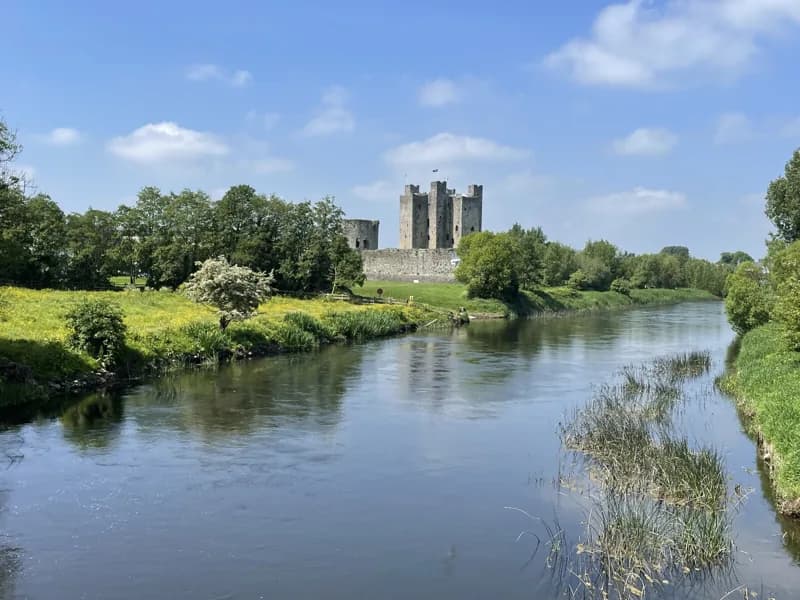
The Porchfields walk: from Trim Castle out to Newtown
The walk Trim people actually do: castle grounds, footbridge, Yellow Steeple, Sheep Gate, then out along the Boyne through a surviving medieval field system to the Newtown ruins and the medieval bridge.
Ask a Trim person what to do with an afternoon and most of them will send you along the river rather than into the castle. The walk from the castle out to the Newtown ruins is the town's own amenity: about two kilometres each way on flat ground, roughly an hour and a quarter there and back at a walking pace, and it takes in more medieval Trim than anything you can do standing still.
Leaving the castle
Start in the castle grounds on the south bank, which are free and open. Head for the footbridge that crosses the Boyne below the keep. The crossing itself is the best view you will get of the castle from ground level, because it puts the curtain wall and the keep together with the water in front of them. On the far side the path climbs a short rise onto the north bank ridge.
The Yellow Steeple and Talbot Castle
The tall broken tower at the top of the rise is the Yellow Steeple, the bell tower of St Mary's Augustinian Abbey and the tallest structure in Trim. Its east face came down in the seventeenth century, which is why it reads as a blade rather than a tower, and the name comes from the colour the stone turns in evening light. The tower is closed and cannot be climbed; this is a look-at rather than a go-in. Beside it stands Talbot Castle, a fifteenth-century fortified house that later served as a school, which is where Trim's Jonathan Swift connections begin. The abbey the steeple belonged to held a wooden statue known as Our Lady of Trim that drew pilgrims from 1397 until the Reformation destroyed it.
The Sheep Gate
A few minutes further on, standing free on the path with grass on both sides, is the Sheep Gate. It is the only surviving gate of Trim's medieval town wall and it is genuinely easy to walk past, which is a fair summary of how this town wears its history. Fragments of the wall itself survive elsewhere, built into later boundaries near Castle Street and Emmet Street, but this is the one piece you can stand under.
Into the Porchfields
Past the Sheep Gate the path opens into the Porchfields, and this is the part of the walk that surprises people. It is a medieval open field system, still legible as one, that survived into the present for the plainest of reasons: the ground floods, so nobody ever built on it. Meath County Council has run interpretive panels with QR-linked local stories along the route, with benches, a wildflower meadow and an outdoor gym, so it functions as a town park as much as a heritage trail. The Boyne runs alongside the whole way. Herons work the shallows, swans sit below the footbridge, and the river is part of the River Boyne and River Blackwater Special Area of Conservation, with otter and Atlantic salmon among the species it is designated for.
Newtown
The path finishes among the ruins at Newtown, roughly a mile and a bit downriver. The big one is the Cathedral of Saints Peter and Paul, begun in the early thirteenth century by the Bishop of Meath and once the largest church of its kind in Ireland; what stands now is the nave and chancel skeleton with the Augustinian priory buildings beside it. Across the water is the Priory of St John the Baptist, a Crutched Friars hospital house with a squat tower, and between them runs the medieval bridge, one of the oldest surviving in the country and still carrying the regional road. Nothing here is ticketed, gated or staffed. Most days there is nobody else in it.
At the far end of the bridge is Marcie Regan's, a low, dark country pub with a claim to one of the oldest publican's licences in Ireland. It keeps its own hours rather than posted ones, so treat it as a bonus if it is open rather than as the plan.
What to wear, and when to go
The surface is a mix of tarmac path and mown grass. The meadow sections go soft after rain and can flood outright in winter, so boots rather than trainers between October and April. There is no lighting past the Sheep Gate, which matters in December when it is dark by half four. Early summer is the walk at its best, when the wildflower planting along the river is out, but flat autumn light on the Newtown ruins is the version worth photographing.
The walk is dog friendly and pushchair-awkward rather than pushchair-impossible; it is not wheelchair accessible over its full length. Park all day at Emmet Street for about €3 rather than feeding a town-centre meter at roughly €1 an hour, and start from the castle rather than driving to Newtown, which misses the point of the route entirely.
Keep Reading
Trim Castle: how to actually get inside the keep
The castle splits into two visits: free open grounds that locals walk through daily, and a cruciform keep you can only enter on a guided OPW tour. Hours, prices, timing and the queue the OPW warns about.
Food & DrinkEating and drinking in Trim
A small town's dining, honestly described: the castle-facing rooms that keep restaurant hours, the daytime places on Emmet Street that serve the town, and the two pubs worth going out of your way for.
Planning a trip?
Explore restaurants, activities, accommodation, and more.