About Kinsale
The history, geography, and character of Kinsale.
History & Heritage
The Head of the Tide
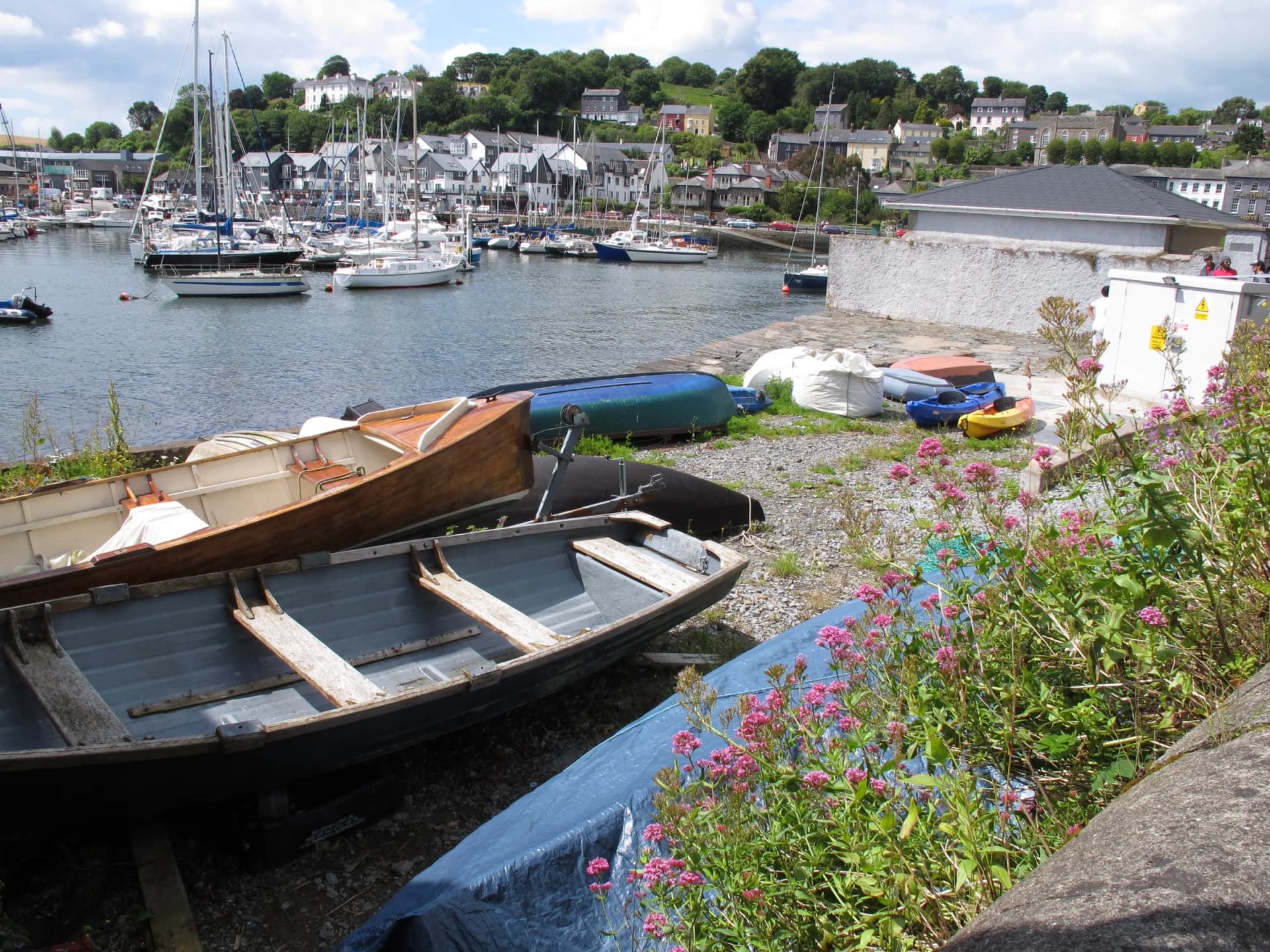
Kinsale's Irish name, Cionn tSáile, is usually rendered as the head of the tide or the head of the sea, from sáile, brine or sea water. It is a fair description of where the town stands, at the point where the River Bandon estuary becomes the harbour and the salt water reaches up to meet the river. A medieval walled port grew here on the strength of that sheltered harbour, trading wine and fish, and the shape of the old town, narrow streets climbing the hill from the water, still follows the lines laid down then.
The Forts and the Garrison
Two forts guard the mouth of the harbour. James Fort, on the western shore, dates from around 1604, built in the aftermath of the siege. Charles Fort, the great star fort on the eastern side above Summercove, was begun in the 1670s and 1680s and is one of the largest military fortifications in the country. It was garrisoned right through to 1922, when the British left, and was burned that same year during the Civil War. The forts are why the harbour mattered to every power that wanted to control the south coast, and walking their bastions is the clearest way to read the town's strategic past.
The Gourmet Capital
Kinsale's reputation as the Gourmet Capital of Ireland was built deliberately. From the 1970s a group of the town's restaurateurs formed the Good Food Circle and set out to make Kinsale a destination for eating, and it worked: the town has carried the title for fifty years and backs it with a Michelin star and a calendar that turns on food. The Wednesday market brings producers into the town, and the October Gourmet Festival is the flagship weekend, but on any given week the point holds: a small Cork harbour town with more good kitchens than places ten times its size.
The Old Head and the Lusitania
Off the Old Head of Kinsale, on 7 May 1915, the Cunard liner Lusitania was torpedoed by a German submarine and sank in eighteen minutes, with the loss of around 1,197 lives. Many of the dead and the survivors were brought ashore at Kinsale and the surrounding harbours. The signal tower on the headland is now a museum to the disaster, and it is the public-facing place to mark it. The tip of the Old Head itself is a private golf course with no right of public access, so the cliffs are not open to walkers; the museum and signal tower are where you go to stand with the story.
The Battle of Kinsale, 1601
In 1601 a Spanish force landed at Kinsale to support the Irish lords in their war against the English crown. The Irish armies of Hugh O'Neill and Hugh O'Donnell marched the length of the country to meet them, but the combined Irish and Spanish were defeated outside the town. The loss broke the back of Gaelic resistance and led, a few years later, to the Flight of the Earls and the end of the old Gaelic order. For all its galleries and restaurants, Kinsale carries one of the heaviest dates in Irish history, and the town does not treat it lightly.
Wildlife & Nature
Marine Life
Harbour and grey seals
Harbour and grey seals are regular visitors to Kinsale Harbour and are often seen from the marina, the Scilly Walk and the harbour boat trips. The sheltered estuary water suits them, and they turn up close to the town more often than visitors expect.
Year-round
Whales and dolphins
Whales and dolphins move through the waters off the Cork coast in season, and harbour and wildlife boat trips out toward the open sea give the best chance of seeing them. Sightings depend on the time of year and the conditions on the day.
Late summer into autumn
Birdlife
Seabirds and gannets
Seabirds work the water off the Old Head of Kinsale, with gannets diving offshore among the gulls and other coastal birds. The headland and the open sea beyond the harbour mouth are the place to watch them.
Spring through autumn