An estate village: how Enniskerry got its square, its clock tower and its film career
Enniskerry was composed rather than grown, laid out from the 1840s for the people who worked the Powerscourt demesne. What that means for what you are looking at when you stand on the Square.
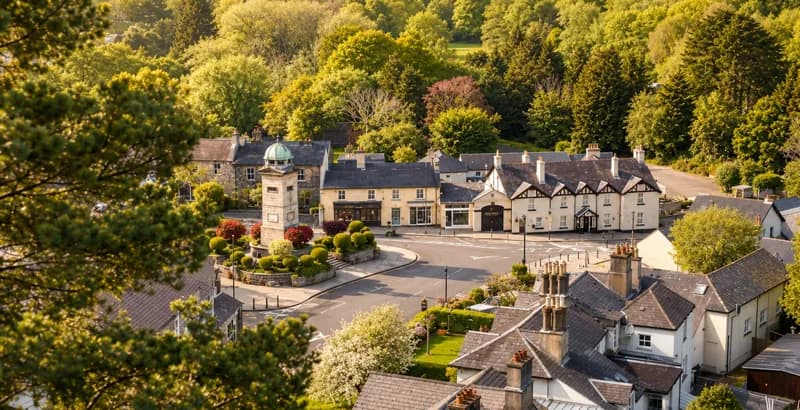
Most Irish villages happened. Enniskerry was decided. Stand on the Square and what you are looking at is a piece of nineteenth-century estate management: a triangular open space on a slope, ringed by low terraces built to a house style, with a monument in the middle of it, all of it laid out from the 1840s by the Wingfield family, Viscounts Powerscourt, to house the people who worked their demesne. The name comes from the Irish Ath na Sceire, the rugged ford, and there was a crossing here long before there was a village. But the village itself is a composition, and once you know that, it reads completely differently.
The clock tower
The tower on the raised granite platform in the middle of the Square went up in 1843. It is a free-standing three-stage Renaissance affair in granite, with moulded panels, clock faces, cast-iron fountain spouts and water troughs at its base, and a copper-domed cupola with a weathervane that was added in 1860. The National Inventory of Architectural Heritage attributes the original design tentatively to John Louch and the cupola to Sir George Moyers, and notes, drily and correctly, that its formal Renaissance manner contrasts with the picturesque architecture around it. That contrast is the point. The terraces are cottage-scale and neo-Tudor; the tower is civic and Italianate, and it is there to say who paid for the place.
The troughs matter too. This was a working village on a hill, and a public water supply with troughs for horses at the centre of the square was infrastructure before it was ornament. Today the tower is ringed by flower beds, and by parked cars, because the Square is also the village car park and has been for decades. There is no way to see Enniskerry's centrepiece without seeing a row of bumpers in front of it. That is not a failure of the village; it is what happens when a village of two thousand people has to function as a village.
The terraces, the church and the demesne
The older buildings around the Square carry neo-Tudor detailing: steep gables, decorative bargeboards, tall chimneys, black-and-cream framing. The long block closing the northern side is the Powerscourt Arms, which still houses a bar and rooms. Below the Square the ground drops sharply toward the Glencullen River, which is why Enniskerry feels tight and enclosed in a way that a village of this size on flat ground never would.
Up Church Hill is St Patrick's, completed in 1861 by the 7th Viscount so that the estate's Protestant community had a parish church rather than travelling to worship at the demesne. The same 7th Viscount, who inherited at the age of eight in 1844, spent roughly twenty years making the gardens at Powerscourt, finishing them around 1880. It is worth holding those two dates together: the village, the church and the gardens are a single programme by a single family across a single generation, and the reason Enniskerry looks coherent is that it largely is.
The demesne as employer
The estate is still the economic centre of gravity, which is unusual and worth naming. Powerscourt House and Gardens, Powerscourt Hotel with its 198 bedrooms, Powerscourt Golf's two courses, Avoca filling the ground floor of the house, and since 2018 Powerscourt Distillery in the estate's 1730s mill house, making Fercullen whiskey. That is a great deal of commercial activity attached to a very small village, and it means Enniskerry runs on two economies sharing a postcode: the demesne's, which turns on visitor numbers, and the village's, which turns on the people who live here. On a fine Sunday the first one is very visible. On a wet Tuesday in February the second one is the only one operating.
The film career
A village that was designed to look like something has an obvious second life. In 1943 Laurence Olivier shot the Agincourt sequences of Henry V here, using hundreds of local people as extras along with their horses, for a film that did not reach cinemas until November 1944, at a point in the war when Ireland's neutrality made it one of the few places in these islands where you could assemble a medieval army without an air raid. More recently, Disney redressed the entire village as a fairytale town for Disenchanted, with a set going up from the start of May 2021 and principal photography in Ireland running from mid-May to late July, and the ballroom at Powerscourt House standing in for a character's home.
Locals are relaxed about it, mostly. It is money, and it is temporary, and it confirms what the village already knew about itself. But it does feed the thing visitors have to be careful about, which is treating a working place as a set. The houses around the Square are houses. The shops are somebody's livelihood. The tower is a monument and not an attraction: there is no interior access, no interpretation panel and no ticket, and there does not need to be.
How to look at it
Give the Square twenty minutes on foot before you drive up to the gardens. Walk the western terrace past the shopfronts, cross to the tower and look at the troughs and the spouts, then take Church Hill up to St Patrick's and turn around at the top for the view back down over the roofs. Then keep going the other way, down out of the village into Knocksink Wood, and you will have seen in an hour the two things that actually made Enniskerry: a river in a ravine, and a family with a plan.
Keep Reading
Powerscourt House or Powerscourt Waterfall? The seven kilometres nobody mentions
The most common planning mistake at Enniskerry is assuming Powerscourt is one place. It is two, with two entrances, two tickets and seven kilometres of road between them. Here is how to plan around it.
WalkingWalking out of Enniskerry: the wood, the ridge and the free waterfall view
Enniskerry has four walks worth the trip and they range from an hour in a river ravine below the houses to a strenuous mountain loop. Here is which one fits your day, and what each actually asks of you.
Planning a trip?
Explore restaurants, activities, accommodation, and more.