About Enniskerry
The history, geography, and character of Enniskerry.
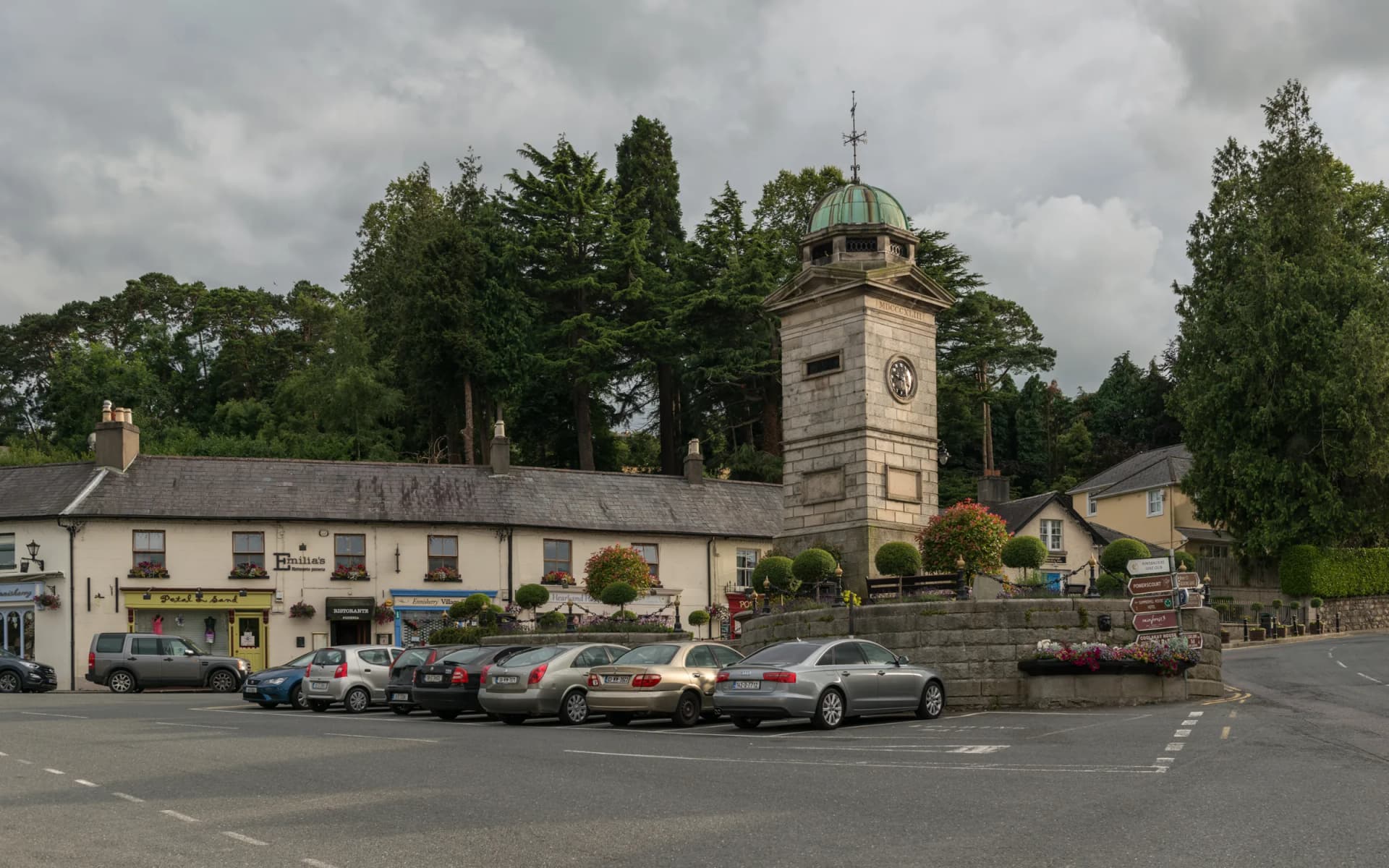
Enniskerry, from the Irish Ath na Sceire, the rugged ford, is a village of around two thousand people in a hollow in the north Wicklow foothills, twenty-four kilometres south of Dublin. It is a planned estate village: laid out from the 1840s in a neo-Tudor style for the tenants and workers of the Powerscourt demesne, arranged around a triangular sloping square with a granite clock tower of 1843 at its pivot. That origin still shapes everything about the place. The demesne remains the main employer and the main reason visitors come; the village supplies the square, the pubs, the wood in the ravine below it and the ordinary weekday life that the day-trippers drive straight past. Enniskerry is also the classic Irish planning trap for visitors, because Powerscourt House and Gardens and Powerscourt Waterfall are two entirely separate sites with separate entrances, separate tickets and seven kilometres of road between them.
History & Heritage
A village built for an estate
There was a settlement at the ford here long before there was a village, but Enniskerry as you see it was largely composed rather than grown. The Wingfield family, Viscounts Powerscourt, laid out the present village from the 1840s to house the people who worked the demesne, and the neo-Tudor detailing on the older terraces around the Square is the signature of that programme. The Square itself is the centrepiece: a triangle on a slope, closed on its northern side by the long mock-Tudor block of the Powerscourt Arms, with the low painted terrace of shops and cafes running down the western edge, and the clock tower on a raised granite platform in the middle of it. The tower went up in 1843 in a Renaissance manner that sits oddly against the picturesque cottages around it, and its copper-domed cupola was added in 1860. The National Inventory of Architectural Heritage records the design as possibly by John Louch, with the cupola by Sir George Moyers. St Patrick's Church on Church Hill was completed in 1861 by the 7th Viscount, so that the estate's Protestant community had somewhere to worship other than the demesne chapel. What none of this tells you is that the Square is also the village car park, and has been for decades. That is the honest condition of Enniskerry: a deliberately composed 19th-century set piece doing daily service as a turning circle for delivery vans and a place to leave the car while you get a coffee.
Powerscourt: two places, not one
The single most useful thing anyone can tell you about Enniskerry is that Powerscourt is two attractions. Powerscourt House and Gardens sit two kilometres uphill from the Square: a Palladian house rebuilt out of a 13th-century castle by the German architect Richard Cassels between 1731 and 1741, and forty-seven acres of gardens that were the twenty-year project of the 7th Viscount, finished around 1880. The house burned out in a fire on 4 November 1974 and was reroofed and re-fitted in the 1990s; only a small part of it is presented as it was when the family lived there, and most of the ground floor is now Avoca, shops and a cafe, all free to walk into. Powerscourt Waterfall is somewhere else entirely: the River Dargle dropping 121 metres off the lip of the Glensoulan valley, in its own parkland with its own gate, its own car park and its own ticket, seven kilometres from the village by road and about six from the gardens. There is no combined ticket, no shuttle, and no bus to the waterfall at all. Visitors who assume the gardens ticket covers the falls lose an afternoon to that assumption every single week of the season.
The village and the day trip
Enniskerry lives with a particular kind of pressure. It is half an hour from Dublin city centre, it is on the standard Wicklow coach circuit, and it looks like a film set, which is not an accident: Laurence Olivier shot the Agincourt sequences of Henry V here in 1943, for a film released the following year, using hundreds of local extras and their horses, and Disney redressed the whole village as a fairytale town for Disenchanted over the summer of 2021. On a fine Sunday in July the Square fills by mid-morning and the village becomes a place for other people's photographs. On a wet Tuesday in February it is what it actually is: a working village with a handful of shops, a pharmacy on Church Hill, a Garda station, a couple of pubs, a school run and a bus every hour to Bray. Both versions are true. The good news for a visitor is that the interesting one is easy to find, because it starts at about six in the evening when the demesne closes and the coaches go back up the N11.
Mountains and water on every side
Enniskerry sits where the Dargle and the Glencullen come out of the hills, and the geography is what makes the village worth more than an afternoon. Immediately below the houses is Knocksink Wood, a steep-sided ravine on the Glencullen River that became a statutory nature reserve in 1994: about fifty-two hectares of sessile oak and wet woodland, with springs and seepage areas including petrifying springs, a priority habitat under the EU Habitats Directive, and one of the richest woodland invertebrate faunas recorded in Ireland. West of the village the Glencree valley climbs toward the Sally Gap and the high blanket bog of the Wicklow Mountains, past the German war cemetery of 1961 and the old barracks that is now the Glencree Centre for Peace and Reconciliation. South, the Wicklow Way passes about four kilometres out, and the loop from Crone Wood over Maulin gives you Powerscourt Waterfall from above for nothing. East, on every horizon, is the Great Sugar Loaf: 501 metres of Cambrian quartzite that looks volcanic and is not, and which the gardeners at Powerscourt framed deliberately at the end of the Italian terraces.
Whiskey, wool and the estate economy
The demesne is still the economic centre of gravity, and what it produces has changed with the century. The old mill house on the estate, a heritage building of the 1730s, was converted in 2018 into Powerscourt Distillery, which makes Fercullen Irish whiskey and runs an hour-long tour of the still house and warehouse. Avoca fills the ground floor of Powerscourt House with a food market, a bakery, a cafe and the throws and knitwear woven at the company's own mill further south in the county. Powerscourt Golf runs two championship courses on the demesne, and Powerscourt Hotel, a 198-room five-star property, sits on the ridge above the gardens. That is a lot of commercial weight for a village of two thousand people, and it explains why Enniskerry can feel like two economies sharing a postcode: the estate's, which employs a great many locals and runs on visitor numbers, and the village's, which runs on the people who live here.
Wildlife & Nature
Mammals
Sika deer
Sika deer were introduced to the Powerscourt demesne in the 19th century and spread from here into the whole of the Wicklow Mountains, hybridising with the native red deer along the way. They are the reason the fine-dining room at Powerscourt Hotel is called Sika, and they remain the most likely large mammal you will see on the fringes of the estate or on the forest edges around Crone Wood.
Dawn and dusk, most visible in autumn during the rut
Badger and fox
Knocksink Wood and the wooded riverbanks around the village hold badger and fox, both of which are far more often heard or tracked than seen. The wood's steep sides and undisturbed cover suit them, and prints along the muddy river paths after rain are the usual evidence.
After dark, year round; tracks visible on the river paths after rain
Birdlife
Dipper and grey wagtail
The Glencullen River through Knocksink and the Dargle below the waterfall both hold dipper, the stocky white-bibbed bird that walks underwater on the riverbed, and grey wagtail. Stand at any boulder-strewn stretch of the river for ten minutes and you will usually see one or the other working the stones.
Year round, easiest in winter when the leaf cover is off
Raven and peregrine
The crags above Powerscourt Waterfall and the open ground on Maulin and the Great Sugar Loaf are raven country, and peregrine hunt the same airspace. On the Crone Wood loop the ravens usually announce themselves before you see them.
Spring and early summer on the high ground
Flora
Sessile oak and wet woodland
Knocksink Wood's slopes are dominated by sessile oak, with mixed and wet woodland on the valley floor. The wet woodland types here are among the more threatened woodland habitats in the EU, which is a large part of why the site was made a statutory nature reserve in 1994 and a Special Area of Conservation.
May for the fresh leaf, October and November for the turn
Petrifying springs
Knocksink carries frequent springs and seepages, including petrifying springs where dissolved lime precipitates out and slowly encases moss and leaf litter in stone. It is a priority habitat under the EU Habitats Directive and it is the reason the reserve asks walkers to stay on the paths through the seepage areas.
Year round; most obvious after wet weather
The demesne trees
The Powerscourt demesne holds one of the best collections of mature specimen trees in Ireland, including beech avenues and a Douglas fir recorded as the tallest tree in the country. The Japanese Gardens, laid out on reclaimed bogland in 1908, add a very different planting again within the same forty-seven acres.
Late April and May for spring planting, October for the beeches