Walking Medieval Drogheda: The Walls, the Gate and Millmount
A four-kilometre circuit through one of medieval Ireland's largest walled towns, from St Laurence's Gate over the river to Millmount, with what survives and what happened where.
Drogheda was one of the largest walled towns in medieval Ireland, and unlike most Irish towns of that rank it still has enough standing to make a walk worthwhile. The circuit below is about four kilometres, takes two to three hours with stops, and has exactly one climb in it. It works best in the late afternoon, when the light comes down St Laurence Street and hits the limestone, and when you can still get up the Martello tower before it closes.
Start at the gate
Begin at St Laurence's Gate, at the eastern end of St Laurence Street. What stands there is a barbican rather than a gate proper, the outer defensive work that sat in front of the actual gate in the wall, and it went up in the 13th century: two great drum towers, a linking arch, and traffic still running underneath. The street and the gate were originally called East Street and East Gate; the Laurence name came later from the nearby hospital of St Laurence. There is nothing to pay and nothing to book. Stand on the footpath rather than the carriageway for the photograph, because this is a live junction.
Walk west down St Laurence Street and Highlanes Gallery is on your right, in the former Franciscan church of St Francis, still recognisably a church from the street with its stained glass in place. It opened in October 2006 and holds the Drogheda Municipal Art Collection, a hundred-odd works whose nucleus was assembled by the artist Bea Orpen, her husband Terry Trench and the 1947 Museum Committee. Admission is free, Tuesday to Saturday, 10:30am to 5pm.
Up to the high ground
Turn north off the main street and climb. Peter Street brings you past Clarke's Bar, whose gold-lettered spirit-grocer front is a piece of the town's commercial history in its own right, and up onto the higher ground where St Peter's Church of Ireland stands in its churchyard off Magdalene Street. This is the older of the town's two St Peter's and the one with the darker story: its predecessor building burned during Cromwell's storming of the town in 1649, with people inside the steeple. The churchyard holds Drogheda's well-known cadaver tombstone, a late medieval carving of two shrouded corpses.
A little further north again is Magdalene Tower, the 14th-century belfry that is all that remains above ground of the Dominican friary. It sits on the highest point of the old town and is visible from a good deal of the north side, which was rather the idea.
Down to West Street
Come back down to West Street, the town's main street, and to the second St Peter's, the Catholic one, completed in 1884 to a design by John O'Neill and William Henry Byrne on the site of an earlier church by Francis Johnston. Inside is the national shrine of St Oliver Plunkett. Plunkett was born at Loughcrew in Co. Meath in 1625, ordained in Rome in 1654, made Archbishop of Armagh in 1669, arrested on a treason charge in 1679 and executed at Tyburn in 1681 after a trial no Irish jury would deliver. His preserved head is in the gilded case, along with other relics and the door of his cell in Newgate prison. It is a working church, so keep it quiet and time your visit around Mass rather than through it.
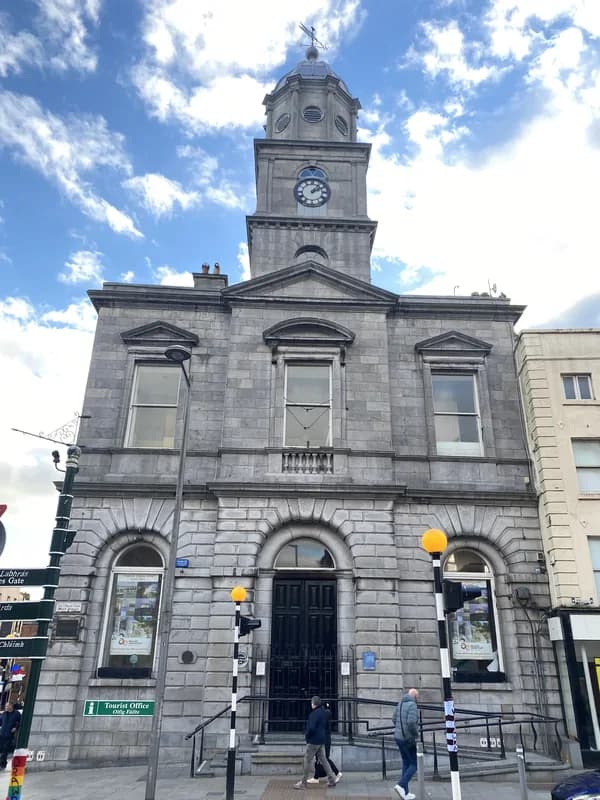
At the top of Shop Street stands the Tholsel, completed in 1770, the old town hall and exchange, now the tourist office. This is where to pick up the free Drogheda Walks map and guide, which sets out four routes mapped by local people: a 1.5km Five Bridges walk, a 4km historical Walls walk, a Spires and Towers walk and a 6.5km Steps walk. The same map is available from the local authority offices on Fair Street, from local hotels, and from many businesses around the town.
Cross the river
Now do the thing that most visitors skip. Cross the Boyne at St Mary's Bridge onto the south bank and climb Congress Avenue. It is short and it is steep, and at the top is Millmount: the great grassed Anglo-Norman mound raised as a motte-and-bailey by Hugh de Lacy before 1186, with a Martello tower on the summit and the old barracks around its base now housing Drogheda Museum Millmount, run by the volunteer Old Drogheda Society. Inside are the guild and trade banners of the town's craft corporations, an industrial exhibition covering the mills, breweries and foundries, a folk kitchen, a geological collection and the old post office. Admission is €6 adult, €3 child, student or over-65, €12 family. The tower closes at 4:30pm and last tours are an hour before the museum shuts, so this is the part of the walk to plan the rest around.
Millmount is also where the defenders of Drogheda made their last stand in 1649. Standing on top of it, with the river below and the town on the far bank, is the only place the whole thing is legible at once.
Finish on the quays
Come off the mound to the south quay and the Boyne boardwalk at Scotch Hall. If you have another twenty minutes, walk east along the quays toward the Boyne Viaduct, which carries the Dublin to Belfast railway across the river on stone piers, went up in the 1850s to Sir John MacNeill's design, and had its three river spans rebuilt in iron in 1932. Trains still cross it. So does the whole point of the town.
Keep Reading
Two Days in Drogheda: How to Plan It
A practical two-day plan for Drogheda that gets both banks of the Boyne, the medieval town on foot, and the Boyne Valley upriver, with the timings that actually constrain the day.
Food & DrinkEating and Drinking in Drogheda
Where to eat and drink in a town of forty thousand people rather than a tourist stop: the two rooms to book, the daytime addresses, the pubs, and what Drogheda still makes.
Planning a trip?
Explore restaurants, activities, accommodation, and more.