About Birr
The history, geography, and character of Birr.
History & Heritage
Biorra, before the Parsons
The town predates its Georgian plan by a thousand years. St Brendan of Birr founded a monastery here in the sixth century and a medieval town grew around the site. Two things came out of it that matter beyond Offaly. In 697 AD the Synod of Birr enacted the Cain Adomnain, the law that placed women, children and clerics outside the business of war, which is routinely described as one of the earliest human rights instruments anywhere. Around 800 AD the scribe MacRegol produced a decorated copy of the four Gospels, known as the MacRegol Gospels or the Book of Birr; the original has been in the Bodleian Library in Oxford for centuries and a facsimile is on display in Birr Library. The Irish name, Biorra, is usually glossed as a place of water, which fits a town where the Camcor comes down off the Slieve Blooms to meet the Little Brosna.
Parsonstown and the planned town
The Parsons family arrived in 1620 and the town carried their name until 1899. What they left is a street plan rather than a single building: the malls and avenues running out from the demesne wall, laid out in formal blocks with mature trees down the middle. The FAN Trail's own list of the town's building dates gives the shape of it. The Doric column at the centre of Emmet Square is dated 1747, raised for the Duke of Cumberland after Culloden and designed by Sir Laurence Parsons with Samuel Chearnley; the duke's statue was taken down in the early twentieth century, a plaque to Robert Emmet went up instead and the square was renamed for him in 1922. The old distillery on Newbridge Street dates to 1805 and burnt in 1889. St Brendan's Church of Ireland is 1816, Oxmantown Mall about the same year, Oxmantown Bridge 1817, John's Hall 1833. The Convent of Mercy that is now Birr Library was built between 1846 and 1856 to a design by A.W. Pugin. Crinkill Barracks, just south of town, went up in 1809 as the home depot of what became the Prince of Wales's Leinster Regiment and burnt in 1922.
The Leviathan of Parsonstown
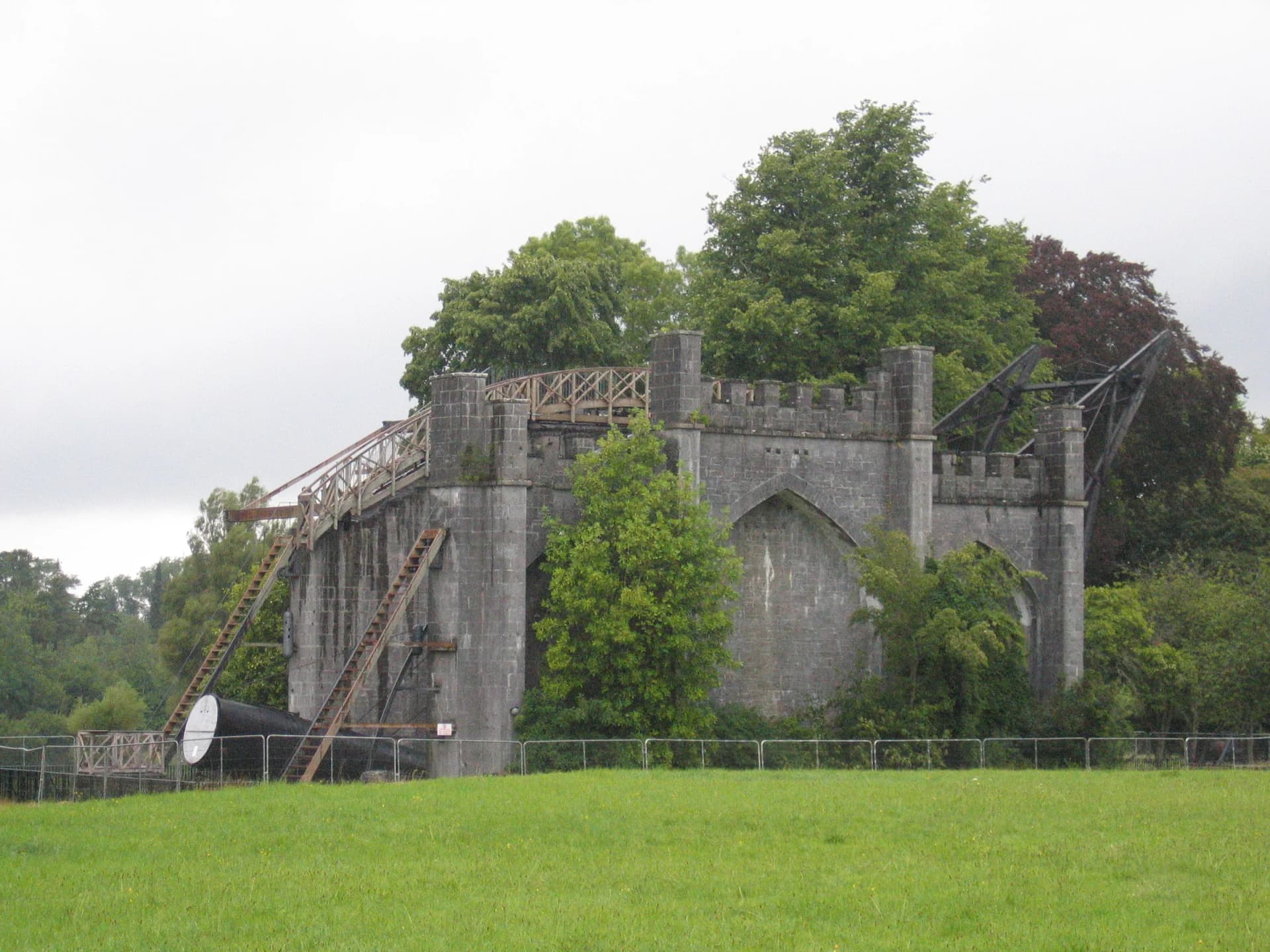
William Parsons, Third Earl of Rosse, cast six speculum mirrors between 1842 and 1845 to get two he could use, and in 1845 hung a 72-inch reflector with a 16.5 metre focal length between two masonry walls in the middle of his demesne. The UNESCO and IAU Portal to the Heritage of Astronomy records it as the largest telescope in the world from 1845 until the 100-inch Hooker Telescope was built at Mount Wilson in California in 1917; the estate's own account of the instrument dates the record from 1845 to 1914, the year the original speculum went to the Science Museum in London, where it still is. With it Rosse drew the spiral structure of M51, the Whirlpool Galaxy, which is why the telescope matters rather than simply being large. The science did not stop with him. His son Laurence, the Fourth Earl, measured the radiant heat of the Moon in 1868. His youngest son Charles invented the compound steam turbine in 1884, the one that took his name to sea in Turbinia ten years later. The telescope was restored in the late 1990s with a new mirror in 1999, and the estate says it was last used in the early 2000s. Astronomy is still live here: I-LOFAR, a radio telescope run by Trinity College Dublin with a 1.4 million euro Science Foundation Ireland grant, sits in the same parkland and links Birr to the European LOFAR network.
The demesne, the gardens and two rivers
The 120 acres behind the wall are the reason most people come. The landscape park dates from the start of the nineteenth century, when the house was Gothicised, a perimeter of trees was planted and the lake was formed. The plant collection was built up through the twentieth century by the Fifth, Sixth and Seventh Earls, and runs to more than 5,000 species: magnolias that thrive here despite the limy soil, a Metasequoia grown from seed that reached Birr in the 1940s, a Giant Redwood planted about 1860, and the Carroll Oak, which the estate believes predates the family's arrival in 1620. On the lower terrace of the formal gardens stand the box hedges Guinness World Records lists as the tallest in the world, at 11 metres, and which it describes as at least three centuries old. The River Camcor runs through the demesne and meets the Little Brosna at the double bridges; the Fernery waterfall garden of the 1880s was refurbished in 2024. The Camcor is a spate river that rises fast after rain in the Slieve Blooms, and in the nineteenth century its water drove sawmills and corn mills and generated electricity for the town. In late August the Croneen, a trout particular to this river, runs up from Lough Derg and can be seen jumping the falls near the suspension bridge.
The town now
Birr was designated a heritage town in 1993, which is when a group of locals bought the derelict Oxmantown Hall and set about restoring it; it reopened as Birr Theatre and Arts Centre in July 2000 and is now the hub of the Birr Festivals Collective. That collective is the best measure of what the town is like: Birr Vintage Week and Arts Festival has run since 1968 and takes nine days at the turn of July and August, Birr Festival of Music takes the May bank holiday, OFFline Film Festival comes in October and Hullabaloo fills the Halloween mid-term with workshops for children. Add a restaurant scene that punches above a town of under five thousand, with a Leinster award winner in a Georgian hotel dining room and another on Market Square, and the picture is a town that is busier culturally than its size suggests. It has no railway station, which keeps day-trip volumes down and is part of why the Georgian streets still feel like a town rather than a set.
Wildlife & Nature
Mammals
Red squirrel
The demesne is a red squirrel stronghold and the estate calls it one of its conservation successes, with good numbers now seen throughout the parkland. The walled boundary and the monitoring for invasive species are part of why.
Year-round, most visible in autumn
Otter
Otters use the Little Brosna, the larger of the two rivers in the demesne. You are unlikely to see one, but their slides on the bank, where they slip into the water, are obvious once you know what you are looking at.
Early morning and dusk, year-round
Birdlife
Grey heron
The small island in the lake at Birr Castle Demesne carries a heronry that the estate says grey herons have used for at least 300 years and describes as the largest in Ireland. The nests and the young are visible from the lake walk, and May is when there is most to see.
Spring, best around May
Kingfisher and dipper
Kingfishers nest in holes in the river bank inside the demesne and are shy, so what you usually get is a flash of blue going fast downstream. Dippers, the chocolate-brown birds with white bibs, are easier: they bob on stones at the water's edge and walk underwater to feed.
Year-round along the Camcor and Little Brosna
Ravens and swifts
The croak of ravens carries across the demesne all year. Swifts scream over the parkland through the summer months and are gone again by early August.
Swifts May to early August; ravens year-round
Flora
The magnolia collection
The Sixth Earl found that magnolias grow well at Birr despite the limy soil, especially in the River Garden, and built a collection the estate rates among the finest in Ireland. Magnolia delavayi on the castle terraces, planted around 1912 by the Fifth Earl, flowers unusually late, in September and October.
Spring for the main collection; September and October for Magnolia delavayi
Green-flowered helleborine
The demesne's rarest orchid, found in the wooded parts of the parkland. Orchids turn up in several places across the demesne later in the year, and the park in front of the castle is a wildflower meadow that peaks around mid-June.
Mid-June for the meadow; later summer for orchids