About Aran Islands (Inis Mór)
The history, geography, and character of Aran Islands (Inis Mór).
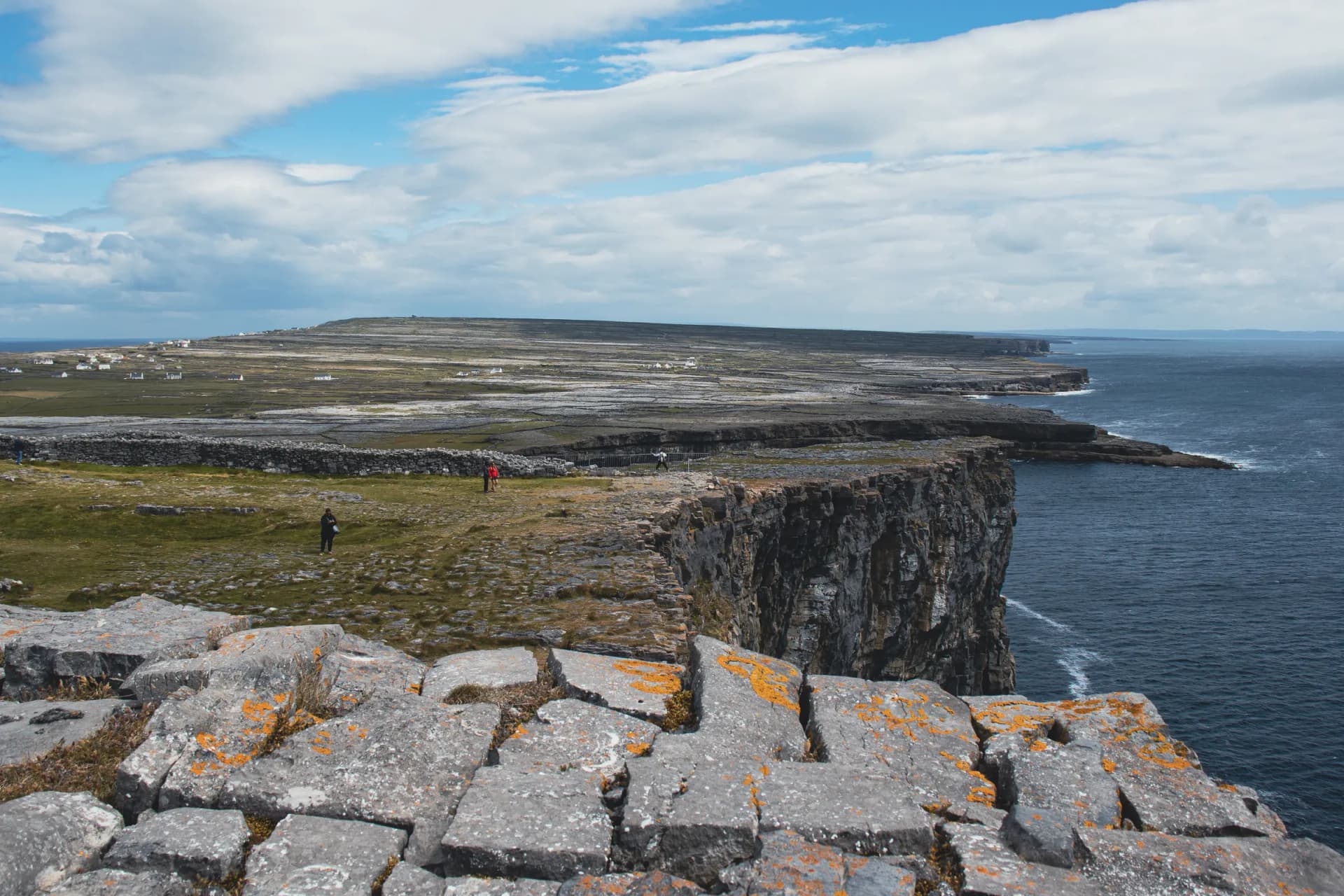
Inis Mór is the largest of the three Aran Islands, a low karst limestone island of about 31 km² sitting in the mouth of Galway Bay, roughly 14 km long and under 4 km wide. It is a Gaeltacht, an Irish-speaking community, and its only legal placename, Árainn, along with Inis Mór, the big island, distinguishes it from its smaller neighbours Inis Meáin and Inis Oírr. Around 820 people live here, most of them in or close to Cill Rónáin (Kilronan), the harbour village that every ferry, bike hire desk and tour operator works out of. The island is best known for Dún Aonghasa, a Bronze Age cliff fort perched above a 100-metre drop into the Atlantic, but it is also defined by what surrounds that fort: a landscape of bare limestone pavement stitched together by well over a thousand kilometres of dry-stone field walls.
History & Heritage
A Gaeltacht island with two names
Under the Official Languages Act 2003, Árainn is the island's only legal placename; Inis Mór, meaning the big island, is the everyday English-language form and the one that distinguishes it from Inis Meáin and Inis Oírr, the two smaller Aran Islands in the same bay. This is a working Gaeltacht, not a heritage re-creation: Irish is the daily language of the resident community, and road signs, shopfronts and conversation on the island lean Irish-first. The harbour village that visitors know as Kilronan is Cill Rónáin on every local sign and in every local mouth, and getting the Irish forms right, or at least recognising them, is a small but genuine mark of respect on a small island that has held onto its language against real pressure.
Dún Aonghasa and the island's other stone forts
Dún Aonghasa is the headline monument: a fort of three concentric dry-stone ramparts on a cliff above Cill Mhuirbhigh, with a defensive chevaux-de-frise of jagged upright stones outside the walls, and a 100-metre unfenced drop into the Atlantic at the cliff edge. The first enclosure dates to around 1100 BC, with the triple-wall defences likely added around 500 BC and refortification again around AD 700-800. It is not the island's only fort. Dún Dúchathair, the Black Fort, sits on a cliff promontory near Killeany, its outer walls up to 6 metres high, its age unknown but clearly ancient, and it is far quieter than Dún Aonghasa since it has no visitor centre and no ticket. Between the two forts and the island's other prehistoric and early Christian remains, Inis Mór carries a genuinely dense concentration of ancient monuments for its size.
A limestone island stitched together with stone walls
Inis Mór shares its karst limestone geology with the Burren in Co. Clare, visible across the sound on a clear day, a pavement of bare grey rock cut by deep fissures known as grykes, where sheltered plant life survives in a landscape that otherwise looks barren. What islanders did with that rock over centuries is as remarkable as the geology itself: they broke it up, carted the fragments, and built well over a thousand kilometres of dry-stone field walls, dividing the island into small, wind-sheltered plots where soil was built up by hand from seaweed and sand. The coast road out to Dún Aonghasa runs the length of that wall network, and it is as much the reason to cycle it slowly as the fort at the end.
An island the sea, not the clock, runs
More than almost anywhere else on this site, Inis Mór is genuinely shaped by its transport links. Aran Island Ferries sails year-round from Ros a' Mhíl (Rossaveal) on the Connemara coast, a 40-minute crossing that is the island's one reliable, all-season sea link; Doolin Ferry Co. runs a faster 35-minute seasonal crossing from Co. Clare that stops entirely over winter. Aer Árann Islands flies a short inter-island hop from Connemara Airport to the island's own airstrip, a genuine working lifeline when the sea is too rough to cross. All three services are weather-dependent, and locals plan around that reality in a way visitors from the mainland often do not expect. It is worth building slack into any Inis Mór visit for exactly this reason.
Wildlife & Nature
Marine Life
Grey seals
Grey seals haul out on rocks around Inis Mór's sheltered coves and inlets, and are regularly spotted from the coast road and from boats crossing to and from the island. Galway Bay and the waters around the Aran Islands support a healthy resident seal population.
Year-round, most easily spotted from a calm-water vantage point or a crossing on a settled day
Birdlife
Seabirds and cliff nesters
The cliffs around Dún Aonghasa and Dún Dúchathair draw nesting and passing seabirds typical of Ireland's Atlantic-facing cliffs, taking advantage of the island's undisturbed, largely traffic-free coastline.
Spring and summer for nesting activity on the cliffs