About Adare
The history, geography, and character of Adare.
Adare is a small village in County Limerick, about 16 km south-west of Limerick city on the N21 road to Kerry, in the newly grouped Mid-West region. It is widely marketed as Ireland's prettiest village, built around a short, concentrated row of thatched cottages laid out as a planned estate village by the Earls of Dunraven in the 1820s and 1830s, with an unusual cluster of medieval religious ruins and the five-star Adare Manor resort on its edge. It is genuinely photogenic, but it is also a real working village mid-transformation, with heavy through-traffic, an N21 bypass under construction, and the countdown to the 2027 Ryder Cup reshaping its future. The honest picture is a beautiful but small and busy place worth a stop rather than a destination in itself.
History & Heritage
A planned estate village
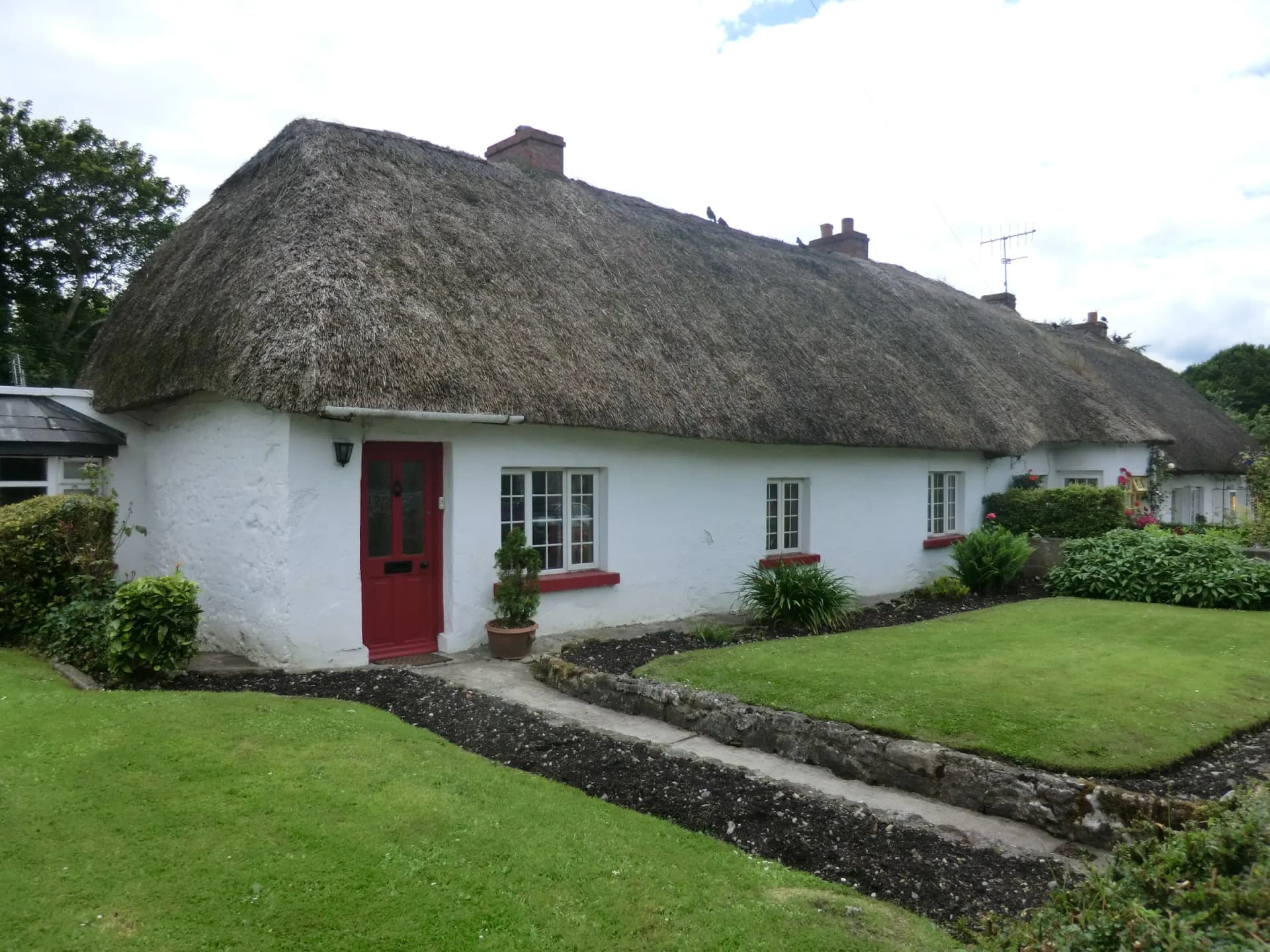
Adare's famous thatched cottages are not a random survival but a designed landscape. They were built in the 1820s and 1830s by the Earls of Dunraven of Adare Manor as part of a planned estate model village, an idealised Victorian vision of an ordered rural community, and that estate hand is visible across the village in its architecture and layout. The result is genuinely attractive, but it is worth managing expectations: the thatched stretch on Main Street is short and concentrated rather than a whole village of thatch, and the street carries heavy through-traffic between Limerick and Kerry. Several of the cottages now hold craft shops, cafes and restaurants. Adare is best seen early in the morning or in the evening, when the light is kind and the road is quieter.
Medieval ruins and churches
For its size Adare is unusually rich in medieval remains, with three religious houses within a short walk. Holy Trinity Abbey, founded around 1226 to 1240, was the only Trinitarian foundation in Ireland and today serves as the Catholic parish church. The Augustinian Priory of 1315 or 1316, long known as the Black Abbey, is now the Church of Ireland parish church of St Nicholas. The Franciscan Friary of 1464 stands as a roofless ruin on the banks of the River Maigue, though it sits on the Adare Manor golf grounds, so public access is not guaranteed. Above the river is Desmond Castle, a 13th-century Norman castle open for guided tours by shuttle from the Heritage Centre in the summer months. Together they make the medieval ruins loop the best reason to linger beyond the thatched street.
Adare Manor and the 2027 Ryder Cup
On the edge of the village, Adare Manor is a five-star resort in a neo-Gothic manor house set in a large private demesne, and its championship golf course will host the 2027 Ryder Cup from 17 to 19 September, marking the tournament's centenary. It is the single biggest event in Adare's modern history, and its approach is reshaping the area: an N21 bypass has been fast-tracked in part to handle it, and region-wide accommodation is expected to be scarce and expensive around the dates. It is important to be clear that the Manor grounds are not open to the general public. Access is for resort guests, booked diners and golfers only, so the estate is not a walk-in attraction, and visitors should not expect open access to the house or the demesne.
A working village mid-transformation
Behind the postcard, Adare is a working village of a few thousand people, and its honest character is a place in the middle of change. The through-traffic on the N21 and the bypass roadworks of 2025 to 2027 genuinely affect the visit, from parking to journey times, and the golf-driven, wedding-driven economy is ramping steeply toward the Ryder Cup. Local and visitor sentiment is candid: it is widely praised for its looks and just as widely called overrated and over-promoted, and the fair verdict is somewhere in between. The village has the practical services of a small Irish town, with a pharmacy, a Garda station and shops on Main Street, while the nearest 24-hour emergency care and larger services are in Limerick city, about 16 to 20 km away.
Wildlife & Nature
Marine Life
River Maigue birds
The freshwater River Maigue along the edge of the village supports herons, little egrets, ducks, moorhens and other river birds, often seen on the riverside walk near the Franciscan Friary. The Maigue is a salmon and trout river, tidal only far downstream toward the Shannon, so the wildlife here is that of a freshwater river rather than the coast.
Year-round, best in the quieter early morning
Wetland and woodland wildlife
The wooded parkland and wetland edges around the Maigue and at nearby Curraghchase Forest Park hold woodland birds, bats, foxes and other countryside wildlife, with the mature trees and lake at Curraghchase, about 10 km west, the best spot to see them away from the village.
Spring to autumn