About Whitby
The history, geography, and character of Whitby.
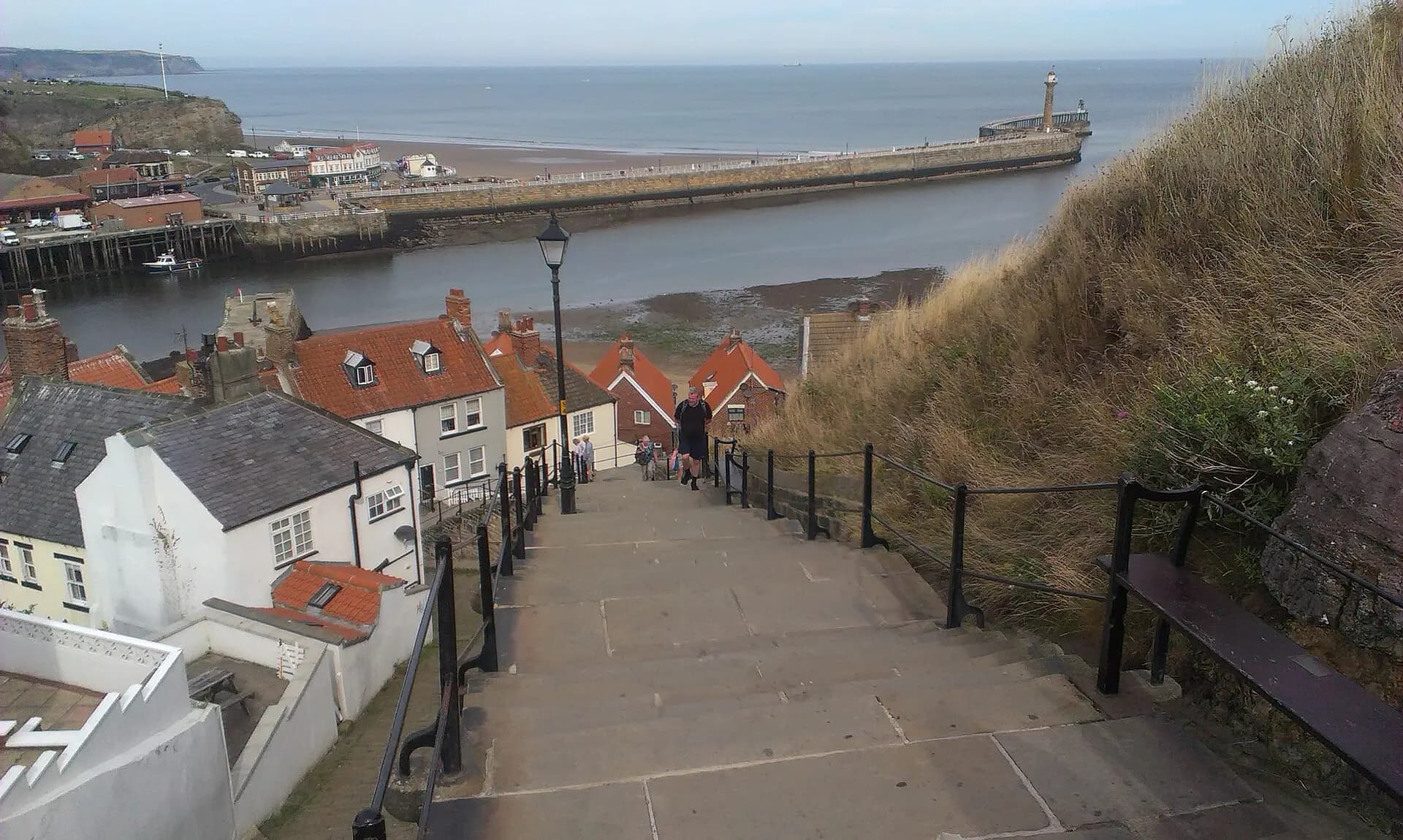
Whitby is a port at the mouth of the River Esk on the North Yorkshire coast, wedged into the only real break in a long line of cliffs and sitting inside the North York Moors National Park. The river divides it: an old town of narrow streets and red pantile roofs on the east bank under the abbey headland, and a Victorian resort town of terraces and crescents on the west. The two are joined by a swing bridge that still opens for shipping. Almost everything distinctive about the place, the fishing, the shipbuilding, the jet, the abbey, the two very different halves of its character, follows from that geography.
History & Heritage
The headland and the abbey
The East Cliff has been occupied since the seventh century, when a double monastery of monks and nuns was founded there under the abbess Hild. It was a place of real consequence: the Synod of Whitby met there in 664 to settle, among other things, the dating of Easter in the English church, and Caedmon, the earliest English poet known by name, was a member of its community. Nothing of that monastery stands above ground. What visitors see is the shell of the later medieval abbey church, dissolved in the sixteenth century and left to weather on an exposed clifftop ever since, which is why it looks the way it does: gaunt, roofless, and visible from most of the town. English Heritage runs the site today with a museum in the seventeenth-century house alongside it. The abbey and St Mary's parish church, a few hundred metres away at the top of the 199 steps, are two separate places with separate histories and separate opening hours, and conflating them is the commonest visitor mistake here.
Cook, colliers and whaling
Whitby's wealth came from the sea, and specifically from building and sailing tough, blunt-hulled ships. James Cook came here as a teenager to serve his apprenticeship with the Quaker shipowner John Walker, lodging in the house on Grape Lane that is now the Captain Cook Memorial Museum. The ship he took to the Pacific was Whitby-built: launched here in 1764 as the collier Earl of Pembroke, bought by the Navy in 1768 and commissioned as His Majesty's Bark Endeavour. The choice was deliberate. A collier had a flat bottom and a shallow draught and could be run aground and repaired, which is what saved the expedition after it struck the Great Barrier Reef. Alongside the coal trade, Whitby ran a Greenland whaling fleet through the eighteenth and early nineteenth centuries, and the Whale Bone Arch on the West Cliff is the surviving monument to it: a set of jawbones set up on the clifftop, framing the abbey across the harbour.
Jet
The black stone in every second window on Church Street is Whitby jet, and it is genuinely local: fossilised wood from the Jet Rock of the Whitby Mudstone Formation, laid down roughly 181 million years ago in the Early Jurassic, from trees related to the Chilean monkey puzzle. It is not a mineral and not simply coal; it is a mineraloid that carves, turns and takes a deep black polish like nothing else. Jet had been worked here since Roman times, but the Victorian mourning fashion made it an industry: Queen Victoria wore jet in mourning, first in the 1850s and again after Prince Albert's death, and the trade in Whitby peaked in the early 1870s. The decline was fast. From more than a thousand workers, the town was down to about three hundred by 1884, and by the end of the Second World War only a handful of makers remained. What exists now is a revival rather than an unbroken line, worked by a small number of Church Street jewellers and workshops, and it is worth buying from one of them rather than from a seaside window, because a great deal of what is sold as jet is glass, onyx or resin.
Dracula, and what is actually true
The Dracula connection is real, and it is worth separating from the merchandise. Bram Stoker arrived in Whitby at the end of July 1890 and stayed at a guesthouse on Royal Crescent on the West Cliff. On 8 August that year, in the town's library, he found the name in an 1820 book by William Wilkinson, a British consul in Bucharest, describing Wallachia and Moldavia and a fifteenth-century prince known as Dracula. Five years before his visit, in October 1885, a Russian schooner called the Dmitry out of Narva had been driven into the harbour in a gale and wrecked on Tate Hill Sands carrying silver sand; Stoker put the wreck into the novel as the Demeter. The abbey, the 199 steps and St Mary's churchyard all appear. What did not happen is any of it being about a local legend: the vampire arrived in Whitby with a novelist on holiday, and the town has spent a century and a bit making something of it. Whitby Goth Weekend, which began in the mid-1990s and now runs twice a year, is a descendant of that, though it is a music festival first and a Dracula event only incidentally.
The town today
Whitby is still a working port. Boats land fish on the quay, the fishmonger on Pier Road sells what came off them, and Fortune's has been smoking kippers on the same Henrietta Street premises since 1872. It is also, unmistakably, a tourist town, and the tension between those two facts is the town's ordinary weather: full car parks, a fish and chip queue that has become a landmark, and a calendar of events that swings between a folk week, a community sea regatta and two goth weekends a year. Administratively it sits within North Yorkshire, governed by North Yorkshire Council, and it is a long way from anywhere: the nearest accident and emergency departments are in Scarborough and Middlesbrough, the railway runs six trains a day, and the roads in are single-carriageway moorland routes. That distance is why the place has kept its shape.
Wildlife & Nature
Marine Life
Minke whales, humpbacks and harbour porpoise
The water off this stretch of the Yorkshire coast draws feeding whales in the second half of the year, following herring and other shoaling fish inshore. Minke whales and harbour porpoise are the regulars; humpbacks are the ones that make the local news. Whitby has a dedicated whale-watching operator running trips out of the harbour, which is the practical way to see them, though nothing about a sighting is guaranteed and a rough sea means no boat at all.
Late summer into autumn, roughly August to October, in settled weather
Grey seals
Seals haul out along this coast and are regularly seen from boat trips and occasionally from the piers. Keep a distance and stay quiet: a disturbed seal that goes back into the water has lost the rest it came ashore for.
Year-round, most reliably from a boat
Birdlife
Kittiwakes, fulmars and guillemots
The cliffs south of Whitby towards Saltwick and on to Robin Hood's Bay hold breeding seabirds through the spring and summer, and the noise of a kittiwake colony is audible from the Cleveland Way long before you see it. Fulmars nest on ledges and hold their ground; if one stares at you from a metre away on the cliff path, walk past rather than lean in.
April to July, from the Cleveland Way clifftop
Herring gulls
Impossible to miss, and worth understanding rather than resenting. Whitby's gulls are a genuine urban population and they are extremely practised at taking food from a hand on Pier Road. Eat chips indoors or with your back to a wall, and do not feed them, which makes the problem worse for everyone behind you.
Year-round, and unavoidably
Flora
Clifftop grassland and thrift
The unimproved grass on the cliff edge along the Cleveland Way carries thrift, sea campion and other salt-tolerant flowers through late spring and early summer, in a narrow band that survives precisely because nothing can be farmed there. It is at its best in May and June.
May and June, on the clifftop path south from the abbey