About Fort William
The history, geography, and character of Fort William.
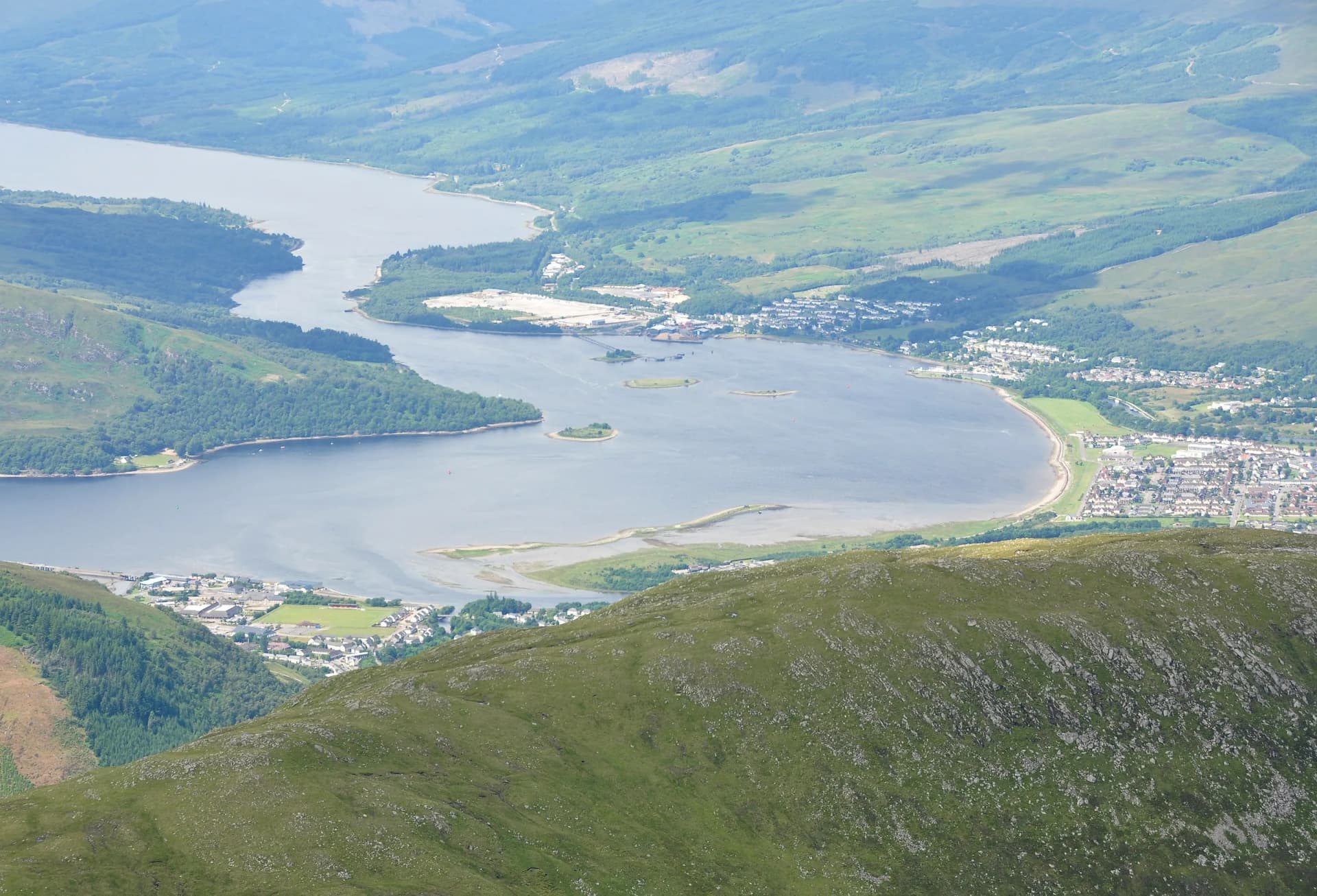
Fort William is An Gearasdan in Gaelic, the garrison. It sits on the eastern shore of Loch Linnhe in Lochaber, with Caol and Corpach along Loch Eil beyond it. Postcodes here start PH33. The Ben Nevis Mountain Track, the end of the West Highland Way, the Jacobite steam train and the Nevis Range gondola all start or finish within about seven miles of the High Street.
History & Heritage
A fort, then a garrison town
A wooden fort, the Garrison of Inverlochy, was built here in 1654 as a base for the New Model Army, and the fort that followed after 1688 took the name of William of Orange, according to Wikipedia. The settlement around it went through Maryburgh, Gordonsburgh and Duncansburgh before the fort's name stuck. Older than any of that is Inverlochy Castle, the ruin north of the town centre, which Historic Environment Scotland says was mostly built by the Comyns in the 1200s. It is fenced off for conservation at the moment.
The Ben
Ben Nevis is 1,345 metres on the Ordnance Survey's 2016 resurvey, and the John Muir Trust, which looks after the upper mountain, says over 130,000 people climb to the summit each year, most of them by the Mountain Track from the Ben Nevis Visitor Centre in Glen Nevis. Both the trust and High Life Highland's visitor centre call it the Ben. Mountaineering Scotland's advice is plain: even in summer the top can be cold, wet, windy and snow-covered, the summit is on the edge of cliffs, and walkers need a map, a compass and the skill to use them.
Glen Nevis
The glen runs south and east from the Nevis Bridge end of town, past the visitor centre, the youth hostel, the campsite and its restaurant, to a car park at the end of the road. From there the path goes through the Nevis Gorge to An Steall, which the John Muir Trust calls Scotland's second highest falls, with a drop of more than 100 metres.
Where the West Highland Way ends
The West Highland Way runs 96 miles from Milngavie. Until 2010 it ended at the roundabout at Nevis Bridge; since September 2010 it has finished in Gordon Square, at the west end of the High Street, by a bronze walker that Highland Council's announcement called Sore Feet.
The railway and the canal
The West Highland Line comes in from Glasgow and goes on to Mallaig, which is the route the Jacobite steam train runs in summer, and the Caledonian Sleeper comes up from London Euston. North of town at Banavie, Neptune's Staircase lifts the Caledonian Canal 19 metres through eight locks, built by Thomas Telford between 1803 and 1822, per Scottish Canals.