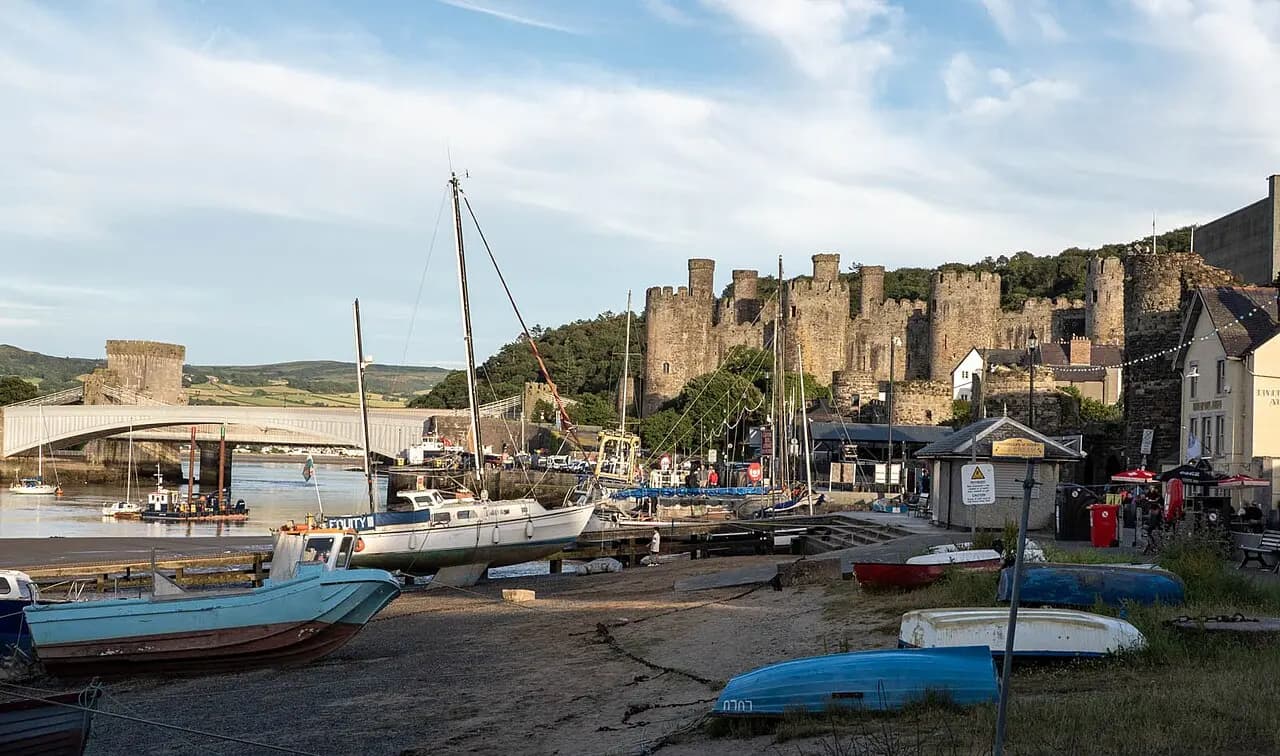
About Conwy
The history, geography, and character of Conwy.
Conwy is a walled medieval town on the west bank of Afon Conwy, at the point where the river narrows before it opens into the estuary and the Irish Sea. Its shape comes from a single decision in 1283: after the conquest of Gwynedd, Edward I moved the Cistercian community of Aberconwy Abbey up the valley to Maenan and put a castle and a walled borough on their ground. Castle and walls went up together between 1283 and 1287 under Master James of St George, and the ring has never been broken. What makes Conwy unusual is not the castle, which has three sisters at Beaumaris, Harlech and Caernarfon inside the same UNESCO inscription. It is that roughly 1.3km of curtain wall, 21 towers and three gateways still enclose a town where people live, shop and catch the bus. Conwy is the administrative centre of Conwy County Borough, a bilingual county where a quarter of residents speak Welsh, and the spelling on the signs changed from the English Conway to the Welsh Conwy in 1972.
History & Heritage
An abbey moved, a town imposed
Before the castle there was Aberconwy Abbey, a Cistercian house founded under the patronage of Llywelyn the Great, and it stood where the town stands. When Edward I took Gwynedd in 1282 and 1283 he did what medieval conquerors did with a strategic river crossing: he took it. The monks were relocated up the valley to Maenan, the site was cleared, and the castle and the walled borough were laid out as one integrated scheme. The parish church of St Mary and All Saints, in the middle of the town, still incorporates parts of the abbey church in its east and west walls, which means the oldest fabric inside the medieval town predates the medieval town by the better part of a century. That single fact is the whole of Conwy's history in one building: a Welsh foundation, an English imposition, and the two of them still standing in the same walls.
The ring that never broke
About 1.3km of wall, 21 surviving towers, three gateways, raised between 1283 and 1287. The figure usually quoted for the building programme is around £15,000, though sources differ on whether that covers the walls alone or the walls and the castle together, so treat it as the order of magnitude rather than an audited total. Most walled towns in Britain kept a gate and a fragment; Conwy kept the lot. Cadw manages the walls today, they are free, and they are open all year in daylight. Walking them is the fastest way to understand the town, because the wall does not follow the streets, the streets were laid out to fit inside the wall. Conservation is continuous and occasionally interrupts access: a short section between the Watch Tower and the Wing Gate is closed at the time of writing while Cadw installs stronger railings and protective mesh, with the reopening targeted for Easter 2027. There is no lighting on the rampart, no room to pass a dog, and Cadw's own warnings about falls from height, uneven stonework and low headroom are worth reading before you climb up.
Three bridges, a hundred and thirty years apart
Where the river narrows below the castle, three crossings sit in a row, and they are the reason engineers come to Conwy. Thomas Telford built the suspension bridge between 1822 and 1826 to carry the London to Holyhead mail road, with a span of 99.5 metres and towers deliberately castellated to answer the castle beside it. Robert Stephenson followed in 1849 with a wrought-iron tubular railway bridge, designed with William Fairbairn and Eaton Hodgkinson, and built as the proof of concept for the far larger Britannia Bridge over the Menai Strait; after the Britannia burned in 1970 and was rebuilt as a truss arch, Conwy became the only surviving Stephenson tubular bridge, and it is Grade I listed, a scheduled monument, and still carrying trains. Telford's bridge carried road traffic until 13 December 1958, the day the modern road bridge opened alongside; the National Trust has owned the suspension bridge since 1965 and it now carries walkers and cyclists. 2026 is its bicentenary, marked with a Telford 200 parade by Conwy Town Council on 27 July.
The quay, and an honest word about the mussels
Conwy Mussels are a Protected Designation of Origin name, granted in 2016. They are gathered by hand-raking the natural beds of the estuary from small shallow-draft boats known locally as dorys, with a 15 metre limit on boat length that keeps dredgers off the beds, and the skill has been carried by four families across more than 150 years. It is said to take five or six seasons to learn to rake properly. All of that is true and none of it means you can eat them right now. The Conwy Bay and estuary mussel fishery is closed to mussel fishing from 1 September 2025 to 31 August 2026 under a Welsh Government public notice, and a Welsh Government consultation running from 13 July to 11 August 2026 proposed extending that closure to 31 August 2027, citing the fishery's position inside the Menai Strait and Conwy Bay Special Area of Conservation and the Aber Afon Conwy Site of Special Scientific Interest, and scientific advice that gathering should be very limited and restricted. Responses were still under review on 17 August 2026. So the mussel shed is still on the quay, the tradition is real, and the season is not open. Anyone telling you otherwise has not checked.
A bilingual county, not a bilingual gesture
At the 2021 census, 25.9 per cent of Conwy County Borough residents aged three and over said they could speak Welsh, down from 27.4 per cent in 2011, roughly 1,600 fewer speakers. The figure is a county one and it flattens real variation: the coastal resort towns pull it down and the Conwy Valley pulls it up. What it means on the ground is that signage, council business and a fair share of shop conversation run in both languages by default, and that Welsh here is the working language of a lot of people's homes rather than a decoration on a road sign. Get the spellings right and you will be treated as someone who bothered. Conwy, not Conway, since the borough council changed the official spelling with effect from 1 August 1972. Afon Conwy for the river. Popty for the bakery on Castle Street, because that is simply what a bakery is called. Mynydd y Dref, the mountain of the town, for the hill behind. Eryri for the national park, which the park authority has used exclusively in its logo since a decision in November 2024 and prioritises in all its communications, with Yr Wyddfa for the summit.
Where the town stops
The walled town is about ten minutes across, which is its charm in April and its problem in August. The relief is immediately to the west. Mynydd y Dref rises to 244 metres straight off the end of the streets, the northernmost outlier of the Carneddau, with heather and gorse, semi-wild ponies, and Castell Caer Seion on the top: an Iron Age hillfort and scheduled monument, unusual for having a smaller, more strongly defended fort built inside the larger enclosure. Beyond it the Sychnant Pass cuts through to Dwygyfylchi and Penmaenmawr, the route the mail coaches took at high tide before the railway came along the coast. An hour's climb from the quay puts the whole thing below you: the estuary, the three bridges, the Great Orme, Anglesey, and the Carneddau stacking up to the south. It is free, it takes half a day, and almost nobody who comes for the castle does it.
Wildlife & Nature
Marine Life
Conwy mussels
The natural mussel beds of the Conwy estuary, worked by hand-raking from small boats and carrying a Protected Designation of Origin name since 2016. The beds sit inside the Menai Strait and Conwy Bay Special Area of Conservation and the Aber Afon Conwy Site of Special Scientific Interest, and the fishery is currently closed to mussel fishing under a Welsh Government notice.
The beds are visible from the quay and from boat trips at low water year-round. Note the fishery closure before assuming a gathering season.
Estuary mudflats and saltmarsh
The Conwy estuary drains to wide mudflats and saltmarsh twice a day, which is what feeds the wader flocks and what makes the tide the governing fact of the quay. The mud is soft and the tide comes in fast; the flats are for looking at, not walking on.
Low water, which shifts through the day. The mud is at its most striking on a clear winter afternoon.
Mammals
Conwy ponies
Semi-wild ponies graze the open ground on Mynydd y Dref and are also used as conservation grazers on the grassland at RSPB Conwy, where they are known as the Conwy ponies. They are working animals rather than an attraction: keep dogs under close control and do not approach or feed them.
Year-round on the open hill
Birdlife
Waders and waterbirds
The lagoons at RSPB Conwy, across the estuary at Llandudno Junction, hold waders and waterbirds especially from August to March. Species logged at the reserve include black-tailed godwit, greenshank, dunlin, common sandpiper and green sandpiper, with curlew and redshank roosting on the islands and wigeon grazing.
August to March, with the estuary at its busiest through the winter
Starling murmuration
Tens of thousands of starlings roost in the reedbeds at RSPB Conwy in winter, and the murmuration over the reeds before they drop in is the reserve's single best spectacle. Free to watch from the reserve, and worth timing an afternoon around.
Winter, in the last half hour before dusk
Reed warblers
Summer visitors to the reedbeds at RSPB Conwy, heard far more often than seen. Water rails are present at the reserve year-round, along with Mediterranean gulls and hobbies.
Summer
Flora
Orchids
The grassland and temporary pools at RSPB Conwy carry orchids in early summer, including bee orchid and the rare coccinea form of early marsh-orchid.
Early summer
Heather, gorse and bracken on Mynydd y Dref
The open ridge behind the town is heathland: heather, gorse and bracken over rocky ground, with the bracken turning rust-coloured through October, which is when the hill photographs best.
Gorse from late winter, heather in late summer, bracken colour in October