Wicklow Town: what it is, and what it is not
A county town with a working harbour, a gaol on the hill and no hotel in the centre. What Wicklow offers that Bray, Greystones and Glendalough do not, and the practical things that catch visitors out.
Four places on the same short stretch of the Wicklow coast get recommended to visitors, and they are not interchangeable. Bray has a Victorian promenade, an amusement arcade and a cliff walk to Greystones. Greystones has a marina, a run of good restaurants and a commuter train that gets you to Dublin in forty minutes. Glendalough, inland, has a sixth-century monastic city in a glacial valley and the coach traffic to match. Wicklow Town, the county town, has none of those things, and working out what it does have instead is the difference between a good day here and a puzzled one.
What Wicklow actually is
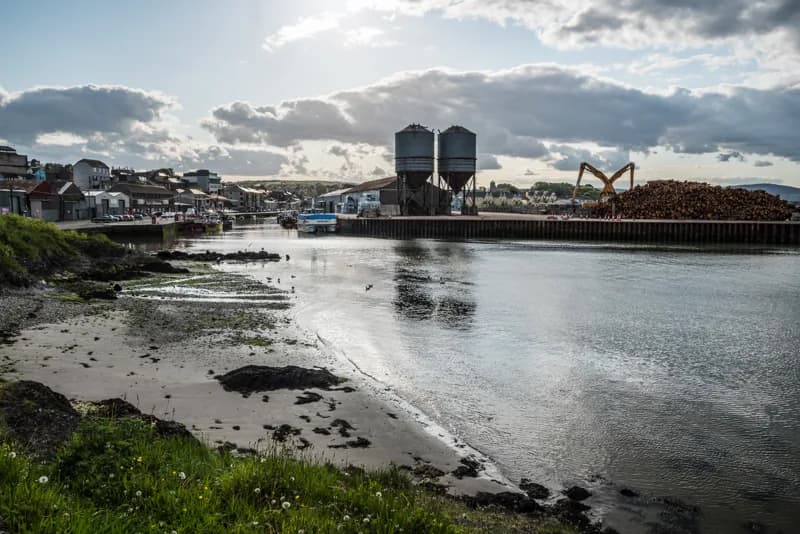
It is a working county town of just under thirteen thousand people at the 2022 census, built around a small commercial harbour at the mouth of the River Vartry. The harbour still handles timber and aggregate and still ties up a fishing fleet, and the quays carry cranes and stacked pine logs alongside the sailing club and the lifeboat station. Wicklow County Council has its offices here at Whitegates. There is a Tesco on the edge of town and a SuperValu with the post office in it on Church Street. This is a place that works for a living and happens to have a spectacular coastline attached to it, rather than a place built to be visited.
That produces some genuinely good things. Nothing on the coast costs money. The Black Castle, the Norman ruin on the promontory above the harbour mouth, has no gate, no ticket and no interpretation panels. The East Pier is a public walk through an operating port. The Murrough, the long shingle and grass strip running north between the sea and Broad Lough, is free and level and goes on for kilometres. The cliff path south of the town costs nothing and has a free car park with about sixty spaces at the trailhead.
What it does not have
There is no hotel in the town centre. That is not an oversight in our listings, it is the situation: the options are a pub with rooms at the bridge, a small number of B and Bs, and the country houses out at Rathnew, about three kilometres northwest, which are lovely and are not walkable from a restaurant. The Bridge Tavern is the answer if you want to stay in the middle of things.
There is also no DART. The DART terminates at Greystones, about twenty kilometres north, and it does not continue here. Wicklow does have its own railway station on the Dublin Connolly to Rosslare Europort line, and it is on the South Eastern Commuter route that runs to Gorey, but the frequency is nothing like a Dublin suburban service: roughly six weekday trains toward Dublin Connolly and about four toward Rosslare, with a thinner weekend timetable. Miss one and you may be waiting hours.
And the station is not where you expect. It sits up on Station Road on the high ground northwest of the town, about 1.6 kilometres from Market Square by road, which is a twenty to twenty-five minute walk with a hill in it. With a day bag that is a pleasant arrival. With luggage, book a taxi. Wicklow Kabs and Sixty Six One Hundred Cabs both work the town.
The other gap, at the time of writing, is indoor. Wicklow's Historic Gaol on Kilmantin Hill is the town's flagship attraction and it has been closed since 26 September 2025 while the council carries out repairs and hands over to a new operator. East Coast FM reported in July 2026 that Coredate Limited had been approved, with a summer 2026 reopening in view, but that did not happen: in late September 2026 the official site still said only 'Reopening soon', with no date. If your plan for a wet afternoon is the gaol, check first and have a second plan.
How to think about a visit
Treat Wicklow as a coast town with a town attached rather than the other way around. The strongest half day here is the quays, the East Pier and the Black Castle, followed by lunch on the South Quay. The strongest full day adds the Glen Beach Cliff Walk in the morning, which is about four kilometres and an hour and a half with roughly 110 metres of climbing, and the Murrough in the evening when the light goes long across the water.
If you want a monastic valley, Glendalough is about forty minutes inland and has its own page. If you want a promenade and a funfair, Bray is up the coast. If you want dinner in a town with a dense restaurant scene, Greystones will serve you better. Wicklow is for people who would rather walk ten kilometres of coastline, eat a plate of fish looking at a working harbour, and not queue for anything.
The practical bits
Parking is cheap and slightly confusing. The main town and SuperValu car parks are 1.20 euro an hour Monday to Saturday with a two-hour maximum, which is fine for errands and useless for a day. The Murrough car park is fifty cent for the whole day and is the one to use. Manntains car park is 1.20 euro for the day. Sundays are free and there is a fifteen-minute grace period on street parking.
Opening days matter more than opening hours in a town this size. Phil's of Wicklow Town, trading on Fitzwilliam Square since 1861, is closed on Mondays and Tuesdays. The Firehouse Bakery on Abbey Street opens 8.30am to 4pm seven days, which makes it the reliable early stop. The Grey Dog on Leitrim Place runs 9am to 9pm every day, which makes it the reliable late one. Between those two you can eat at almost any hour, which is not something you can assume in an Irish town of this size.
Keep Reading
Walking the Wicklow coast: the Murrough, Glen Beach and Wicklow Head
Two coastal walks either side of the town that could not be more different: a flat, exposed shingle strip running north, and a clifftop path south with grey seals below it.
Food & DrinkEating and drinking in Wicklow Town
A small, mostly independent scene: one harbour-front restaurant worth booking, a bakery worth crossing town for, a brewery named after a ship, and the pub that is shut on Mondays and Tuesdays.
Planning a trip?
Explore restaurants, activities, accommodation, and more.