About Wicklow Town
The history, geography, and character of Wicklow Town.
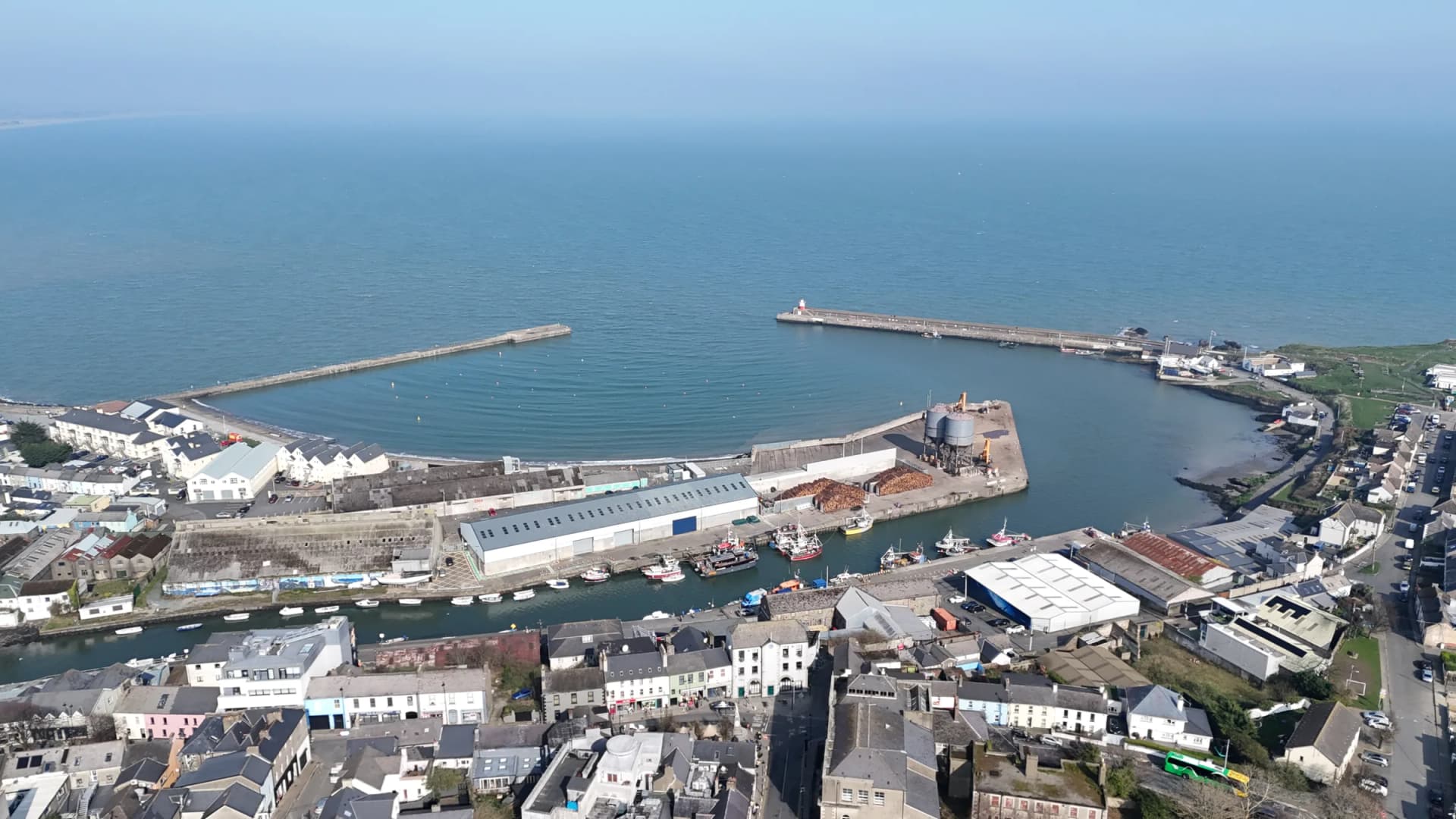
Wicklow Town, Cill Mhantain, is the county town of Co. Wicklow, built around one of the few natural harbours on a long and exposed stretch of the Irish Sea coast. It has a Norse name and an older Irish one, a Norman castle ruin on the headland above the harbour mouth, a Franciscan friary founded in 1252, a gaol on the hill that held prisoners into the twentieth century, and a port that still works. It is the seat of Wicklow County Council and had a population of 12,957 at the 2022 census. It is not a resort town and does not pretend to be one, which is the main thing that distinguishes it from Bray and Greystones up the coast.
History & Heritage
Two names, two peoples
The English name is Norse. Norse raiders established a base at Wicklow around the middle of the ninth century, taking advantage of the natural harbour, and the name is generally derived from vikingr, Viking, and lo, meadow, though the exact etymology is still argued over. The Irish name is older and tells a different story. Cill Mhantain means church of the toothless one. Local tradition holds that St Patrick and some followers tried to land at Travailahawk beach, on the south side of the harbour, and were driven off, one of them losing his teeth in the encounter. Manntach, the toothless one, came back later and founded a church. The council still lists Travalahawk among the bathing waters it monitors, which is a very Wicklow way for a saint's legend to survive: as a line in a water-quality report.
The castle, the friary and the gaol
After the Norman arrival in 1169 Maurice FitzGerald was granted land here and built the fortress on the promontory above the harbour mouth that is still called the Black Castle. What survives is fragmentary, two broken sections of rubble masonry on bare rock, and it is free and unfenced. A Franciscan friary was founded in the town in 1252 and its ruins stand in the Abbey Grounds, which were listed as closed for renovation at the time of writing. The third of the town's stone landmarks is the county gaol on Kilmantin Hill, in use from the eighteenth century until 1924 and later restored as a museum covering the 1798 rebellion, transportation to Australia, the Famine years and the War of Independence. It has been closed since September 2025 for repairs and a change of operator.
Captain Halpin and the cable
Robert Charles Halpin was born in Wicklow in 1836, the youngest of a large family, above his parents' dockside tavern at the bridge, the Bridge House. He went to sea at eleven and by 1865 was chief officer of Brunel's Great Eastern, the largest ship in the world, during the attempts to lay a telegraph cable across the Atlantic. The 1866 crossing succeeded, and Halpin went on to command the ship, laying something in the order of 26,000 miles of submarine cable linking Europe with America, Asia and Australia. He retired to build Tinakilly House outside Rathnew, which is now a hotel, and died in 1897. There is a monument to him in the town and a Celtic cross on his grave in the local cemetery, and his name is on a cafe at the bridge, a bunkhouse, a suite at Tinakilly and a brewery on the South Quay.
Ninety-eight
Wicklow was deeply involved in the 1798 rebellion and the county became one of the last areas of sustained resistance afterwards. Billy Byrne of Ballymanus, a United Irishman, was tried and executed in the town, and the statue of him in Market Square is the monument people photograph without always knowing who he was. The gaol on the hill held rebels and, later, men and women transported to Australia. If you walk the town's heritage trail you move between these two histories constantly: the maritime one down at the water, the rebellion one up on the hill.
A harbour that still works
The harbour was substantially rebuilt through the 1880s and 1900s and has not changed shape much since. It handles timber, aggregate and a small fishing fleet, and the quays carry cranes and stacked logs alongside the sailing club and the lifeboat station. Wicklow RNLI has been on station since 1857, acquired Ireland's first motor lifeboat in 1911, and today operates the Shannon-class all-weather boat Bridie O'Shea and the D-class inshore Dennis-Audrey from the 1886 boathouse on the East Pier. Wicklow Sailing Club on the South Quay is the host club of the Round Ireland Yacht Race, a 704-nautical-mile offshore race run every second year since 1980. None of this is staged for visitors, which is precisely why it is worth walking.
The Murrough, the cliffs and the head
North of the harbour the Murrough runs for kilometres: a strip of shingle, grass and rock armour between the Irish Sea and the wet grassland and open water of Broad Lough, and one of the better places to watch birds on this coast. South of the town the ground rises into low cliffs, and a path runs along them past Glen Beach and Lime Kiln Bay to Bride's Head, with grey seals hauled out on the rocks below from roughly August to April. Beyond that is Wicklow Head, the easternmost point of the Republic of Ireland, carrying three lighthouse towers: two built in 1781, deliberately paired so mariners could not confuse Wicklow with Howth Head or Hook Head, and the 1818 tower that is still the working light. The 1781 octagonal tower was gutted by lightning in 1836 and is now let as self-catering accommodation.
What is lifeguarded and what is not
This is worth stating plainly because visitors get it wrong. Wicklow County Council's bathing season runs from 1 June to 15 September. Within that season the council provides lifeguards at Wicklow Harbour, Brittas Bay North, Brittas Bay South, Greystones South, Bray Promenade and Arklow. It does not provide lifeguards at Silver Strand or on the Murrough, both of which people swim at regularly. Blue Flags in Co. Wicklow for 2026 went to Brittas Bay North, Brittas Bay South and Greystones South. Silver Strand is monitored as an identified bathing water but is not lifeguarded and is not a Blue Flag beach, and the Murrough and the Wicklow Harbour bathing area are monitored as non-identified bathing waters. Outside the season, nothing on this coast is supervised.
Wildlife & Nature
Marine Life
Grey seals
Grey seals haul out on the rocks below the cliffs between Glen Beach and Wicklow Head and are usually audible before they are visible. They are also seen from the boat trips that run out along the coast. Watch from the clifftop path, do not climb down to them, and keep dogs on a lead: a pup disturbed by people or dogs can be abandoned by its mother.
Roughly August through to April
Birdlife
Broad Lough and Murrough waterbirds
The wetland behind the Murrough shingle, the largest of its kind on this coast according to the town's own tourism site, holds wintering waterbirds and waders in numbers, with the walking path running along the seaward side of it. It is the reason the Murrough is described locally as a birdwatcher's site rather than just a beach walk.
Autumn and winter for wintering waterbirds
Cliff seabirds south of the town
The low cliffs between Glen Beach and Wicklow Head carry nesting and roosting seabirds, best seen from the clifftop path or from the water on a coastal boat trip.
Late spring and summer for breeding activity