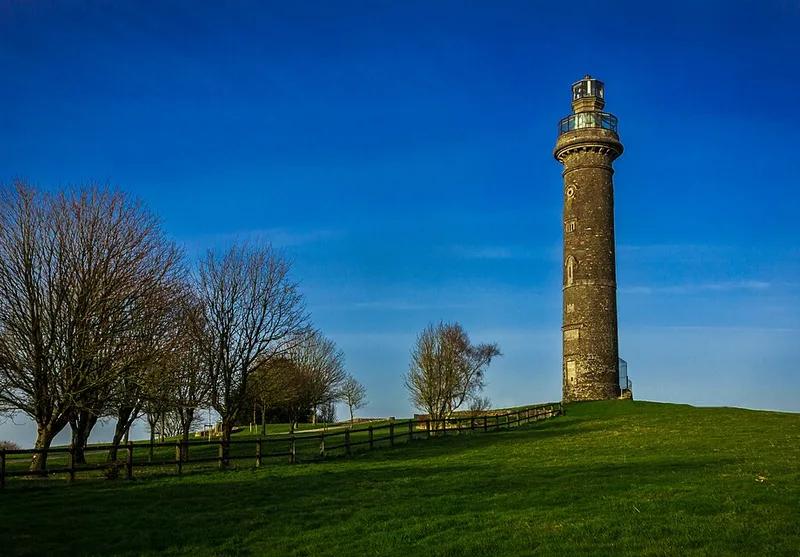
The Spire of Lloyd: a lighthouse a long way from the sea
The 1791 inland lighthouse on the Hill of Lloyd outside Kells, Co. Meath: its Headfort history, the hillfort under it, the famine graveyard in the People's Park, and how the Friday summer tours up the 164 steps work.
Two kilometres west of Kells on the R163, on the top of a green hill, stands a lighthouse. It has a lantern, a stone column and a door, and it is a long way from any sea. The signs call it the Spire of Lloyd. A good many people in Kells still say the Tower of Lloyd, and you will hear both.
Why there is a lighthouse on a hill in Meath
The tourist office's account is that it was designed by Henry Aaron Baker, the architect of the King's Inns in Dublin, for Thomas Taylour, first Earl of Bective, in memory of his father, and built in 1791. A plaque on it names Baker, the stone cutter Joseph Beck, the head mason Owen McCabe and the overseer Bartle Reilly. It gave work during a local famine, and it was meant to be seen: a column visible for miles was a statement of how much land and power the Headfort family held. It is also said to have been used to watch horse racing and the hunt in the nineteenth century, though the tourist office notes that the Kells racecourse was only built later.
On the east side is a plaque with the Headfort coat of arms and the family motto, which the tourist office translates as he follows what he seeks.
The hill is much older than the tower
The spire stands on an Iron Age ringfort, and the tourist office's notes say geophysical survey has found concentric ditches round the summit, a large hillfort that may reach back to the Bronze Age. The old name was Mullach Aiti, which became Mulloyde and then Lloyd. The hillfort guarded the way from the kingdom of Bréifne in Cavan into Meath. In the Táin, Queen Medb is said to have camped here on the way north for the Brown Bull of Cooley, and Edward Bruce, brother of Robert the Bruce, camped here after his victory at the Battle of Kells, during his invasion of Ireland.
The People's Park and the famine graveyard
The ground round the tower is the People's Park, free and open, with a playground beside the car park. During the Great Famine destitute people lived on the hill, and the park includes a paupers' graveyard where many of the famine dead are buried. There is a memorial, and it is a quiet place in the corner of a cheerful one. The Ringfort and Blackwater River looped walk starts from here if you want to stretch the visit.
Going up: the Friday tours
Inside is a spiral stair of 164 steps with a protective cage round the centre, and the only way up is on a tour run by the Courthouse, the tourist office in Kells. The published pattern is three tours every Friday at 12 noon, 1.30 and 2.30 in the summer season. When this guide was written in November 2026 the listing said the tours were closed for the winter, so ring the Courthouse on 046 924 7508 to find out when they restart and whether you need to book. From the top the tourist office says you can see as far as the Mourne Mountains on a clear day.
Practical notes
- It is about 2 km from the centre of Kells on the R163. Most people drive; there is a free car park.
- The park is open any time, so you can see the outside on any day. The inside is tours only.
- The hill is exposed and windier than the town. Bring a layer.
- The stairs are steep and narrow inside a column. If you are unsure about tight spaces or heights, ask the Courthouse what to expect before you book.
Fitting it in
The spire and the town make a natural day: the monastic site and St Colmcille's House in the morning, the Friday noon tour, then lunch back in town. Outside the tour season, come up in the evening for the light on the hill and the view over north Meath, and leave the stairs for another summer.
Keep Reading
The Book of Kells is in Dublin. Here is what Kells itself has
What survives of Colmcille's monastery in Kells, Co. Meath: the round tower, the high crosses, St Colmcille's House and how to get it opened, the Market Cross and the Courthouse facsimile, with opening days and the round tower's conservation status.
History & CultureReading the high crosses of Kells
A close look at the four high crosses of Kells, Co. Meath: the Cross of Patrick and Columba, the broken West Cross, the unfinished East Cross and the Market Cross, and what is carved on them.
Planning a trip?
Explore restaurants, activities, accommodation, and more.