About Kells
The history, geography, and character of Kells.
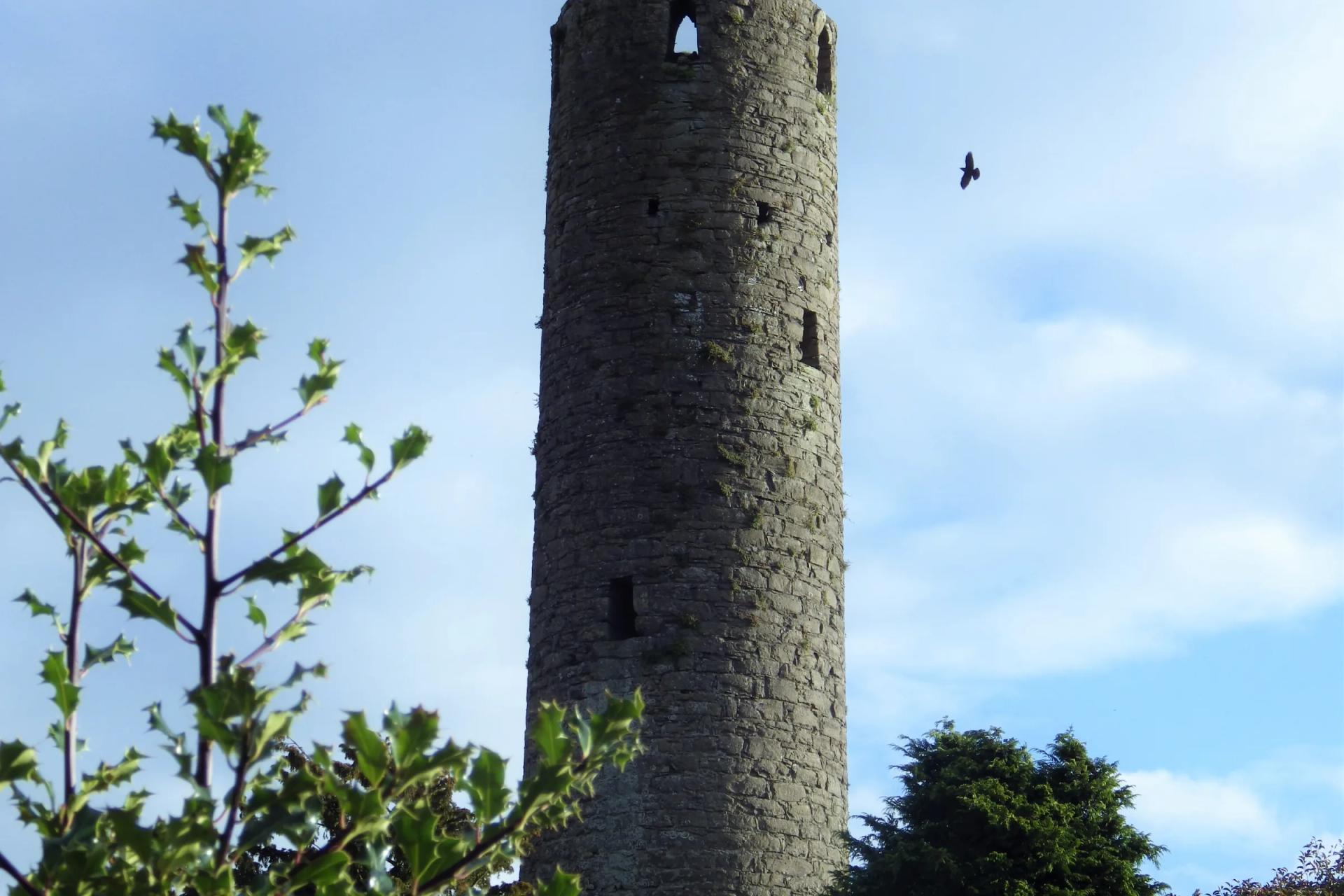
Kells is a market town in north Meath, on the high ground above the River Blackwater, and its name is the one the whole world knows from the Book of Kells. The book is not here. It is in Trinity College Dublin, and the town has a facsimile in the Courthouse and a long patience with visitors who ask. What is here is the monastery that kept it: a round tower, three high crosses in St Columba's churchyard, a fourth in front of the Courthouse, and St Colmcille's House, a stone-roofed church up a lane at the top of the town. In Irish the town is Ceanannas Mór, which the council translates as the great residence. Most people here say Colmcille rather than Columba, and the town is a working one: shops on Market Street and John Street, the Headfort Arms on Headfort Place, schools, and a bus roughly every hour to Dublin Airport.
History & Heritage
A royal seat, then a refuge from Iona
Meath County Council's heritage notes describe Kells as a royal residence before Christianity, linked in legend with Conn of the Hundred Battles and Cormac mac Airt, and Discover Boyne Valley suggests that seat was probably on the nearby Hill of Lloyd. Colmcille is said to have been granted the place for a church around the middle of the sixth century, by the high king Diarmuid, his cousin. The monastery grew in importance after 804, when the Columban community on Iona, raided by Viking fleets in 795, 802 and 804, was given land here as a refuge. The first church was finished by 814 and the relics of Colmcille were brought over from Iona in 878. For the next few centuries Kells was the head house of the Columban monasteries in Ireland, raided in its turn by the Vikings and later by Irish kings, and in 1076 a claimant to the high kingship was murdered in the round tower.
The book, and why it is in Dublin
The great illuminated gospels written around the year 800 take their name from the abbey here, where they were kept through the medieval period. Whether they were written at Kells, on Iona, or begun on one and finished on the other is still argued; the Discover Boyne Valley account puts the Iona raids and the move to Kells side by side and leaves the question open. The council's trail records that the book was kept in the porch of the great stone church built after a Norse raid of 920, and that it was stolen from there in 1007. It is now in Trinity College Dublin, and Kells has a facsimile on display in the Courthouse. The town also tells the story of the first copyright ruling, Colmcille's secret copy of the Latin Bible his teacher Finnian had brought back from Rome, and the high king's judgement: to every cow its calf, to every book its copy.
The Taylours, Headfort and the Georgian town
After the Cromwellian land settlement, Kells was sold by the soldier it was granted to and bought by Thomas Taylor, a surveyor who had worked on the Down Survey. The family took the title Headfort, an anglicised form of Ceanannas, and the council's heritage trail says they dominated the town for the next two centuries. Most of what is handsome in the centre is theirs. St Columba's Church was rebuilt in 1778 by Thomas Taylor, first Earl of Bective, to designs by Thomas Cooley, the architect of Dublin's City Hall. The Courthouse on Headfort Place was built in 1801 to designs by Francis Johnston. The Spire of Lloyd on the hill west of the town went up in 1791. Headfort House, with interiors by Robert Adam, stands in the demesne on the east side of the town; the Taylours leased it to Headfort School in 1949, and it is not open as a visitor attraction.
Kells today
The centre is a tight knot of streets, Headfort Place, John Street, Market Street, Cannon Street, Castle Street and Farrell Street, and the way they curve round the churchyard still follows the line of the monastic enclosure. It is a bus town: the railway is long gone and the 109 and 109A run to Busáras and Dublin Airport. The council has put money into the place in recent years, most visibly the Kells Printing Works, opened on Church Lane in June 2026 in an old sawmill to house a local printing family's presses, and the Courthouse is now an arts and tourism hub with a gallery as well as the tourist office. Hinterland, the festival of literature and arts, takes the town over at the end of June, and the Samhain Festival of Food and Culture fills a weekend in early November.
Wildlife & Nature
Mammals
Badger, fox and hare
The route card for Girley Bog says all three cross the bog to feed. Early morning and late evening are the times to look.
Dawn and dusk
Birdlife
Snipe
On the open raised bog at Girley, about 7 km from the town, where the Discover Boyne Valley route card tells walkers to watch for it. A bird you usually see only as it bursts up from your feet.
Year round on the bog
Skylark
Singing high over the open bog at Girley in spring and summer, named on the route card alongside snipe.
Spring and early summer
Willow warbler, chiffchaff and blackcap
Summer visitors from Africa that breed in the birch and willow scrub round the cut-over edges of Girley Bog. You hear them long before you see them.
Late April to August
Flora
Great sundew
An insect-eating plant of the wettest parts of Girley Bog, which traps insects on its sticky leaves. One of the species the interpretive panels on the loop point out.
Summer
Bog mosses, ling heather and cottongrass
The living surface of the raised bog: cushions of sphagnum in several colours, ling heather on the drier ground, cross-leaved heath in the wet, and hare's-tail cottongrass. Raised bog is rare in the EU and becoming scarce in Ireland.
Late summer, when the heather flowers