The Book of Kells is in Dublin. Here is what Kells itself has
What survives of Colmcille's monastery in Kells, Co. Meath: the round tower, the high crosses, St Colmcille's House and how to get it opened, the Market Cross and the Courthouse facsimile, with opening days and the round tower's conservation status.
Start with the disappointment and get it out of the way. The Book of Kells is not in Kells. It is in Trinity College Dublin, an hour and a half away on the 109, and the town has a facsimile of it in the Courthouse on Headfort Place. People in Kells have been asked where the book is more times than they can count, and the honest answer they give is the useful one: come for the monastery it was kept in, because most of that is still standing, in the middle of a working town, and almost none of it costs anything.
Why the book has this town's name
Colmcille is said to have founded a church here in the sixth century, but Kells came into its own after 804, when the Columban community on Iona, raided by Viking fleets in 795, 802 and again in 804, was given land at Kells as a refuge. The first church was finished by 814, and the relics of Colmcille came over from Iona in 878. The gospel book written around 800 was kept here through the medieval period, which is where the name comes from, though whether it was written in Kells, on Iona or in both is an argument nobody has settled. Meath County Council's trail notes say it was kept in the porch of the stone church and was stolen from there in 1007.
The churchyard: tower and crosses
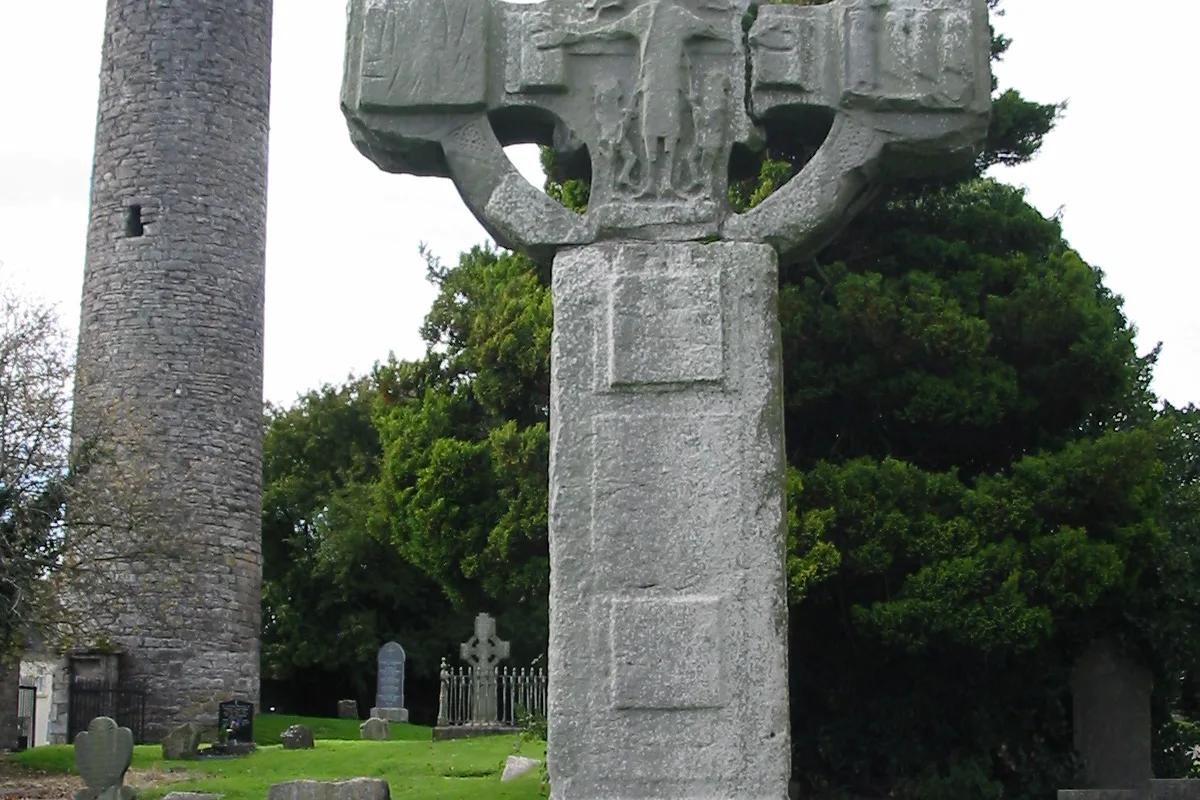
The monastic core is the churchyard of St Columba's, the Church of Ireland church at the top of Cannon Street, rebuilt in 1778 on the site of the monastery. The round tower stands by the churchyard wall. It is roofless, its doorway is well above the old ground level, and it has five windows at the top rather than the usual four, which the council's notes say look out over the five roads into the town. It has no stairs and you cannot go up it.
Three high crosses stand in the churchyard. The South Cross, nearest the tower, is the Cross of Patrick and Columba, and it is the one to spend time on: the OPW lists Adam and Eve, Cain and Abel, Daniel in the lions' den and David with his harp among its carvings, with the crucifixion on the west face. The West Cross is a broken shaft, still richly carved. The East Cross was blocked out and never finished, which makes it oddly instructive: you can see how a cross was roughed out before the carvers began. The base of another cross is behind the church's medieval bell tower.
One thing to check before you travel. The OPW conserved the round tower under scaffolding from early 2024; the work was delayed by storm damage to the scaffolding and was due to finish in September 2026, and completion was reported at the start of November 2026. The OPW's heritageireland.ie listing still says the site is closed for conservation works, so treat it as closed until that page changes, and look at it on the day you go.
St Colmcille's House: how to get in
Up Church Lane from the churchyard, at the highest point of the old town, is St Colmcille's House, a small stone church with a roof so steep it is nearly a pyramid. Meath County Council calls it possibly the oldest surviving building in Kells. Tradition has it that Colmcille's relics were kept in it. It is locked. The Courthouse opens it for visitors subject to availability and asks for 24 hours' notice, by phone on 046 924 7508 or by email. Ring the day before. If you turn up on spec you will see the outside, which is still worth the climb.
The Courthouse and the Market Cross
The Courthouse on Headfort Place, designed by Francis Johnston and built in 1801, is the tourist office and a free exhibition: the Book of Kells facsimile, a replica of the Kells Crozier, a model of the town and touch screens on the monastery and the Headfort family. The Toradh 2 gallery shows changing exhibitions in the same building. It is open Monday to Friday from 9am to 5pm and Saturday from 9am to 4pm, closed from 1.30 to 2pm for lunch, and closed on Sundays. Outside, under a glass canopy, stands the Market Cross, a ninth-century cross that stood at the crossroads in the town for centuries. Its base carries an inscription of 1688, and the council's notes record a local tradition that it was used for hangings after the 1798 rising.
Putting it together
All of this is within a few hundred metres. Do the Courthouse first, because it is where you collect the trail map and confirm St Colmcille's House, then walk up through the town to the churchyard and Church Lane. Allow two hours without hurrying. A Sunday works for the churchyard and the crosses, but the Courthouse is shut, and so the house will be too unless you arranged it before the weekend. The volunteer Walk-About Tours, free and booked through the Courthouse, cover the same ground with someone local pointing out where the monastic enclosure still runs in the streets.
Getting here
There is no railway station in Kells. Bus Éireann's 109 runs from Busáras and the 109A from Dublin Airport, both through Navan, and both stop in the centre. By car it is the M3 to exit 10. Check the Bus Éireann timetable for the day you travel, because weekend and holiday services differ.
And if you came for the book itself, go to Trinity afterwards. Having stood in the churchyard it came from, you will look at it differently.
Keep Reading
Reading the high crosses of Kells
A close look at the four high crosses of Kells, Co. Meath: the Cross of Patrick and Columba, the broken West Cross, the unfinished East Cross and the Market Cross, and what is carved on them.
WalkingWalking the Kells Historic Trail
A step-by-step walk round the monastic and Georgian town of Kells, Co. Meath, from the Courthouse and Market Cross through the churchyard to St Colmcille's House and the Printing Works, about 1.5 km and an hour.
Planning a trip?
Explore restaurants, activities, accommodation, and more.