Reading the high crosses of Kells
A close look at the four high crosses of Kells, Co. Meath: the Cross of Patrick and Columba, the broken West Cross, the unfinished East Cross and the Market Cross, and what is carved on them.
Ask how many high crosses Kells has and you will get two answers, both defensible. The OPW counts five within the old monastic settlement. Discover Ireland says four survive with the base of a fifth still in St Columba's churchyard. The difference is a stump behind the church's medieval bell tower, which is a base and nothing more. Four are worth your time, three in the churchyard and one on Headfort Place, and each of them teaches you something different.
What a high cross was for
Meath County Council's trail notes put it simply: the crosses were mainly for religious instruction, with scenes from the Old and New Testaments carved on their faces, and they may once have been painted. Think of them as stone sermons set up in the open for people who could not read. Some also marked boundaries. The Market Cross is described as a termon cross, standing at the gate of the monastery, inside which a fugitive could claim sanctuary.
The South Cross: the Cross of Patrick and Columba
This is the one nearest the round tower and the one to give real time to. The highcrosses.org survey dates it to the early ninth century and gives its height as about 3.3 metres, cut from a single block of sandstone. An inscription on the base once read PATRICII ET COLUMBE CRUX, the cross of Patrick and Columba, though it has weathered past reading.
The OPW's description is the best guide to the faces. On the east side are Adam and Eve, Cain and Abel, the three children in the furnace and Daniel in the lions' den. The head has interlace with seven bosses at the crossing, the sacrifice of Isaac, the hermits Paul and Anthony, and David playing a harp. The west face has the crucifixion on the shaft and Christ in majesty on the head, and the ends of the arms show David killing a lion. Go in low afternoon light, when the sun comes across the faces at an angle and the figures stand out. At noon in flat light much of it disappears.
The West Cross, the broken one
Only the shaft survives, but it is still about 3.5 metres of sandstone and carved on every side. The high crosses survey describes the east face as scenes from the life of Christ and the west face as early scenes from the Bible, with ornament on the narrow sides. It is the cross that most rewards walking all the way round.
The East Cross, the unfinished one
The East Cross, north of the church, is the oddest of the set and in some ways the most useful. It was blocked out in stone and then abandoned, with little more than a crucifixion begun on the east face and only the lower part of the ring left. The OPW listing describes a long programme of scenes, from the baptism of Christ and the marriage feast at Cana to Noah's ark and Moses. Standing in front of it you can see the stages: the rough block, the planned panels, and the work stopped. The high crosses survey puts it at about 4.75 metres, the tallest of the group.
The Market Cross
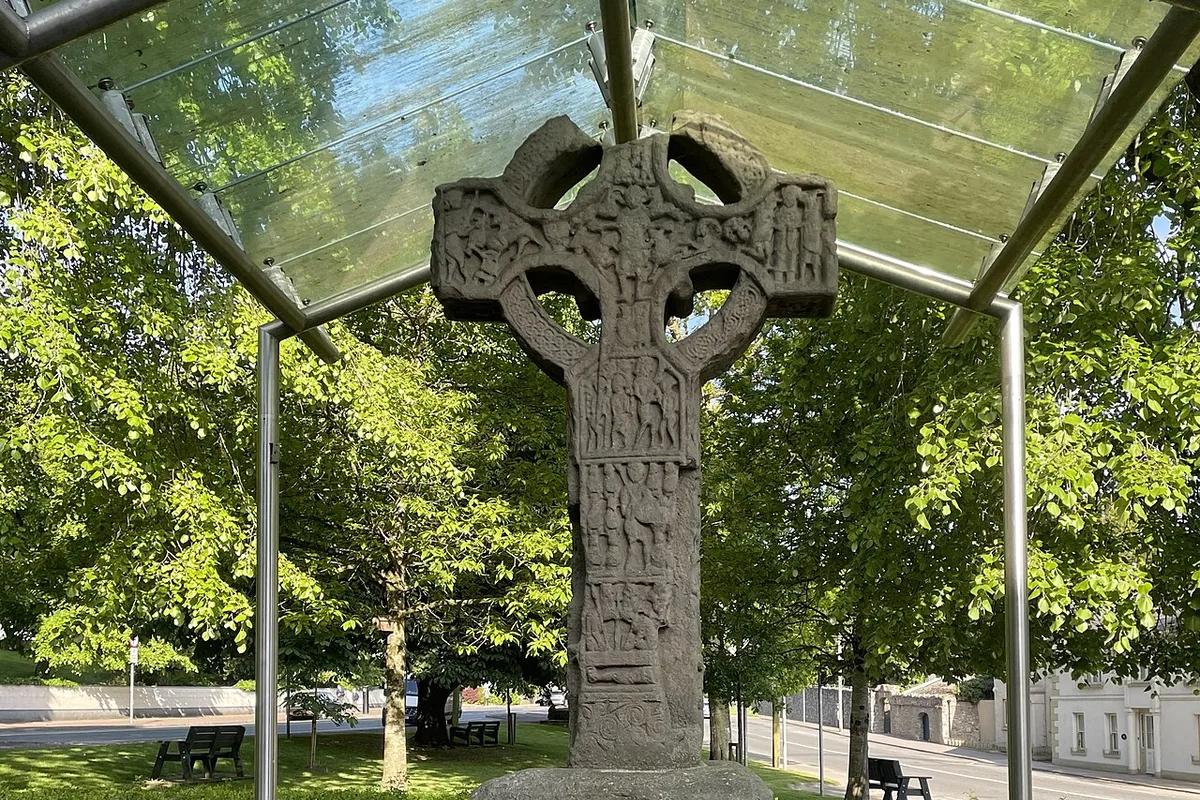
The fourth is not in the churchyard at all. The Market Cross stood for centuries at Cross Street in the middle of the town, and in 2001 it was re-erected in front of the Courthouse on Headfort Place under a clear roof to slow the weather. Council notes date it to the ninth century. The carving is badly worn, partly by time and, as the council's trail puts it, partly by damage attributed to Cromwell's army. Two things are easy to read. The base carries an inscription recording that the cross was set up again at the expense of Robert Balfe of Callierstown, sovereign of the corporation of Kells, in 1688. And the local tradition, which the council repeats as tradition, is that it was used as a gallows for rebels after 1798.
Looking after them
The crosses are sandstone and the stone is soft. Do not touch the carving, do not climb the bases, and keep children off them. The churchyard is a working graveyard, so treat it as one.
Seeing them all
The three churchyard crosses are a few metres apart in St Columba's churchyard at the top of Cannon Street, free to visit. The Market Cross is a ten-minute walk away on Headfort Place, outside the Courthouse, which is the tourist office and open six days a week. Inside the Courthouse is a model of the town that makes the layout of the monastery, and where each cross stood, much easier to picture before you go back out and look again.
Keep Reading
The Book of Kells is in Dublin. Here is what Kells itself has
What survives of Colmcille's monastery in Kells, Co. Meath: the round tower, the high crosses, St Colmcille's House and how to get it opened, the Market Cross and the Courthouse facsimile, with opening days and the round tower's conservation status.
WalkingWalking the Kells Historic Trail
A step-by-step walk round the monastic and Georgian town of Kells, Co. Meath, from the Courthouse and Market Cross through the churchyard to St Colmcille's House and the Printing Works, about 1.5 km and an hour.
Planning a trip?
Explore restaurants, activities, accommodation, and more.