About Glendalough
The history, geography, and character of Glendalough.
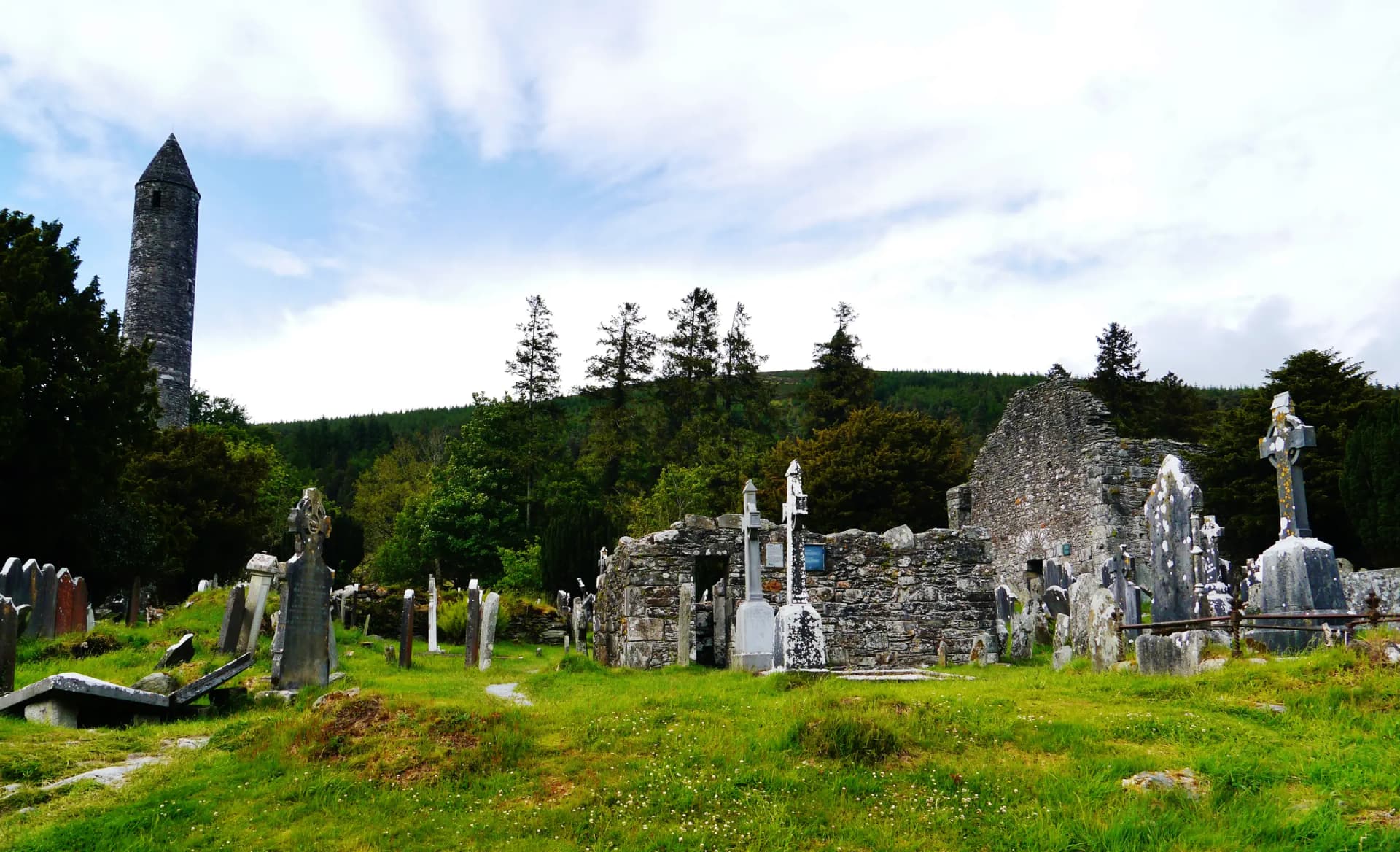
Glendalough, Gleann Dá Loch, the valley of the two lakes, is a glacially carved valley in the Wicklow Mountains where St Kevin founded a monastery in the 6th century. What grew up around it survived for around six hundred years as a working monastic city, a genuine centre of learning and pilgrimage, and much of it still stands today: a round tower close to thirty metres tall, a roofed cathedral, several stone churches, high crosses and a graveyard, spread around the shore of the Lower Lake, with the wilder Upper Lake a short walk further into the valley beneath the cliffs of Camaderry and Lugduff. There is no town at the monastic site itself; the village of Laragh, with its restaurants, pubs and places to stay, is a short walk or drive down the road, and Glendalough today is both one of Ireland's most-visited heritage sites and the main gateway to Wicklow Mountains National Park.
History & Heritage
St Kevin and the monastic city
St Kevin, reputedly born around 498, was ordained by Bishop Lugidus and, seeking a remote retreat away from his followers, settled in the Glendalough valley, where the mountain streams meet, to found a monastery in the 6th century. He died around 618, was canonised in 1902, and his feast day is 3 June. The monastery he founded grew into a genuine monastic city over the centuries that followed, with the surviving buildings, the round tower, the cathedral and the smaller churches, mostly dating from the 10th to 12th centuries. It flourished as a centre of learning and pilgrimage until English forces destroyed the settlement in 1398, after which it declined. The best-known story attached to St Kevin, retold in Seamus Heaney's poem St Kevin and the Blackbird, describes him holding out his hand in prayer with such stillness that a blackbird nested in it, laid her eggs, and raised her chicks before he moved.
The round tower and the surviving ruins
The round tower at Glendalough stands close to thirty metres tall, with its entrance set 3.5 metres above ground level, a defensive feature typical of Irish round towers, and four storeys above it, each lit by a small window. Around it stand a roofed cathedral, several smaller stone churches including St Kevin's Kitchen, named for its kitchen-like round belfry rather than any literal kitchen use, decorated high crosses, and a gateway with granite arches, the only surviving example of its kind at an Irish monastic site. St Kevin's Bed, a small cave carved into the rock face above the Upper Lake, is where the saint is said to have retreated to pray. The graveyard around the ruins is still occasionally used today, a reminder that this is a living site rather than only a museum piece.
The two lakes and the glacial valley
Glendalough's name records its geography exactly: Gleann Dá Loch, the valley of the two lakes. Both lakes sit in a glacially carved valley formed during the last ice age, ringed by Camaderry, Conavalla and Lugduff. The Lower Lake sits closest to the monastic ruins, reached easily on the flat Green Road; the Upper Lake, further into the valley, was originally one larger lake before the delta of the Poulanass River divided it, and it is here that the valley's wilder character shows, with the Spinc boardwalk climbing the cliff on its southern side and the Glenealo Valley running on beyond it toward the old lead and zinc mine workings, worked on and off between 1825 and 1957.
Gateway to Wicklow Mountains National Park
Glendalough is the main entry point to Wicklow Mountains National Park, a protected area of close to 23,000 hectares stretching south from the edge of Dublin, and the park's Information Office sits beside the Upper Lake. Nine colour-coded walking trails begin from Glendalough, ranging from the easy, flat Green Road to the strenuous Spinc and Glenealo Valley loop, and entry to the park itself is free, with only the car parks charging a fee. The valley is also one of Ireland's most-visited heritage attractions and a standard half-day trip from Dublin, so both the visitor centre and Upper Lake car parks fill by mid-morning on a good-weather day, particularly through the summer coach season.
Wildlife & Nature
Birdlife
Peregrine falcon
The peregrine falcon is the symbol of Wicklow Mountains National Park and nests on the cliffs above the Upper Lake, where its progress is monitored annually by park rangers. It is one of the fastest birds in the world in its hunting dive and a genuine highlight for anyone walking the Spinc with binoculars.
Spring and summer, on the cliffs above the Upper Lake, best viewed from the Spinc boardwalk
Red grouse
Red grouse depend on the heather moorland of the higher Wicklow Mountains and are on Ireland's red list of conservation concern, meaning a sighting on the higher trails is a genuinely notable one rather than a common occurrence.
Year-round on the heather moorland above the valley, most visible in early morning
Flora
Native sessile oak woodland
The lower slopes of the valley, particularly around the Lower Lake and the Poulanass Waterfall path, carry mature native sessile oak woodland, some of it 100 to 120 years old, one of the best-preserved stretches of this habitat type in the Wicklow Mountains National Park.
Spring for bluebells and fresh growth under the canopy, autumn for the turning leaves