About Doolin
The history, geography, and character of Doolin.
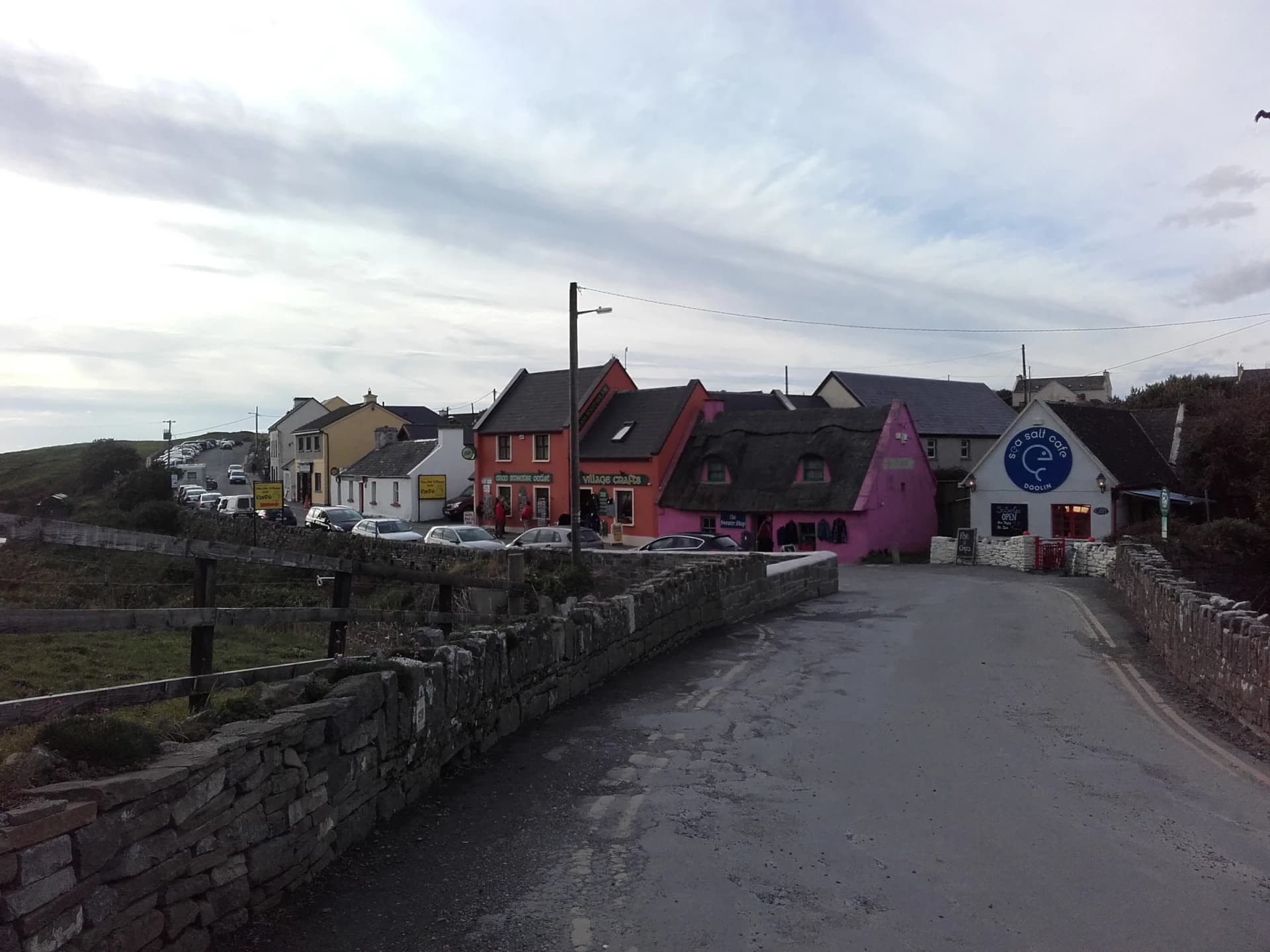
Doolin is a small village on the Atlantic coast of north County Clare, on the south-western edge of the Burren, a few miles up from the Cliffs of Moher. It is famous out of all proportion to its size as a home of Irish traditional music, played in its pubs every night of the year, and it serves as a gateway to the Cliffs of Moher and as one of only three mainland ports for the Aran Islands. It is not a tidy village with a centre but a scatter of linked sections strung along a coast road, and that, along with the music and the wild light off the ocean, is its character.
History & Heritage
A home of Irish traditional music
Doolin's reputation rests on its music. County Clare is the heartland of Irish traditional music, and Doolin is widely regarded as its home, with sessions played in the village pubs every night of the year. The tradition was carried to a worldwide audience in the second half of the twentieth century by the three Russell brothers, Micho, Packie and Gussie, who were born up the hill at Doonagore. Micho Russell, a master of the tin whistle and flute, became one of the best-known traditional musicians in Ireland before his death in 1994, and the village keeps the brothers' memory each February with the Russell Memorial Weekend. Other notable musicians associated with Doolin include Sharon Shannon and Davy Spillane. The music draws players and listeners from all over the world, and while the summer pubs are busy with visitors, the sessions in the quieter months remain a genuine local tradition rather than a performance.
The cliffs, the pier and the islands
Doolin is the closest village to the Cliffs of Moher, about 7 km up the coast, and the cliffs can be reached on foot along a clifftop path, by a short drive to the visitor centre, or seen from the water on a cliff cruise. The cruise and the Aran Islands ferries both leave from Doolin Pier, a working harbour a short way out from the village. Doolin is one of only three mainland departure points for the Aran Islands, the others being Galway city and Rossaveal, and the closest island, Inis Oirr, is about fifteen minutes across. The pier and the boats are seasonal, running roughly from late February to early November, so the village's life on the water has a clear summer rhythm and a quiet winter.
On the edge of the Burren
Doolin sits on the south-western corner of the Burren, the karst limestone landscape that covers much of north Clare, recognised as a UNESCO Global Geopark. The Burren is a country of bare grey limestone pavement, glacial erratics and an unusual flora, where Arctic, Alpine and Mediterranean plants grow side by side on the rock, with the gentians and orchids best from late spring. Doolin Pier itself is a designated geosite where the Ice Age history of the landscape is written in the stone. The Burren Way long-distance walking trail runs through the village, and the limestone country, the Great Stalactite at nearby Doolin Cave, and the wider Burren attractions of Poulnabrone Dolmen, Caherconnell and the Burren National Park are all within reach.
A scattered village
Doolin has no town square and no defined centre. It is made up of several linked sections strung along the coast road, each a short walk or drive from the next: Fisher Street near the harbour, with Gus O'Connor's pub; Roadford a little inland, with McGann's and McDermott's; Fitz's Cross, where Hotel Doolin sits and the road branches for Lisdoonvarna; and Doolin Pier on the coast. Almost everything a visitor comes for is within this loose cluster. The village has very limited services of its own, with no bank, pharmacy or Garda station, so most practical needs are met in nearby Lisdoonvarna, about 6 km away, or in Ennistymon and Ennis.
Wildlife & Nature
Marine Life
Seabirds and puffins
The sea cliffs and stacks along this coast, including An Branan Mor off the Cliffs of Moher, hold large seabird colonies. Puffins nest here in the breeding season and are a highlight of the cliff cruise in late spring and early summer, along with guillemots, razorbills and kittiwakes.
Late spring and early summer, from the cliff cruise
Burren wildflowers
The Burren is famous for its flora: Arctic, Alpine and Mediterranean plants growing together on the bare limestone, including spring gentians and several orchids. They are at their best from late April through the early summer on the limestone pavement around Doolin and inland.
Late April to June