About Donegal Town
The history, geography, and character of Donegal Town.
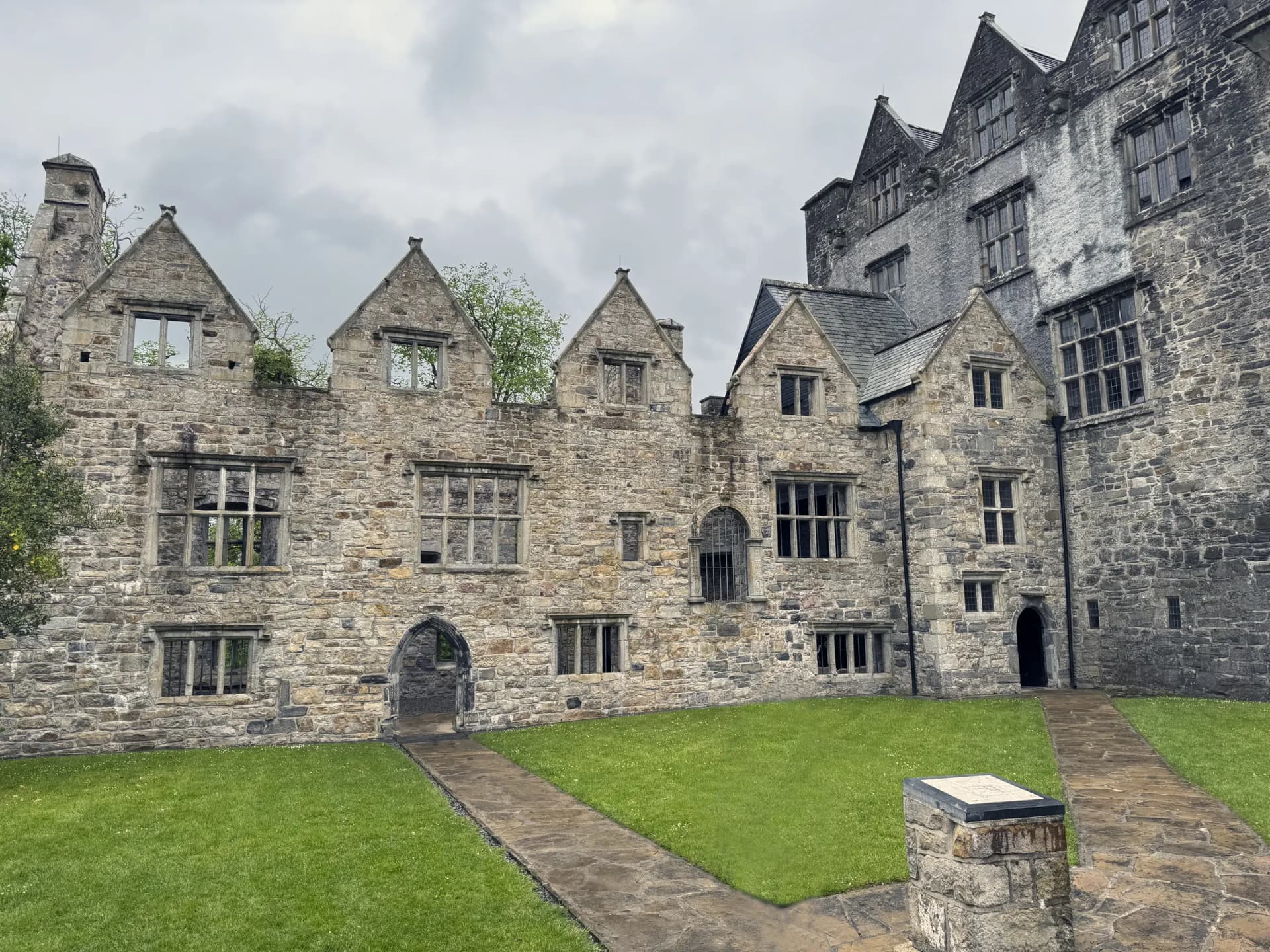
Donegal Town stands at the tidal head of Donegal Bay in the north-west of Ireland, where the River Eske meets the sea and the county town takes its name from the same Irish root, Dun na nGall, fort of the foreigners, a reference to Viking traders recorded in the bay from around the ninth century. It grew up twice over: first as the O'Donnell clan's stronghold around their castle, built around 1474, and then as a formal plantation market town, laid out around the Diamond after the O'Donnells lost the castle following the Flight of the Earls in 1607. Today it is best known for the restored castle, the Diamond's monument to the Four Masters, tweed and craft shopping, and its role as the road junction where routes toward Sligo and Derry meet the coast road out to Killybegs, Kilcar and Slieve League.
History & Heritage
Dun na nGall: a harbour town before it was a market town
The Irish name Dun na nGall, meaning fort of the foreigners, is the source of both the town's name and the county's, and it points to a harbour that outsiders were using long before the O'Donnells built their castle. The Annals of Tirconaill record Viking activity in Donegal Bay from around 807, and the town's position at the tidal mouth of the River Eske made it a natural landing point for centuries of seaborne trade. That harbour function is still visible today at the Quay, where the Donegal Bay Waterbus now departs for its tours of the bay.
The O'Donnells, the castle and the Flight of the Earls
The O'Donnell clan controlled a large part of Ulster from Donegal Castle, built at the water's edge around 1474, and traded directly with Spanish, French and papal contacts, earning a continental reputation as maritime traders. That era ended with the Flight of the Earls in 1607, when the Gaelic lords left Ireland for the continent and Sir Basil Brooke took over the castle, adding a Jacobean manor house and an ornate chimney-piece. The castle fell into ruin over the following centuries before a restoration in the 1990s, and it is now managed by the Office of Public Works, open to visitors with a spiral stairwell, a wooden-roofed hall and information panels on its full history.
The Diamond and the Annals of the Four Masters
After 1607, Sir Basil Brooke rebuilt Donegal as a plantation market town, laying out the Diamond, the pedestrian square that still forms the centre of the town today, in the same style as other Ulster plantation towns like Clones and Enniskillen. At its centre stands a freestanding sandstone obelisk, erected in 1934 and unveiled in 1938, commemorating four Franciscan scholars, Micheal O Cleirigh, Cu Choigcriche O Cleirigh, Cu Choigcriche O Duibhgeannain and Fearfeasa O Maolchonaire, who compiled the Annals of the Four Masters in the ruins of Donegal Abbey between 1632 and 1636, still one of the most-cited chronicles of early and medieval Irish history.
A road junction and a base for the north-west
Donegal Town sits where the N15, running between Sligo and Derry, meets the N56, the road that follows the coast out toward Killybegs, Kilcar and Slieve League, and it functions today as much as a gateway as a destination in its own right. That position, combined with a walkable historic core, tweed and craft shopping around Magee 1866 and Donegal Craft Village, and the Donegal Bay Waterbus tour, makes it a sensible base for a night or two before heading further into the county's more remote coastline.
Wildlife & Nature
Marine Life
Grey and common seals
A natural seal colony of around 200 animals is a regular sight on the Donegal Bay Waterbus tour, hauled out on rocks within the bay. The 75-minute boat tour is the most reliable way to see them at close range.
March to October, on a Donegal Bay Waterbus sailing
Birdlife
Songbirds and waders along the Eske estuary
The Bank Walk follows the River Eske estuary south of the town centre, and the tidal riverside stretch draws songbirds, waders and other water birds, with squirrels also reported along the wooded sections.
Year-round, best on a falling or low tide