About Dalkey
The history, geography, and character of Dalkey.
History & Heritage
The Medieval Port of Dublin
From the 13th to the 15th century Dalkey was the busiest landing place on the east coast. Ships too large for the silted river mouth at Dublin anchored in the sheltered sound off Dalkey and unloaded into smaller boats at Coliemore Harbour, whose name comes from the Irish for the great harbour. To guard the valuable cargo of wine, cloth and grain, the town's merchants built seven fortified houses, each part residence and part strongroom. The town had walls and gates and a reputation for wealth that long outlived the trade, which faded as Dublin's own quays were improved in the 1600s.
The Castles and St Begnet
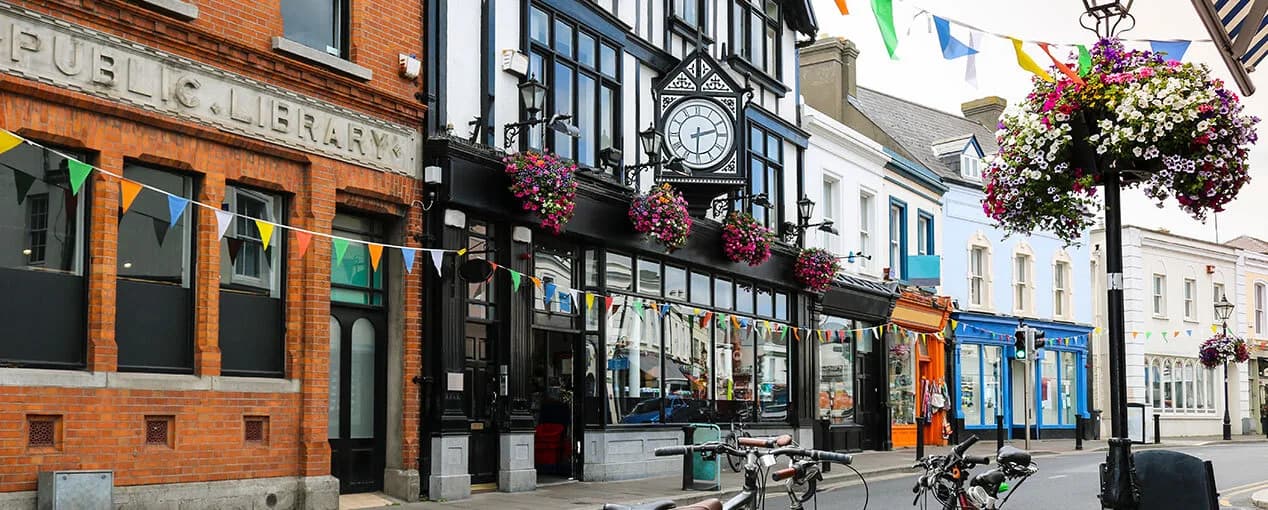
Two of the seven medieval castles survive on Castle Street, facing each other a few doors apart. Goat Castle, now the Heritage Centre, is a 14th-century fortified town house complete with battlements and a murder hole over the entrance. Archbold's Castle stands across the street. Between them is the older churchyard of St Begnet, with the ruins of a 10th-century church, named for a local early-Christian saint whose name recurs out on the island as well. The cluster of two castles, a medieval church and a graveyard on one short street is what earned Dalkey its standing as one of Ireland's heritage towns.
The Quarry and the Atmospheric Railway
In the 19th century Dalkey Hill was quarried for granite to build the great piers at Dún Laoghaire, then called Kingstown. The cut stone was run down to the coast on a funicular, and a horse-drawn line carried it along the shore on the alignment that locals still call the Metals. Dalkey also hosted one of the strangest experiments in railway history: the Dalkey Atmospheric Railway, which from 1844 to 1854 pulled carriages up from Kingstown using air pressure in a sealed pipe rather than a locomotive. The conventional railway that replaced it is the line the DART runs on today.
Writers and Residents
Dalkey has drawn writers and artists for well over a century. The Heritage Centre's Writers' Gallery records 45 figures with local connections, among them George Bernard Shaw, who lived on Dalkey Hill as a boy, Samuel Beckett, Flann O'Brien, Hugh Leonard and Maeve Binchy. Flann O'Brien even set his novel The Dalkey Archive in the village. In more recent decades the musicians arrived, Bono, The Edge, Enya and Van Morrison among the names attached to the area, and the local etiquette settled into leaving them alone. The annual Book Festival, founded by writer Sian Smyth and economist David McWilliams, is the village's argument that the literary connection is still live.
Dalkey Island
Just offshore, Dalkey Island carries the long version of the village's story in miniature. There are prehistoric and early-Christian remains, including another church dedicated to St Begnet, a holy well, and the standing evidence of a settlement going back thousands of years. The most prominent buildings are a Martello tower and a gun battery, built around 1804 when a French invasion was feared. Nobody has lived on the island for generations, and the resident population is now a herd of feral goats, joined by seals on the rocks and seabirds on the cliffs. In summer small boats run out from Coliemore.
Wildlife & Nature
Marine Life
Grey and harbour seals
Seals haul out on the rocks around Dalkey Island and gather at Bulloch Harbour, where they wait by the slip for the returning fishing boats. One of the most reliable places near Dublin to see them up close from land.
Year-round
Birdlife
Terns
Terns breed on the rocks and islets off Dalkey Island through the summer, diving for fish in the sound. The islands are a protected site for nesting seabirds.
Late spring and summer
Cormorants, shags and gulls
Cormorants and shags dry their wings on the rocks around the harbours and the island, alongside the resident gulls. A common year-round coastal sight.
Year-round
Flora
Gorse and heather
Dalkey Hill is covered in gorse and heather. The gorse flowers bright yellow in spring and the heather turns the slope deep purple in late summer.
Gorse in spring, heather in late summer