Medieval Carlingford: what survives, and what you can actually go inside
Carlingford has more standing medieval fabric than almost any Irish village its size. Here is what each building is, which ones you can enter, and which are a look from the street.
The first thing worth knowing about Carlingford is how much of its medieval town is still standing, and the second is that most of it is on the street rather than behind a ticket desk. This is a village of somewhere around fifteen hundred people. It has a Norman castle, a surviving town gate, two fortified merchant houses, a ruined friary and a medieval church, and you can walk past all of them inside an hour.
King John's Castle
The castle is the one everyone photographs, on a rock directly above the harbour with Slieve Foye behind it. Hugh de Lacy, the Norman baron, began it around 1190. King John of England seized it during his visit in 1210, which is where the popular name comes from, and de Lacy had it back by 1222. The eastern half was remodelled in the 1260s and living quarters were added to the south-east in the 1400s. By 1549 it was recorded as being in wretched condition, Nicholas Bagenal patched it back into a stronghold, and after the Battle of the Boyne it is said to have held wounded soldiers waiting on hospital ships. It was abandoned in the 1700s and left to fall down.
After a long conservation programme by the Office of Public Works it is open again for guided visits, and this is where you have to read the detail carefully. The visitor service is run by Carlingford Heritage Centre rather than by the OPW itself, which is why OPW Heritage Cards are not accepted here. Tours go daily at 2pm, seven days a week, and depart from the tourist office at Station House rather than from the castle gate. The season is looser: the operator's own castle page says March to October, while the Office of Public Works opening-times panel says April to October, so ring Carlingford Heritage Centre on +353 42 937 3454 before travelling in March or late October. What is not in dispute is that the castle is open for guided tours in season, that those tours are run by the local heritage trust rather than by the OPW, and that admission is €8.50 for an adult, €4 for a child and €20 for a family of four. Tickets can also be bought at the tourist office at Station House on the Greenore road.
If you turn up out of season, walk the harbour quay underneath it instead. That view costs nothing and is the one that appears on most of the postcards anyway.
The Tholsel
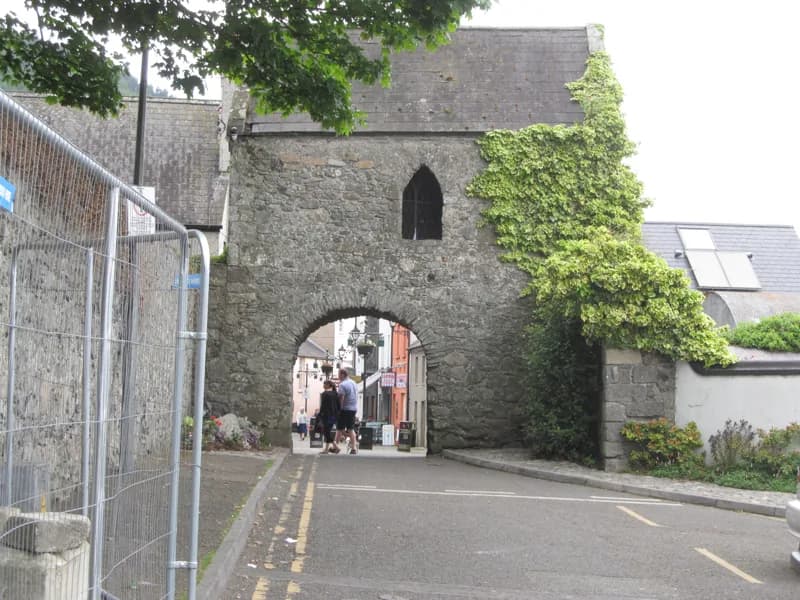
Walk up from the harbour into the village and you go through the Tholsel, a squat stone arch across the street with a chamber above it. This is the last of Carlingford's medieval town gates, originally three storeys, and it served as both gate and administrative building. It has been the focus of conservation work supported by the Heritage Council and the Irish Walled Towns Network. Nothing to pay, nothing to book: you simply walk through it, which is the point. Behind it, Tholsel Street, Market Street and Newry Street still follow the medieval plan, with narrow alleys and entries dropping between them toward Old Quay Lane and the water.
Taaffe's Castle and the Mint
These two are fortified townhouses rather than castles in the military sense, and they are the most informative buildings in Carlingford about how the place made its money. Taaffe's Castle, on the seaward side, dates from the early sixteenth century and was most likely a merchant's trading depot, built when the tide came in much closer than the reclaimed ground in front of it suggests today. It is a tall blunt tower with a battlemented range beside it and is a National Monument.
The Mint is a three-storey limestone tower house in the middle of the village, dated to the fifteenth or sixteenth century and named for the licence to mint coins granted to Carlingford by Edward IV in 1467. No coin from a Carlingford mint has ever been found, and it may in fact have been the house of a wealthy merchant family, possibly the Marmions. Stand back across the street and look at the five ogee-headed windows on the ground and first floors: they carry carvings of a horse, a man's bust, a bird, a snake and Celtic interlace, along with hood mouldings and mullions. There is a battlemented walkway on the roof with musket loops, and a machicolation over the door. Neither building is open to walk inside. Both are free to look at.
The friary and the church
At the southern end of Dundalk Street are the ruins of the Dominican friary, founded in 1305, dissolved in 1540 and abandoned in the eighteenth century. It is five minutes from the pubs and it is where almost nobody on a weekend break gets to, which makes it the most reliably quiet thing in Carlingford. In the middle of the village, in Darcy McGee Courtyard, the restored medieval church of the Holy Trinity with its battlemented tower is now Carlingford Heritage Centre, still functioning as a place of assembly as it always did.
How to actually do it
Give it an hour and a half on foot, starting at the harbour car park and finishing at the friary. If you want it explained rather than guessed at, the Heritage Centre advertises a guided town tour Monday to Friday at 11am, meeting at the tourist office at Station House. Come midweek or out of season if you want the streets to yourself; the laneways are cobbled and setted and the village slopes up from the harbour, so this is not a step-free walk.
Keep Reading
Walking and cycling out of Carlingford: the greenway, Slieve Foye and the Tain Way
Three routes leave this village: a flat lough-shore greenway anyone can do, a strenuous waymarked mountain loop, and a two-day circuit of Carlingford Mountain. Here is how to pick.
Food & DrinkEating and drinking in Carlingford: oysters, early last orders and a village with two speeds
A small village with a serious oyster and a short list of kitchens. What to eat, where, and why the day of the week matters more here than in most Irish towns.
Planning a trip?
Explore restaurants, activities, accommodation, and more.