About Carlingford
The history, geography, and character of Carlingford.
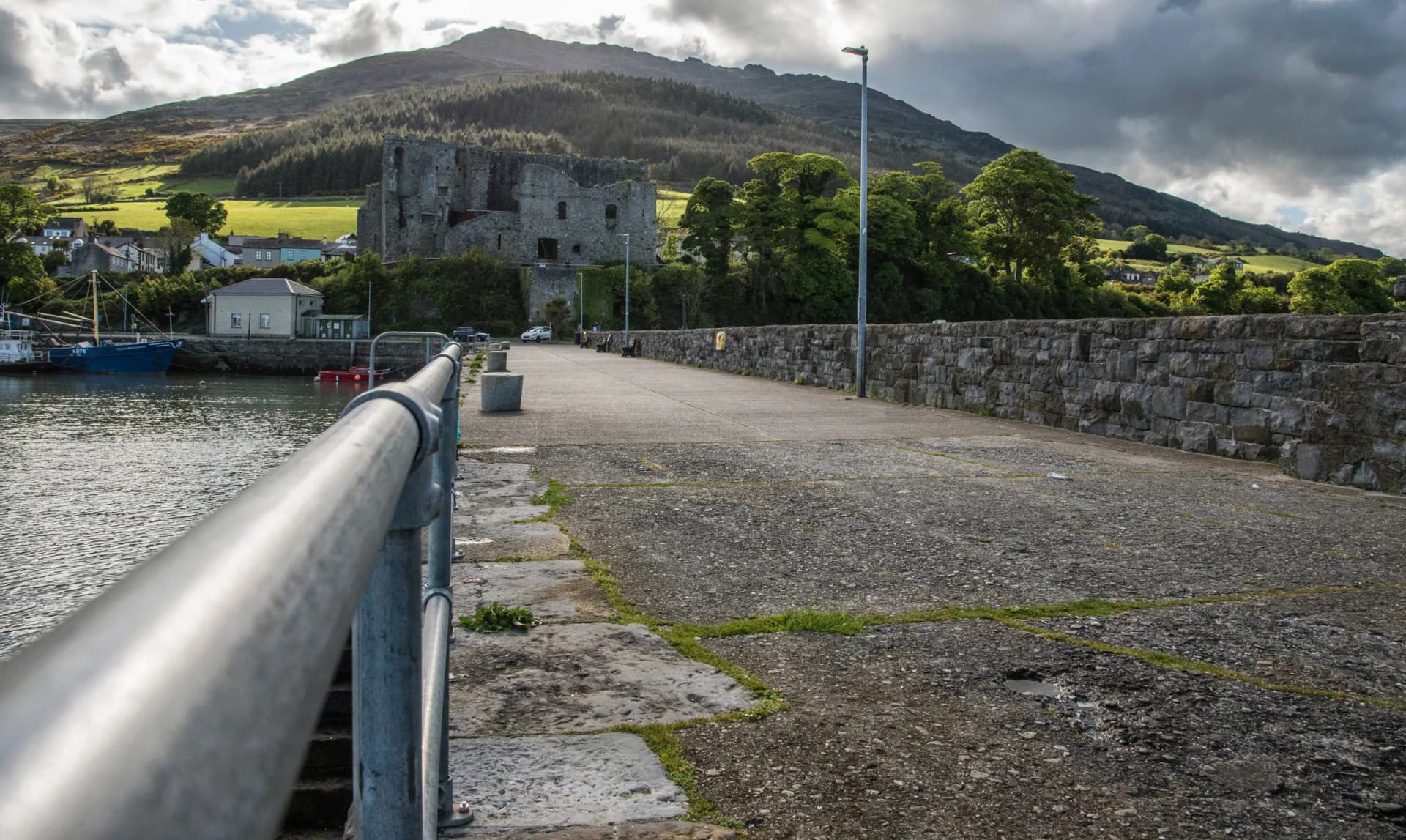
Carlingford, Cairlinn, is a village of somewhere around fifteen hundred people on the northern shore of the Cooley Peninsula in County Louth, squeezed onto a narrow shelf of land between the flank of Slieve Foye and the water of Carlingford Lough. It is one of the best-preserved medieval towns in Ireland at village scale: a Norman castle, the last of its town gates, two fortified merchant houses, a ruined Dominican friary and a street plan that has barely moved in six hundred years. It is also, at weekends, an adventure and group-break town with kayaks stacked against the harbour wall and hen parties on Market Street. Both things are true, and the village is used to holding them at the same time.
History & Heritage
A Norse name on a Norman town
The name is not Irish. Carlingford comes from Old Norse, Kerlingfjordr, the inlet of the hag, given by Viking traders who worked this coast from the ninth century; the Gaelic settlement here was called Dun Ogalla. What you walk through today, though, is Norman. Hugh de Lacy built a castle on the rock above the harbour around 1186 to 1190, and a walled trading town grew up under its protection. King John of England came through in 1210 and seized it, which is how it got the name it still carries locally, and de Lacy had it back by 1222. The town prospered on seaborne trade through the fourteenth to sixteenth centuries, was burnt in a Scottish raid in 1388, and declined through the wars of the 1640s to 1690s and then, decisively, when the herring shoals moved away in the early eighteenth century.
What actually survives
For a village this size the medieval survival rate is unusual. King John's Castle stands on its rock above the harbour, with a western section that predates 1186, an eastern range remodelled in the 1260s and living quarters added in the 1400s; it came through a long Office of Public Works conservation programme and is open for guided visits in season. The Tholsel is the only one of the town gates still standing, originally three storeys, part gate and part administrative building. Taaffe's Castle is an early sixteenth-century fortified merchant's house on the seaward side, probably a trading depot when the tide came further in. The Mint is a three-storey limestone tower house named for a minting licence granted by Edward IV in 1467, notable for five carved ogee windows showing a horse, a man's bust, a bird, a snake and Celtic interlace, though no coin from a Carlingford mint has ever been found. The Dominican friary at the southern edge of the village was founded in 1305, dissolved in 1540 and abandoned in the eighteenth century. The old church of the Holy Trinity, restored, is now the heritage centre.
The Tain and the Cooley cattle raid
The Cooley Peninsula is the Cuailnge of the Tain Bo Cuailnge, the cattle raid at the centre of the Ulster Cycle, in which Queen Medb of Connacht comes for the brown bull of Cooley and the young Cu Chulainn holds the ford against her army. This is not decoration bolted on for tourists: it is the local landscape's own story, and Carlingford uses it in ways that are genuinely rooted rather than themed. The Tain Way, a waymarked forty-kilometre route around Carlingford Mountain with over a thousand metres of cumulative ascent, starts and finishes here and is managed from the tourist office in the village. Feile na Tana, the traditional music festival held between late January and early February in Carlingford and at Bush, takes its name from the same story. And the folklore park up the Ghan Road has a sculpture of the brown bull among its figures. If you want the mythology, walk into it rather than reading a plaque.
Oysters and the lough
Carlingford's green-finned oysters were famous across Britain and Europe when the town was still trading, and they were the economic backbone alongside herring until the shoals left. The modern industry starts in 1974, when Peter Louet-Feisser, who had come to Carlingford from the Netherlands in the late 1960s, started farming oysters here after hearing a radio programme about it. His family still run the Carlingford Oyster Company, producing around two and a half million Irish rock oysters a year in the lough, and you will find them on menus all over the village and at the centre of the Oyster Festival in August. Carlingford Lough itself is an international waterway: the southern shore is County Louth in Ireland, the northern shore is County Down in the United Kingdom, and the boundary runs down the middle of the water. The ferry that used to connect Greenore on this side with Greencastle on the far shore has been suspended for all of 2026.
The railway, and the town it left behind
Carlingford had a railway from 1876 to 1951, the Dundalk, Newry and Greenore line, and it was the railway that turned the village into a resort in the first place. When it closed the tourist trade went with it, and the modern version of that trade was rebuilt from the 1990s on around adventure rather than sea bathing: an adventure centre on the harbour running kayaking and paddleboarding, climbing and laser combat in the woodland on Slieve Foye, and a high ropes park up the Dundalk road. That business is what makes Carlingford one of Ireland's standard hen and stag destinations, and the village makes no secret of it. The old railway line, meanwhile, came back as the Carlingford Lough Greenway, which reopened the route north to Omeath and on across the border toward Newry in 2025. The village has, in effect, got its railway back as a footpath.
Two Carlingfords, and how to choose
The honest planning advice for Carlingford is about timing rather than about what to see. Friday afternoon to Sunday afternoon between about March and October, the village is loud, the pubs are full, group bookings take most of the restaurant capacity and the accommodation prices reflect it. Midweek, and any time between November and February outside the Adventure Lights season and Feile na Tana, it is a quiet village of a few hundred houses where you can have the Tholsel and the friary to yourself. Neither version is the real one. If you want the medieval town, come on a Tuesday in October. If you want the weekend, come on a Saturday in July and book everything in advance.
Wildlife & Nature
Marine Life
Pacific and native oysters
Carlingford Lough is a working shellfish water, and oyster trestles are visible on the shore at low tide along the peninsula. The modern crop is Irish rock oyster, farmed since 1974; the historic Carlingford oyster with its green fin was famous across Britain and Europe before the fishery declined.
Farmed year-round; at their best on menus and at the Oyster Festival in August
Mussels
Mussel dredgers work Carlingford Lough and tie up at the harbour in the village, which is one of the more honest sights here: this is still a working water rather than a decorative one. Mussels appear on menus across the village alongside the oysters.
Autumn and winter
Birdlife
Waders and wildfowl on the lough shore
The intertidal flats along the Louth shore of Carlingford Lough, visible from the greenway between the marina and Omeath and from the harbour at low tide, hold feeding waders and wildfowl, and the greenway is the easiest place to watch them from without disturbing the birds.
Autumn and winter, around low tide
Flora
Bracken, gorse and heather on Slieve Foye
The flank of Slieve Foye above the village runs from conifer plantation through gorse and bracken to open heath. The gorse flowers yellow from late winter, and the bracken turns the whole hillside russet and copper from October, which is the colour every view out of Carlingford takes on in autumn.
Gorse from February; bracken colour from October to December