About Bundoran
The history, geography, and character of Bundoran.
Bundoran, Bun Dobhráin, the foot of the little water, is the southernmost town in County Donegal, sitting on Donegal Bay where the N15 crosses into the county from Leitrim. It grew from two separate settlements into a railway resort in the second half of the nineteenth century and became one of Ireland's most popular seaside towns. Today it is known for surfing, on Tullan Strand and the reef at the Peak, for country music weekends, and for the coastal walk to the Fairy Bridges that has been drawing visitors for two hundred years.
History & Heritage
Two villages and a bridge
Until a little over a century ago there were two places here. Bundoran proper was the village west of the bridge over the River Bradóg, the area now called the West End, and it was where the better-off visitors stayed. Almost a mile to the east was Single Street, where most of the native population lived, and the townland of Drumacrin lay between the two. It was the railway station, opened in 1866 and named Bundoran, that pulled them together into one town. The first official mention of Bundoran is from 1777, when Viscount Enniskillen built Bundoran Lodge as his summer residence; the building still stands as Homefield House.
The Brighton of Ireland
The Viscount's friends followed him to the sea, and the town became known as the Brighton of Ireland. The railway, with its connections to Belfast and on to Dublin, opened it up across the classes, and hotels and lodging houses went up along the front, the best known being the Great Northern Hotel, built by the Great Northern Railway company on the headland. The last train left Bundoran station at 2.30pm on Monday 30 September 1957. The resort outlived the line: the storm of 9 February 1988, which wreaked havoc on the town, was the start of the improvement works that brought the promenade and Waterworld, and the town now has one of the largest stocks of holiday accommodation in the north-west.
Ireland's surf capital
Bundoran calls itself the surf capital of Ireland, and the surfing has stretched what used to be an Easter-to-September season into a year-round one. The breaks are a short walk or cycle from Main Street: Tullan Strand, which picks up swell when other beaches are flat; the Peak, a reef break off the West End that suits experienced surfers only; and a string of reefs and sandbars in between. The town hosted the European Surfing Championships in 2011, the third time they had come to Bundoran, and the European Junior Surfing Championships in the autumn of 2026.
History on the cliffs
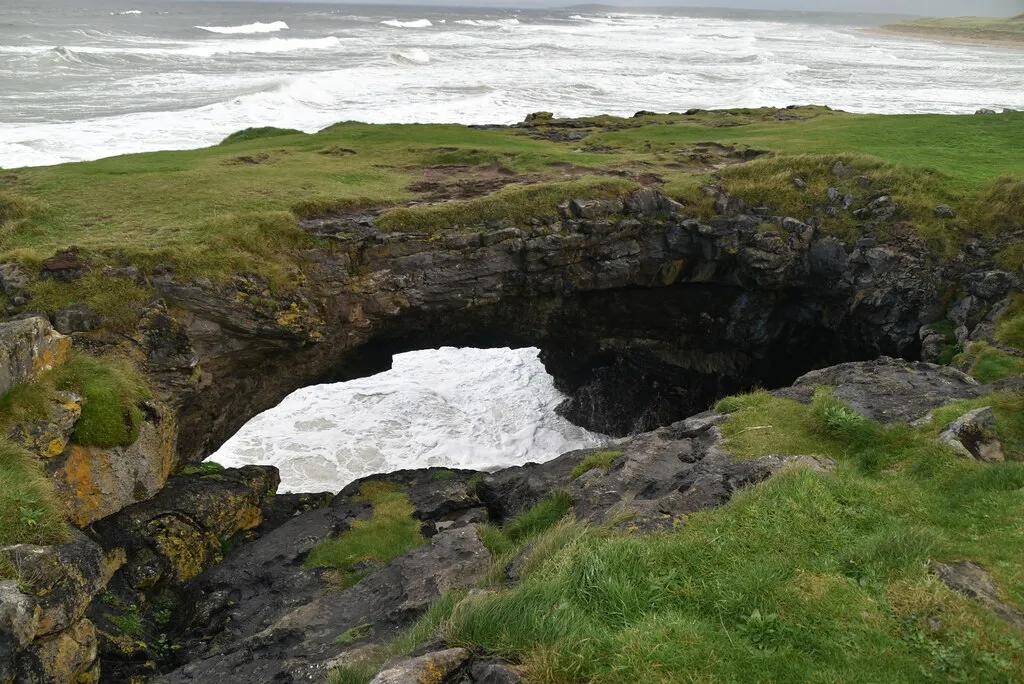
The Fairy Bridges, sea arches in the cliffs above Tullan Strand, were the town's first tourist attraction, and the walk out to them past Aughrus Point has been a promenade since Victorian times. The same cliffs saw the crash of a Halifax aircraft of 518 Squadron on the morning of 23 January 1944, flying a weather reconnaissance sortie from Tiree in Scotland, and there is a memorial on the clifftop. Finner Camp, just outside the town, was handed over by the British Army to Irish forces on 17 February 1922.
Wildlife & Nature
Marine Life
Seals and dolphins
Bundoran Golf Club lists seals and dolphins among the marine visitors seen from the clifftop course and the Rougey Walk; a calm evening on the headland is the time to look.
Calm days, any season
Rockpool life
The rocks at both ends of the main beach and below the West End hold crabs and other shore life at low tide; Discover Bundoran publishes a rockpooling guide. Watch the tide.
Low tide in summer
Birdlife
Coastal birds
Discover Bundoran publishes a Bird Bingo sheet of the species visitors can spot around the town's beaches, cliffs and promenade.
Year-round