About Oxford
The history, geography, and character of Oxford.
Oxford grew up where the Thames and the Cherwell meet, a Saxon river town whose name records a ford for oxen, and the university grew up inside it from the late 1000s onward, which is why there is no campus, just thirty-nine colleges threaded through working streets. The result is a city with two histories running in parallel: the gowned one of the Bodleian Library, the Radcliffe Camera and Christ Church, and the town one of markets, breweries, canal wharves and, in the 20th century, the Cowley car works that made Oxford a manufacturing city as much as an academic one. Town and gown have rubbed against each other here for eight centuries, sometimes violently (the St Scholastica Day riot of 1355 started in a pub argument), and the friction is part of the character. For a visitor the practical upshot is generous: the Ashmolean, the Museum of Natural History and the Pitt Rivers are all free, Port Meadow has been open common grazing since before the Domesday Book, and the colleges, though they charge and close on their own schedules, sit within a centre small enough to walk end to end in twenty minutes.
History & Heritage
Highlights
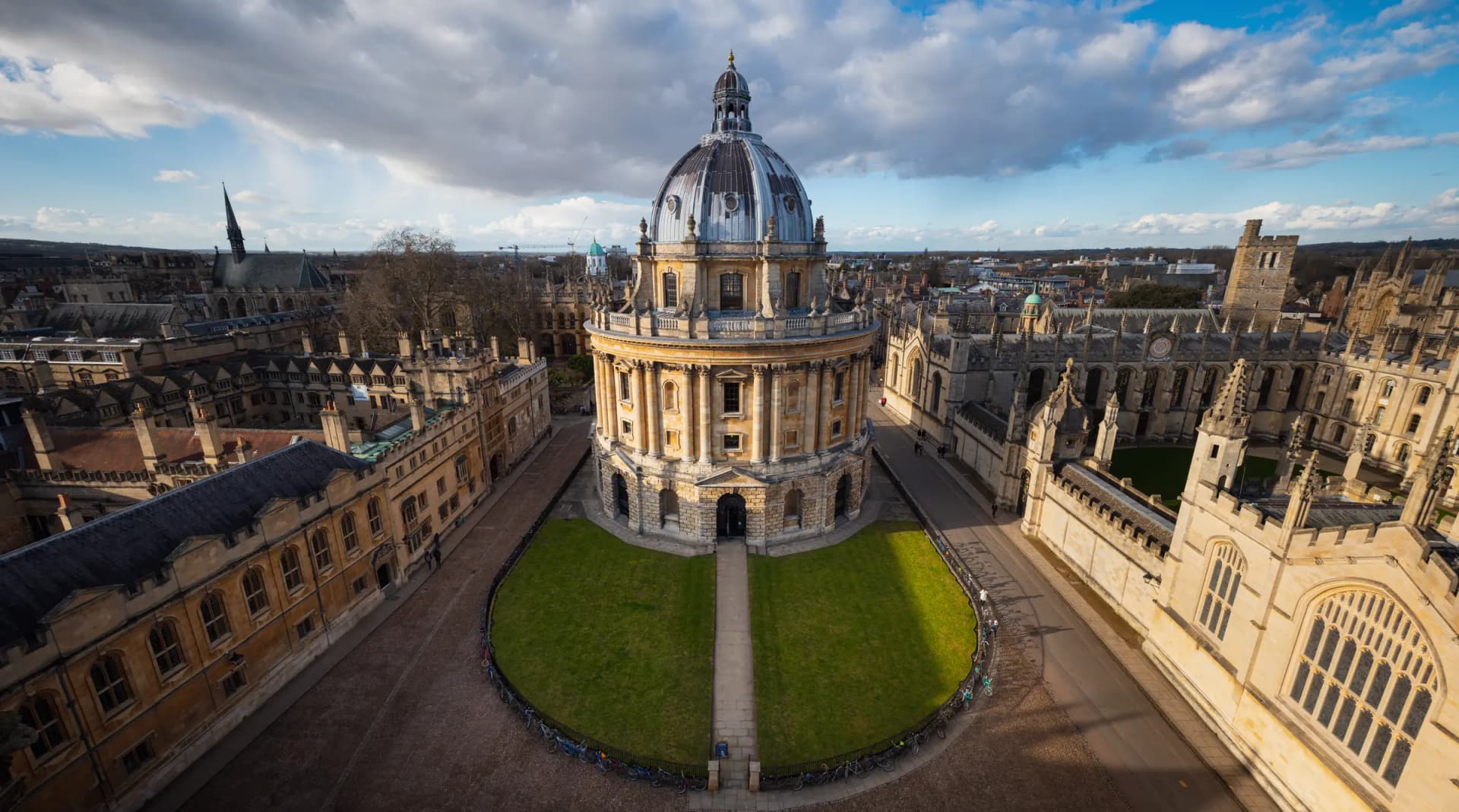
Radcliffe Square, with the Radcliffe Camera of 1749 at its centre, the single view that says Oxford; the Bodleian Library's Divinity School and its fan-vaulted ceiling; Christ Church's Tom Tower, Tudor Great Hall and a chapel that is also a cathedral; Magdalen College's Great Tower, deer park and Addison's Walk; punting on the Cherwell from Magdalen Bridge; the Covered Market's fifty-plus independent traders under a Georgian roof; three free world-class museums (the Ashmolean, the Museum of Natural History and the Pitt Rivers); Port Meadow and the Thames Path walk to Godstow Abbey's ruins, with the thatched Perch and the weir-side Trout as pub rewards; and pubs like the Turf Tavern and the Bear whose histories are measured in centuries.
Town and gown
The university has no fence around it because it was never separate from the town: colleges bought and built along existing streets, and the city carried on trading around them. That is why college opening hours follow term dates, exams and ceremonies rather than visitor expectations, and why the honest rule for any college visit is to check the college's own page that morning. It is also why the city's best eating and drinking splits between the polished centre and the streets where Oxford actually lives: Jericho north of the station, and Cowley Road east of Magdalen Bridge, where the tapas bars, gastropubs and cheap good kitchens cluster. The three terms are Michaelmas (autumn), Hilary (winter into spring) and Trinity (spring into summer); out of term the city breathes out, and college access generally loosens.
Wildlife & Nature
Mammals
Deer in Magdalen College's Grove
Magdalen keeps a deer herd in the Grove, its walled parkland, visible from the visitor route and Addison's Walk depending on the season and where the herd is grazing.
Year-round; check the college's visiting page for access
Free-roaming horses and cattle on Port Meadow
Commoners' cattle and horses graze loose across the whole meadow, as they have since before the Domesday Book. They are used to people but are not tame; give them room, especially with dogs.
Year-round
Birdlife
Wildfowl on Port Meadow's winter floods
When the Thames floods the meadow in winter it becomes a shallow lake that draws large flocks of ducks, geese and gulls, with waders working the margins. One of the best casual birdwatching sites in any English city.
November to February, after sustained rain
Swifts over the Museum of Natural History
A colony of swifts nests in the ventilation shafts of the museum's tower each summer, and the birds' screaming parties over Parks Road are a city sound of high summer. The colony has been studied by Oxford researchers for decades.
May to early August