About Chester
The history, geography, and character of Chester.
History & Heritage
Highlights
The Rows, Chester's genuinely rare two-tier covered shopping galleries, running along all four streets that radiate from the old market Cross; the near-complete circuit of Roman and medieval City Walls, walkable in under an hour; Chester Cathedral, a working church with roots as an Anglo-Saxon monastery; the Roman Amphitheatre, the largest yet uncovered in Britain; Chester Racecourse at the Roodee, the world's oldest racecourse still holding meetings; Chester Zoo just north of the city, one of the largest and best-regarded zoos in the country; and the River Dee at the Groves, Chester's riverside promenade for boat trips, kayaking and an evening walk.
The walls and the Rows
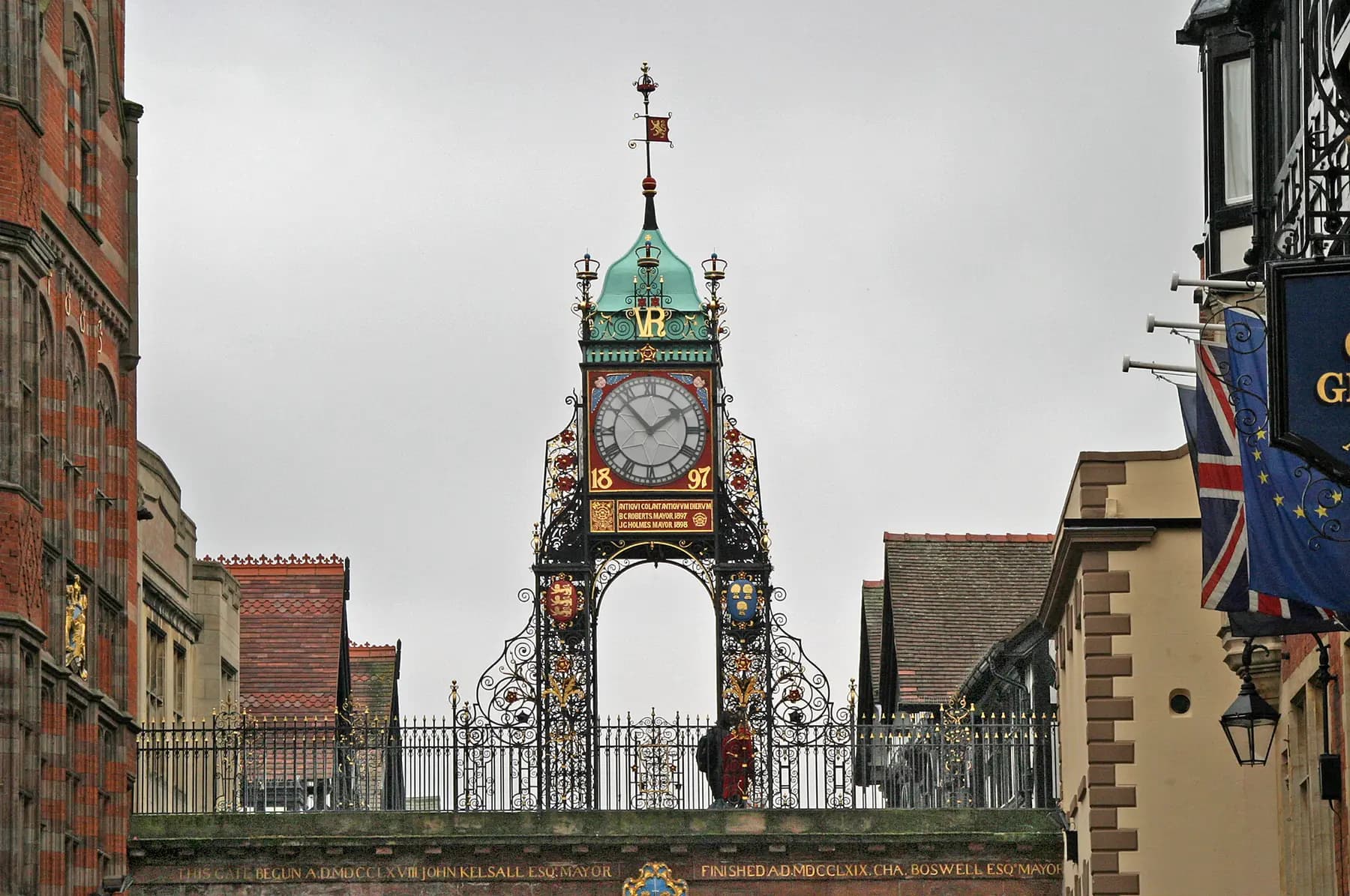
Chester's two defining structures are both about levels. The City Walls trace a nearly unbroken loop of just under two miles along the line the Roman legion first fortified, rebuilt and extended by the Anglo-Saxons and Normans and kept walkable ever since, so a single circuit takes in the Roman Amphitheatre, the Water Tower, King Charles Tower, stretches above the racecourse, and views over the Dee without leaving the top of the wall. The Rows do something similar at a smaller scale: a two-tier system of covered galleries at first-floor level, with shops both up on the walkway and down in stone undercrofts below, first documented by name in 1293 and reaching something like their full extent by around 1350. Nothing quite like it survives elsewhere in England at this scale, which is the reason the Rows, not the black-and-white timber alone, are Chester's real architectural signature.
What is genuinely old, and what is Victorian
It is worth being honest about Chester's timber-framed look, because a lot of visitors assume every black-and-white frontage is medieval and most are not. Chester went through a deliberate 'black-and-white revival' from the 1850s onward, led in large part by the architect John Douglas, rebuilding and reclading much of the city centre in a self-consciously historic style. The genuine medieval fabric survives mostly below street level and in the stone undercrofts beneath the Rows, of which around twenty examples from the 13th and 14th centuries remain, plus scattered timber-framed buildings that are the real thing. The Victorian work is not a con: it is a well-executed piece of civic self-image that happens to now be well over a century old in its own right, and Chester is generally upfront about which is which.
Beyond the walls
Step outside the historic core and Chester is a working Cheshire city rather than a museum piece. The Groves, the riverside promenade below the Old Dee Bridge, is where locals actually spend a Sunday: rowing boats and the ChesterBoat cruises on the water, ice cream stalls, and Edwardian bandstand concerts in season. Hoole, a short walk or bus ride northeast of the centre, has become the city's most talked-about food street, home to Sticky Walnut among others. Chester Racecourse at the Roodee runs a full fixture list from May to September and the crowds it draws are as much a part of the city's character as the Rows. And a few miles north, Chester Zoo pulls in visitors from across the North West on its own, a genuinely separate half-day trip rather than a stop on a walking tour of the centre.
Wildlife & Nature
Birdlife
Herons, swans and waterbirds along the Dee and the Groves
Grey herons and mute swans are a regular sight along the River Dee by the Groves and the Old Dee Bridge, with mallards and moorhens on the calmer stretches; the weir at the Old Dee Bridge is a reliable spot to watch them working the water.
Year-round, early morning or early evening along the Groves