About Brighton
The history, geography, and character of Brighton.
Brighton started out as a small fishing settlement called Brighthelmstone, and it became fashionable in the late 1700s when sea bathing was prescribed as a cure for everything from gout to nerves. The Prince of Wales, later the Prince Regent and then King George IV, took a liking to the town and built the extraordinary Royal Pavilion here, turning a modest resort into a royal playground. Brighton has never really stopped playing since. Today it combines Regency architecture, two piers, one working and one a ruin, a shingle beach, and a reputation as one of Britain's most creative and LGBTQ+-friendly cities, all of it an hour by train from central London.
History & Heritage
The Prince Regent's seaside folly
Brighton's transformation from fishing village to fashionable resort began in the 1750s, when the physician Richard Russell published work promoting seawater as a treatment for glandular diseases, drawing wealthy visitors to Brighthelmstone for sea bathing. The turning point came in 1783, when George, Prince of Wales, first visited on the advice of his physician, who recommended sea air and bathing for his health. He leased a modest farmhouse and had it enlarged from 1787, then continued expanding it in stages. Between 1815 and 1822 the architect John Nash rebuilt it into the Royal Pavilion seen today, an Indo-Saracenic fantasy of onion domes, minarets and cusped arches. The Prince became Prince Regent in 1811 and King George IV in 1820. The Pavilion's exotic silhouette, still owned by the city and open to visitors, remains the clearest physical evidence of how a royal whim built a town.
Two piers, one working, one a ruin
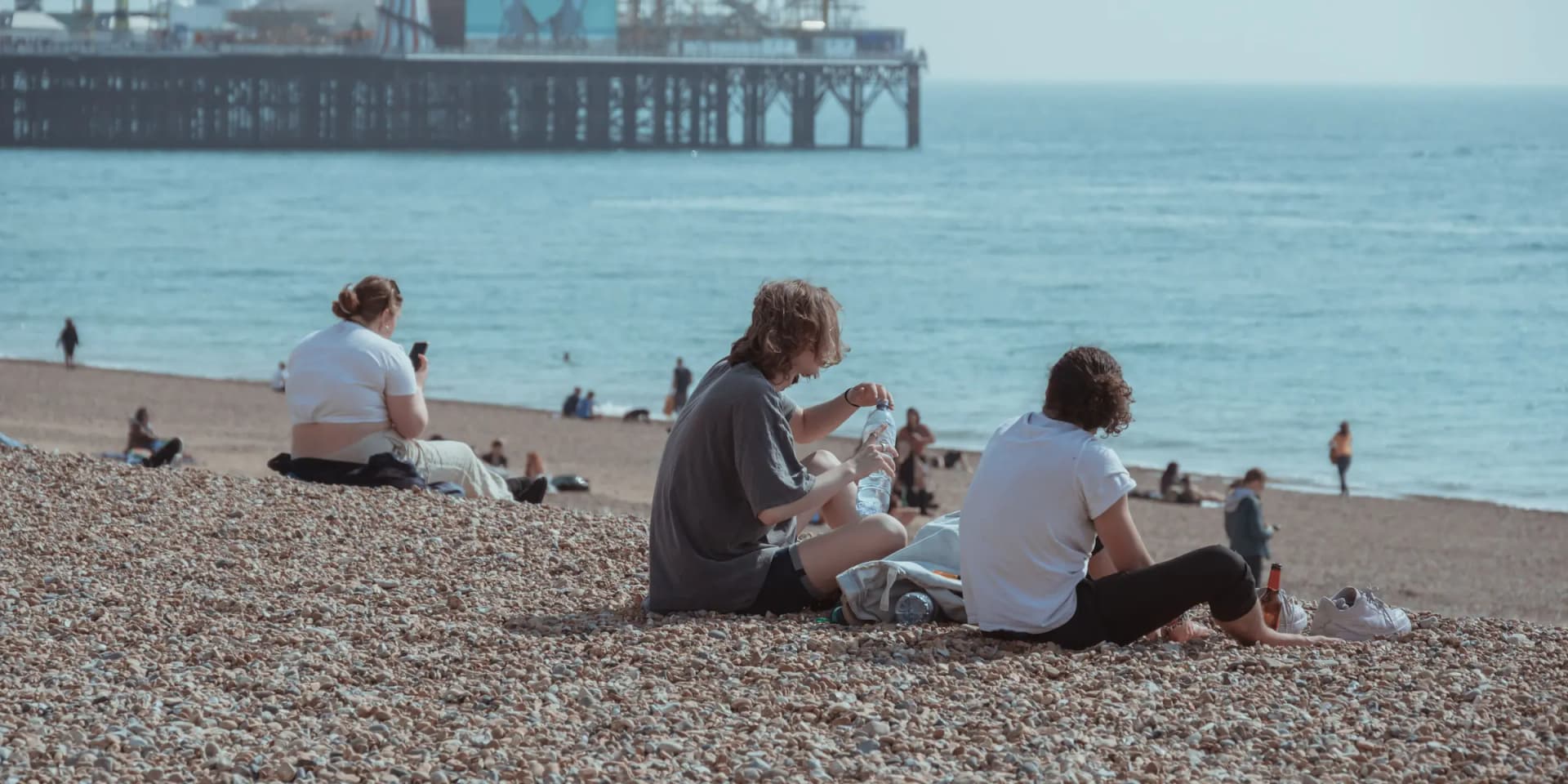
Brighton's seafront is defined by two piers built decades apart in the Victorian pleasure-pier boom. The West Pier opened in 1866, designed by the engineer Eugenius Birch, and became one of the most admired piers in Britain before closing to the public in 1975. Storm damage and two fires in 2003 gutted what remained, leaving only a blackened iron skeleton standing offshore, now left deliberately in place as a ruin rather than demolished. The Brighton Marine Palace and Pier, known today as Brighton Palace Pier, opened in 1899 further east and remains a fully working pleasure pier, with fairground rides, arcades, fish and chips and doughnut stalls. Between and beneath the two runs the beach itself, which is shingle rather than sand, backed by the arches, a run of vaulted spaces built into the sea wall that house independent bars, cafes and studios along the promenade.
A creative and LGBTQ+ capital
Brighton's oldest quarter, the Lanes, is a tight knot of narrow streets and twittens tracing the layout of the original fishing village, now filled with jewellers, antique dealers and small restaurants. To its north, North Laine grew up as a Victorian working district of terraced streets and has become the city's independent shopping and creative hub, dense with vintage stores, record shops and cafes. Brighton has long been known as Britain's unofficial gay capital, a reputation concentrated today around Kemptown and St James's Street, where Brighton and Hove Pride each August draws large crowds for its parade and its Preston Park festival. The city's creative identity is reinforced every May by Brighton Festival, one of England's largest annual arts festivals, alongside Brighton Fringe and the new-music showcase the Great Escape. This concentration of independent business, community and festival culture is what locals point to when they distinguish Brighton from other English seaside towns.
Between the Downs and the Channel
Brighton and Hove sits where the South Downs meet the English Channel, and that setting shapes the place as much as its history does. The chalk hills of the South Downs, a National Park since 2010, rise directly behind the city, and a short bus ride or drive north leads to Devil's Dyke, a dramatic dry valley cut into the Downs and once described by John Constable as one of the grandest views in the world. East of the centre, the coastline turns to chalk cliffs at Ovingdean, Rottingdean and Saltdean, followed on foot along the Undercliff Walk from Brighton Marina. Hove, joined with Brighton into a single authority in 1997 and granted city status together in 2001, extends the seafront west with a quieter, more residential character. The combination of downland, chalk coast and Channel water gives Brighton a geography that is compact but varied within a short walk or bus ride of the centre.
Wildlife & Nature
Marine Life
The recovering Sussex kelp forest
Sussex's offshore kelp forest declined by an estimated 96 percent over the twentieth century, largely due to bottom-towed trawling and storm damage. Since the Sussex Nearshore Trawling Byelaw came into force in 2021, banning trawling across a large area of seabed, the Sussex Kelp Recovery Project has documented several years of natural regrowth and returning marine life. The kelp is not visible from the shore, but the project is a genuine and actively monitored conservation story tied directly to this stretch of coast.
An ongoing recovery; project updates are published year-round
Harbour porpoises and dolphins
Harbour porpoises are seen with some regularity off the Sussex coast, and small numbers of bottlenose dolphins have also been recorded close to Brighton, including within sight of the beach on occasion. The Sussex Dolphin Project, based in Brighton, records public sightings and researches this coastline. Sightings are irregular rather than guaranteed and are best treated as a possibility rather than an expectation.
Reported in most months; there is no fixed season
Mammals
South Downs wildlife
The chalk grassland and scrub of the South Downs immediately behind Brighton, including the areas around Devil's Dyke, support roe deer, foxes and a range of bat species that forage over the Downs. This is downland rather than woodland habitat, so sightings tend to come in early morning or evening rather than from dense cover.
Dawn and dusk, spring to autumn
Birdlife
Starling murmuration over the piers
Brighton's best-known wildlife spectacle takes place at dusk above the West Pier ruins and the Palace Pier, where tens of thousands of starlings gather into a swirling, shifting flock before dropping down to roost in the ironwork. The behaviour, known as a murmuration, builds through autumn and peaks in the coldest months, drawing photographers and residents onto the promenade to watch. It is one of the surest reasons to be on the seafront at dusk between late autumn and late winter.
Late October to February, at dusk
Gulls and seabirds
Herring gulls are a constant and vocal presence across Brighton's seafront and rooftops, well known locally for stealing chips, and the city has one of the higher urban gull densities in the UK. Along the chalk cliffs east of the marina toward Rottingdean, seabirds including fulmars nest on the cliff ledges.
Year-round, with nesting activity in spring and summer