About Bath
The history, geography, and character of Bath.
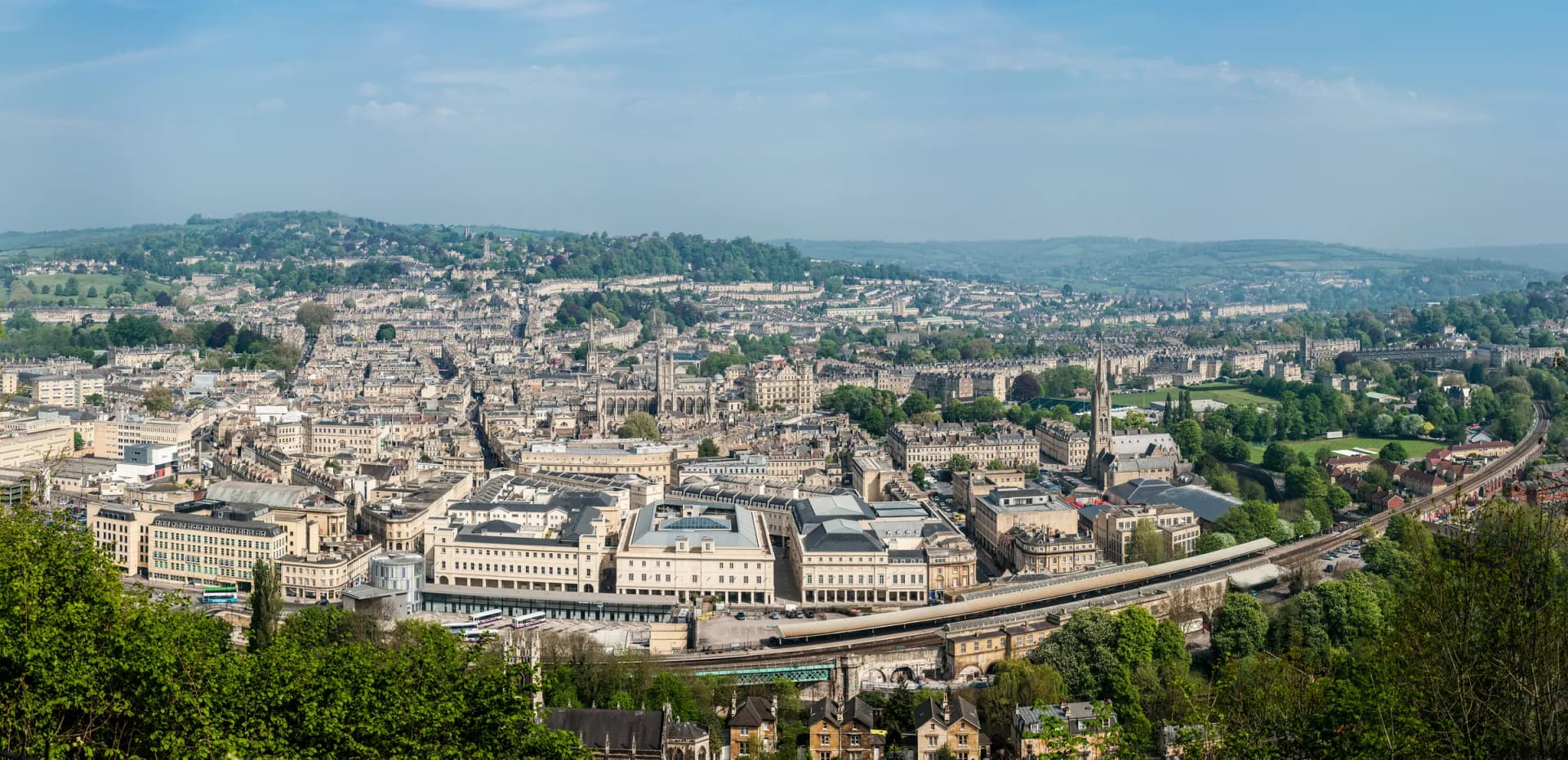
Bath is the city the hot springs built, three times over. The Romans raised the temple and baths of Aquae Sulis around Britain's only thermal springs in the first century AD; the medieval wool city grew over the ruins, and its abbey church of 1499 was the last great medieval church raised in England; then the Georgians, led by the architects John Wood the Elder and Younger, the entrepreneur Ralph Allen, whose quarries supplied the stone, and the master of ceremonies Beau Nash, rebuilt the whole town as the most fashionable resort in the kingdom, giving it the Royal Crescent, the Circus, Pulteney Bridge and the Pump Room. UNESCO listed the entire city as a World Heritage Site in 1987 and listed it again in 2021 among the Great Spa Towns of Europe, a double inscription almost nothing else in Britain holds. Around 90,000 people live here, most of them well away from the coach parties: in Widcombe and Bear Flat south of the river, Walcot and Larkhall to the north-east, and the student streets of Oldfield Park. The springs still rise at 46 degrees, some 1,170,000 litres (240,000 gallons) a day; the difference now is that you can bathe in the water again, in a rooftop pool with the whole honey-stone city spread out below.
History & Heritage
Highlights
The Roman Baths, the finest Roman religious spa surviving in northern Europe, with the steaming Great Bath at its centre; Thermae Bath Spa, where the same thermal water fills a modern rooftop pool; the Royal Crescent and the Circus, the twin masterpieces of Georgian town planning, with No.1 Royal Crescent restored as a 1770s house museum; Robert Adam's shop-lined Pulteney Bridge above the horseshoe weir; the six-mile National Trust Skyline loop on the hills above the city; Sally Lunn's bun house in the oldest house in Bath; the September Jane Austen Festival and its Regency costumed promenade, around 2,000-strong in 2025; and one of Britain's biggest Christmas markets each late November and December.
The water
Everything in Bath traces back to rain that fell on the Mendip Hills thousands of years ago, sank deep enough to be heated, and rises here through three hot springs, the main one at 46 degrees Celsius delivering 1,170,000 litres (240,000 gallons) a day. The Celts dedicated the spring to the goddess Sulis; the Romans merged her with Minerva and built their great religious spa around her sacred pool. Georgian Bath sold the same water as medicine, drunk in the Pump Room and bathed in across five bath houses. Today the Roman levels are a museum you cannot swim in, while Thermae Bath Spa and one hotel spa pipe the thermal water for actual bathing, and the Pump Room fountain that pours it by the glass for the curious was closed for essential maintenance through 2026 (thepumproombath.co.uk, checked 2026-10-04).
The stone city
Bath looks the way it does because nearly all of it is built from one material: the honey-coloured oolitic limestone quarried from the hills above, most famously by Ralph Allen at Combe Down, whose fortune the quarries made and whose eye-catcher folly, Sham Castle, still decorates the skyline. The Woods, father and son, laid the stone out in the great set pieces, Queen Square, the Circus, the Royal Crescent, and the city has protected the effect ever since: long views end in green hills, and the evening sun turns whole streets amber. Walking is the whole point; the centre is compact, and the climb to the upper town is part of the architecture's theatre.
Beyond the postcard
Two streets from the Abbey courtyard the city belongs to the people who live in it. Walcot Street, the self-declared artisan quarter, runs north with food shops, salvage yards and Landrace's bakery counter; Green Park Station hosts the Saturday farmers' market under its Victorian glass roof, trading since 1997; the Star and the Raven pour cask ale in rooms that have not changed in living memory; and rugby at the Recreation Ground, in the middle of the city with the Abbey in view, is the Bathonian winter ritual. Locals take the city in from above, on the Skyline loop or from Alexandra Park on Beechen Cliff, and in a heatwave they head upstream to swim at Warleigh Weir rather than queue in town.
Wildlife & Nature
Birdlife
Herons, gulls and waterbirds along the Avon and the canal
Grey herons work the quieter stretches of the River Avon and the Kennet & Avon Canal east of Sydney Gardens, with moorhens, mallards and mute swans along the towpath; lucky, patient watchers report kingfishers on the calmer reaches upstream towards Bathampton.
Early morning, year-round; the canal towpath east of the city is the most reliable stretch
Buzzards and kestrels over the Skyline downs
The meadows and woodland edges of Bathampton and Claverton Downs suit raptors: buzzards soar over the slopes on warm days and kestrels hover along the field margins of the Skyline route.
Warm, bright days from spring to autumn, on the Bath Skyline circuit
Flora
Bath asparagus (spiked star-of-Bethlehem)
A tall woodland lily whose unopened flower spikes were once picked and eaten locally like asparagus, and which grows around Bath in numbers found almost nowhere else in Britain, hence the common name. Look, do not pick: it is a scarce plant and part of the city's natural signature.
Flower spikes appear in late May and June in the woods and hedgerows around the city
Wildflower meadows of the Skyline
The National Trust manages the meadows on the downs above the city for wildflowers, at their best in early summer before the late-season cut, with orchids among the grasses in the right spots.
May to July on the Bath Skyline route