About Roundstone
The history, geography, and character of Roundstone.
History & Heritage
A Scottish engineer's village
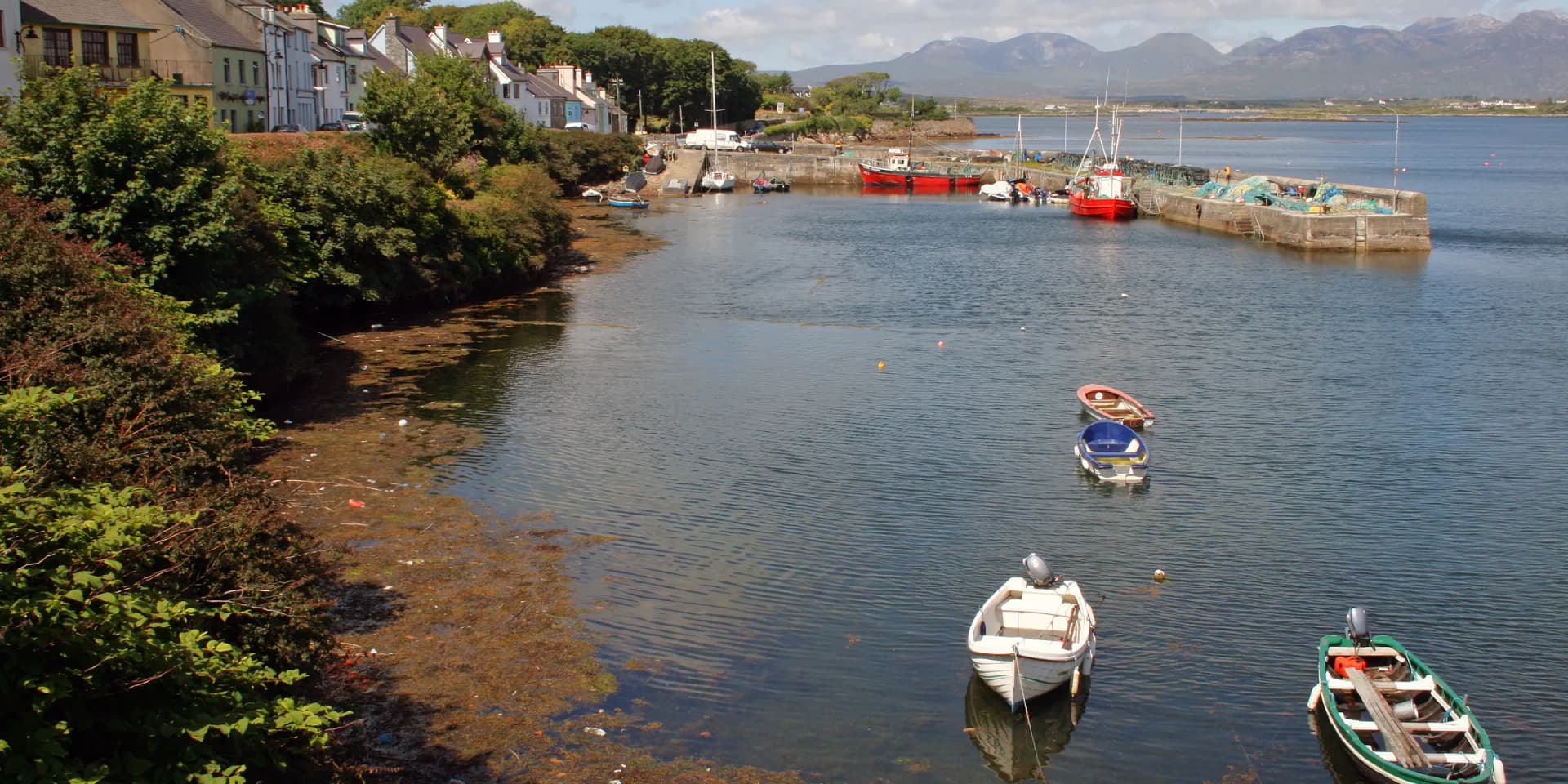
Unlike most Irish towns, Roundstone did not grow up around a castle, an abbey, or a market rights grant. It exists because Alexander Nimmo, the Scottish engineer responsible for much of Connemara's harbour and road infrastructure in the early nineteenth century, laid it out in the 1820s as a fishing settlement, and Scottish fishing families were among the first to work the bay. The Franciscan Monastery, built in 1835 after Catholic Emancipation, gave the village its second landmark. The result is a single curved street of terraced, painted houses running above the harbour, a shape that has barely changed since. The name itself carries two explanations: Cloch na Ron, the rock of the seals, is the accepted Irish form, though some local tradition points instead to a distinctly round marker rock at the entrance to the bay, documented as early as 1684, as the source of the English name.
Errisbeg and the bog of a hundred lakes
Errisbeg rises directly behind the village to a modest 300 metres, but it dominates Roundstone's skyline out of all proportion to its height, since there is nothing else around to compete with it. There is no marked path to the summit: walkers pick a line up through sheep tracks and past a series of false summits, and are rewarded with a view that takes in Gorteen Bay, Dog's Bay and the wider sweep of the Connemara Bog Complex, a blanket bog holding an estimated 140 or so small lakes. This bog is not just scenery. It is a protected Special Area of Conservation, and the R341 loop road, known locally as the Bog Road, runs directly through it on its way from Roundstone to Ballyconneely and Clifden, a 37.7 kilometre circuit that is one of the most complete introductions to Connemara's interior available from a single village.
The tombolo: Gorteen Bay and Dog's Bay
A few kilometres from the village, a granite promontory is joined to the mainland by a sand spit, a tombolo, with a beach on each side: Gorteen Bay facing east, Dog's Bay facing west. The sand at both is unusual: it is made almost entirely of the calcium carbonate shells of foraminifera, tiny single-celled marine organisms, rather than the more usual quartz grains, which is what gives the beaches their strikingly white colour and the shallow water its turquoise cast. The dunes behind the beaches carry machair, a rare grassland habitat found only along the western coasts of Ireland and Scotland, and the site has been the subject of active community-led erosion control since the early 1990s. It is a genuinely small piece of coastline doing something geologically unusual, not just a pretty beach.
Artists, a bodhran maker, and a pop star
Roundstone has drawn painters for the best part of a century, among them Paul Henry and Jack B. Yeats, and the tradition of small working studios continues today in the crafts made in and around the village. Malachy Kearns has been making bodhrans by hand from goatskin on the edge of Roundstone since 1978, at what is now known as Roundstone Musical Instruments or Irish Bodhran, and every bodhran used in the stage show Riverdance came from his workshop. Roundstone Ceramics keeps a working pottery studio in the village itself. The village also has an unexpected footnote in rock history: Sting is reported to have recorded some of the Police's early-1980s material while staying in the area. None of this is heavily signposted; it is simply part of what the village has quietly been doing for decades.
The village today
Roundstone today is a working harbour village first and a tourist stop second. Lobster, crab and mackerel boats still go out from the pier, O'Dowd's bar has been pouring pints since 1840 and is often called the oldest pub in Connemara, and the village runs a modest but genuine summer calendar: a Sunday country market at the tennis court beside Roundstone Hall, Thursday traditional music nights at the community hall, guided sea kayaking out toward Inishlacken island, and two long-standing July fixtures, the Feile Cloch na Ron regatta of currachs and Galway Hookers and the Connemara Pony, Dog and Sheep Show. It is twinned with Noyelles-sous-Lens in France, and its striking setting has drawn film crews over the decades, including The Mackintosh Man in 1973, Into the West in 1992, and Marley & Me in 2008.
Wildlife & Nature
Marine Life
Grey seals
Roundstone Bay takes its Irish name, Cloch na Ron, from the seals that have long been associated with this stretch of coast. Grey seals are regularly seen around the bay and the harbour, and around Inishlacken island where the local sea-kayaking tours head.
Year-round, most reliably spotted from the harbour or on a kayak trip out toward Inishlacken.
Flora
Machair grassland
The dunes behind Gorteen Bay and Dog's Bay carry machair, a rare, low-lying coastal grassland found only along the Atlantic-facing coasts of Ireland and Scotland, growing on the calcium-rich shell sand blown in from the tombolo.
Late spring to summer for wildflowers on the machair.