About Midleton
The history, geography, and character of Midleton.
History & Heritage
Two names, two histories
The Normans founded an abbey at a weir on the Owenacurra in the 1180s, a Cistercian house later known as Chore Abbey, and that is where Mainistir na Corann comes from: the monastery at the weir. The river's own Irish name, Abhainn na Cora, means river of the weirs, so the weir is the oldest thing in the place's naming. The English name came later and from a different logic entirely, describing the settlement's position midway between Cork and Youghal. King Charles II granted Midleton its charter as a market town in 1670, which is the moment the town's modern function starts. St John the Baptist's Church, put up in 1825, stands on the abbey site.
Whiskey since 1825
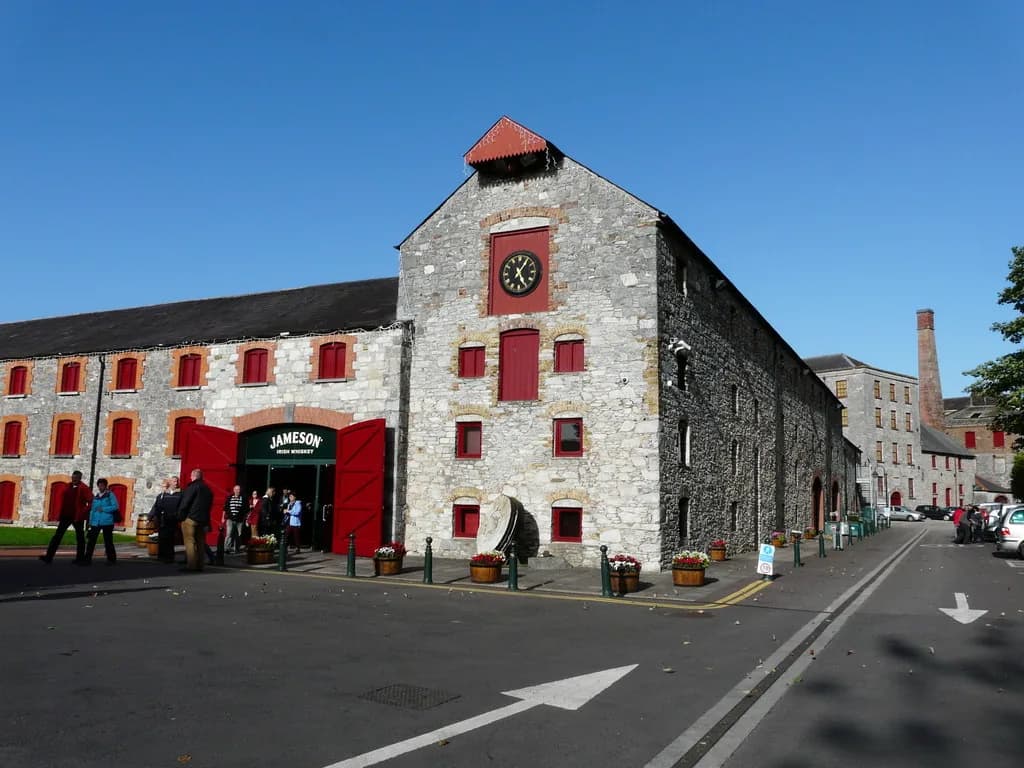
The Murphy brothers converted a woollen mill off Main Street into a distillery in 1825, and whiskey was made on that fifteen-acre site until 1975, when production moved next door into a modern plant. The old site reopened as a visitor attraction in 1992 and today trades as the Midleton Distillery Experience. Get the name right if you are searching for it: the older branding, the Jameson Experience Midleton, is still carried by a large number of listing sites that have not updated, and it refers to the same place. The old still house holds an enormous copper pot still, the kind of object that has to be assembled where it stands and the building put up around it. You will see the claim that it is the largest in the world; that superlative does not appear on any of the operator's own pages, so this guide does not make it.
What a market town actually is
Midleton is not a tourist town that happens to have residents. It is a market town with an attraction in it, and the difference shows. The Saturday market on Park Street is for the people who live here, and it works because East Cork is genuinely one of the most productive food landscapes in Ireland: the growers, fishmongers and makers who trade there have farms and boats and kitchens within a short drive. That same density is why fEast Cork, the region's food and drink festival, is based in the town and is deliberately timed to harvest rather than to the tourist season. It is also why most of the accommodation is out in the county rather than on Main Street. People come here to shop and to eat, then they go home.
The Choctaw memorial
In Bailick Park at the south end of the town stand nine stainless steel eagle feathers, each about twenty feet tall, arranged in a circle. Alex Pentek's sculpture, Kindred Spirits, was unveiled in June 2017 with members of the Choctaw Nation present. It commemorates a donation the Choctaw sent to Ireland in 1847 for famine relief. Sources vary on the exact sum, with around 170 dollars the figure usually given. What makes it land is the timing: the Choctaw had themselves been forced west along the Trail of Tears only sixteen years before, and sent money anyway. It is free, it is always open, and it takes five minutes to look at.
The railway, twice
Midleton is the terminus of the Cork commuter line, 23 minutes out from Cork Kent, and the train is genuinely the best way to arrive. What is less obvious is that the town sits at the end of two railways, one live and one retired. The old Youghal line closed to trains and reopened in December 2024 as 23km of off-road greenway running east through Mogeely and Killeagh to the sea at Youghal. Its Midleton trailhead is the station car park, which means you can come out on the train, walk fifty metres and start cycling. Because it is built on a railway alignment it holds a railway gradient, which is Cork County Council's own selling point for it: an easy route usable by people of all ages and abilities rather than a hill route with a view at the end.
Wildlife & Nature
Marine Life
Owenacurra estuary mudflats
Ballyannan Wood sits on the edge of the Owenacurra estuary, and when the tide is out the shoreline exposes mudflats that draw feeding birds in. Coillte, which manages the wood, describes the habitat as one of the site's genuine attractions rather than an incidental feature. Time a visit to low water if the birds are the point.
Low water, at any time of year
Birdlife
Little egret
Small, brilliant white herons that feed along the exposed shoreline at Ballyannan. Coillte records them as a regular sight down at the shore, which for a bird that only colonised Ireland in the last few decades is worth noting.
Low water, year round
Flora
Bluebells at Ballyannan
The reason the wood is known locally as the Bluebell Woods. Coillte puts the display from mid-April into May and calls it a sight to behold, which is not language a state forestry body uses casually. Look but leave them where they are.
Mid-April to May
Estate lime and beech
Ballyannan was an estate wood long before it was a public one, and it shows as woodland on the Down Survey map of 1654 to 1656. Specimen lime and beech survive from the estate era, with lines of limes still flanking some of the old cobbled carriage paths.
Year round; best structure in winter when the canopy is off