About Letterkenny
The history, geography, and character of Letterkenny.
History & Heritage
A market town that grew into a county town
Letterkenny began as a market town during the Plantation of Ulster in the early seventeenth century, with a castle built around 1625. Its most famous early visitor was reluctant: Theobald Wolfe Tone was arrested at a hotel in the town on 12 October 1798, shortly after a failed French landing in support of the United Irishmen's rebellion. For most of its history after that, Letterkenny was a modest county town, no bigger than several others in Donegal. Its transformation into the county's largest town happened comparatively recently, driven by decisions rather than geography: the Department of Social and Family Affairs relocated around 200 civil service jobs here from Dublin in 1990, the county's main hospital and its university campus both landed in the town, and a major US employer, Pramerica, arrived in 2000 and grew to over 2,000 staff before being acquired by Tata Consultancy Services in 2020. The result is a town whose economy looks more like a small city's than a rural market town's.
The Cathedral Town
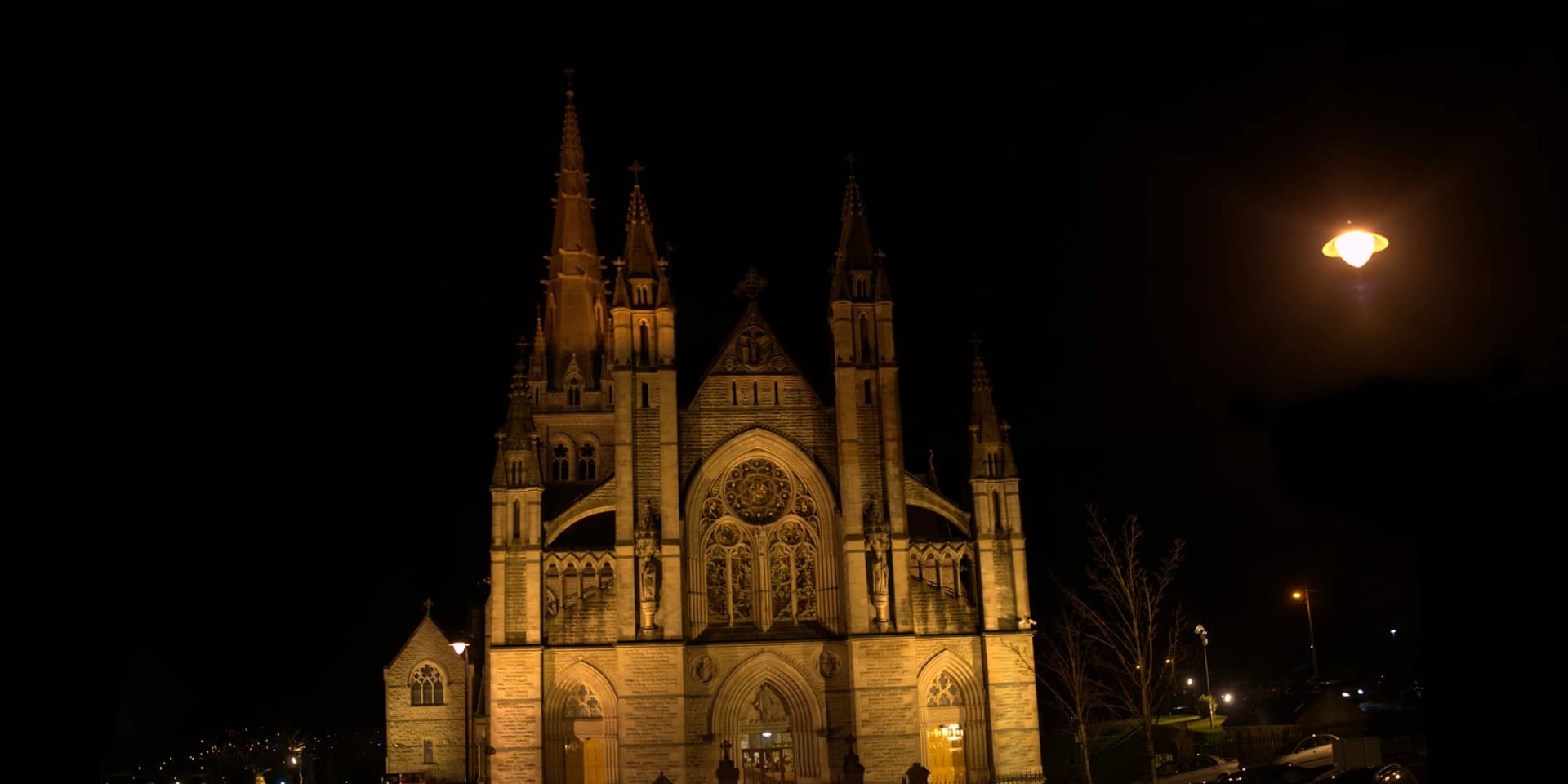
Letterkenny's enduring nickname comes from the Cathedral of St Eunan and St Columba, completed in 1901 in Victorian neo-Gothic style and still County Donegal's only Catholic cathedral. Its single soaring spire is the first thing most visitors notice on the approach roads, and the Cathedral Quarter of lanes behind it now hosts the town's community festivals, including the annual Street Feast. St Eunan's College, built in 1904 in a neo-Hiberno-Romanesque style with round towers, sits nearby and adds another distinctive silhouette to the skyline. In 2015 Letterkenny was named Ireland's tidiest town in the national Tidy Towns competition, a title that surprised some visitors given the EPA had flagged the town's air quality as a concern only a few years earlier; both facts are true, and the town has worked hard on the former since.
An unlikely arts scene
For a commercial county town, Letterkenny has built a genuinely disproportionate arts and culture offering. An Grianan Theatre, opened in 1999 with 383 seats, is the largest theatre in County Donegal, and the Regional Cultural Centre behind it, opened in 2007, adds galleries, a cinema and workshop spaces in a purpose-built glass-and-oak building. Both are regular hosts for the Earagail Arts Festival each July, which brings international and Irish performers to venues across the county. It's not the arts scene most visitors expect from a market town of this size, and it's one of the clearest signs that Letterkenny's ambitions go beyond simply serving as a road junction on the way to somewhere else.
Gateway to the northwest
Letterkenny's other defining feature is what surrounds it. Glenveagh National Park and Castle, one of Ireland's most significant protected landscapes, is around 25 to 30 minutes' drive away and is genuinely worth a full day; it is not in Letterkenny itself, and this guide treats it as a day trip rather than an in-town attraction. The Inishowen Peninsula, Fanad Head and the Grianan of Aileach hillfort are all within easy reach, and the town's position on the N13 and N14 makes it the natural overnight base for anyone touring the northwest without wanting to change hotels every night. Letterkenny does not have a beach or a harbour of its own to build a tourism pitch around; what it has instead is a genuinely useful location, a working town centre that doesn't shut down when the visitors leave, and a growing reputation for the things (theatre, food, a serious independent brewery) that a county's biggest town should have.