About Killarney
The history, geography, and character of Killarney.
Killarney sits in a bowl of lakes and mountains in the southwest of Ireland, in the part of County Kerry that Kerry people will tell you, without much prompting, is the best part of the country. It is two things at once: a working tourism town that has been welcoming visitors since the railway arrived in 1853, woollen shops, jaunting cars and all, and the gateway to Killarney National Park, the oldest in Ireland, whose oak woods, red deer and three lakes are the real reason anyone ever came. Take the town for what it is, busy and commercial in high summer, and the park behind it is world-class.
History & Heritage
The Lakes and the Park
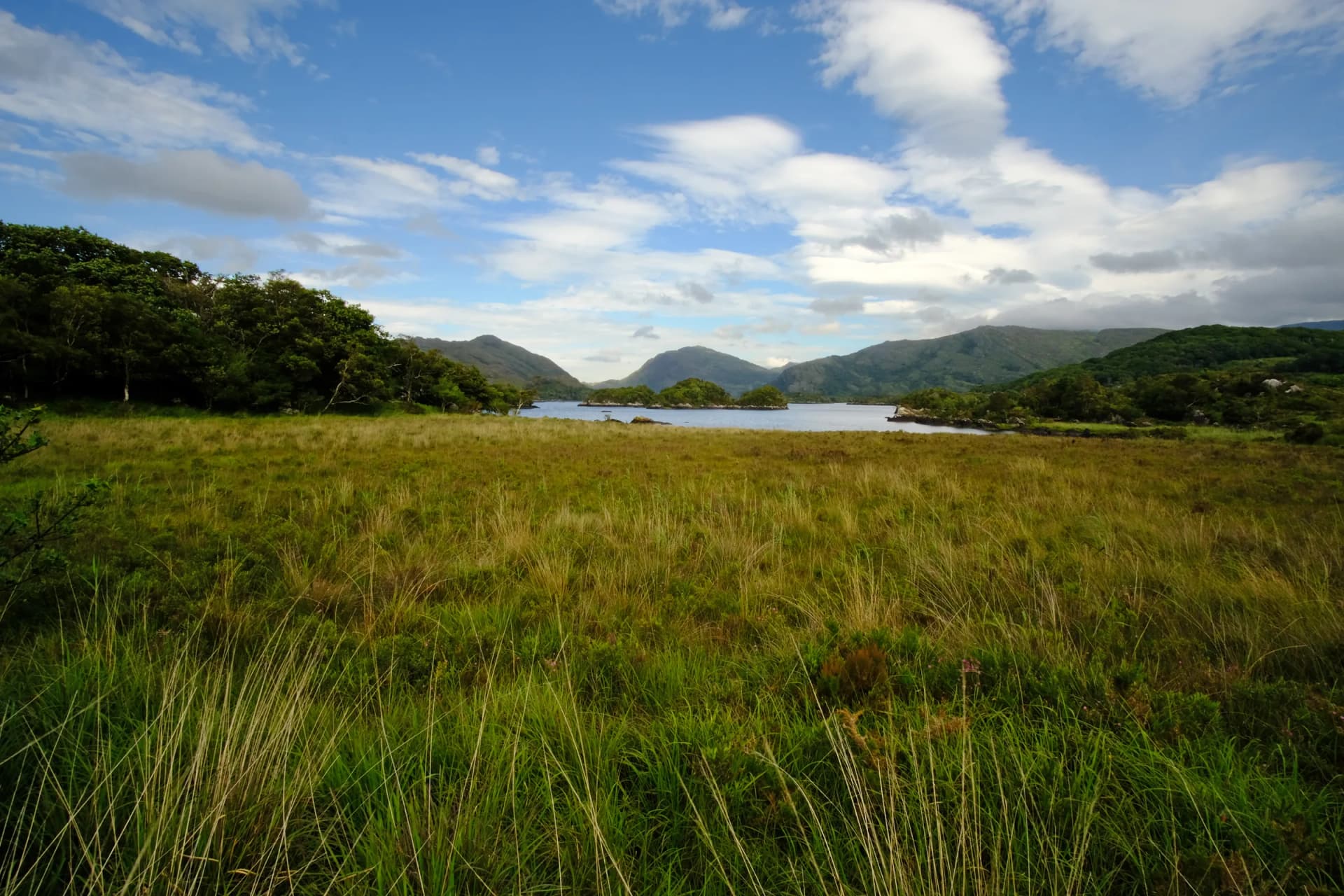
Everything in Killarney arranges itself around three lakes: Lough Leane, the largest, with Ross Castle and the monastic island of Innisfallen; Muckross Lake; and the Upper Lake, deeper into the mountains. They sit inside Killarney National Park, which began with the gift of the Muckross estate to the Irish State in 1932 and now runs to over 10,000 hectares of lake, mountain and woodland, a UNESCO Biosphere Reserve. Behind the lakes rise the MacGillycuddy's Reeks, the highest mountains in Ireland, with Carrauntoohil topping out at 1,038 metres. The park holds the country's largest surviving native oak and yew woods, and you can walk straight into it from the edge of the town.
The Original Irish Tourist Town
Killarney was a destination before Ireland really had a tourism industry. The lakes were already a fixture of the Romantic imagination when the railway reached the town in 1853, and Queen Victoria's visit in 1861 set the seal on the place. The jaunting car driven by a local jarvey, the lakeside hotels, the guided boat trips across the lakes: all of it dates from that Victorian heyday, which is why the town can feel purpose-built for visitors, because in large part it was. It is worth knowing this rather than being surprised by it. The souvenir end of the High Street is the surface; the park and the lakes are the substance.
Red Deer, Eagles and the Oak Woods
Killarney National Park holds the only herd of wild native red deer in Ireland, descended from animals that have been here since the last ice age, and they are the great wildlife sight of the place. Autumn, from late September into October, brings the rut, when the stags roar and clash across the valleys and the woods at Knockreer and Muckross are among the most reliable places in the country to see and hear it. White-tailed eagles, reintroduced to the park in 2007, now breed on the lakes again. One honest note: the carpets of purple flowering shrub you will see in places are Rhododendron ponticum, an invasive that has overrun roughly a third of the park and smothers the native woodland, and the National Parks and Wildlife Service spends heavily clearing it every year. It is a problem the park is fighting, not a bloom to seek out.
The Kingdom of Kerry
Killarney is the main town of the part of Kerry known, only half-jokingly, as the Kingdom, a county with a fierce identity built on Gaelic football, a distinctive accent and a confidence that the rest of the country finds either charming or insufferable depending on the day. It is also the practical base for the wider southwest: the Ring of Kerry loops out from here around the Iveragh Peninsula, Dingle and the Skelligs lie to the west, and Kenmare sits over the mountains to the south. Most visitors use Killarney as the place to sleep and eat between days out on the peninsulas, which is exactly what it has been doing, very well, for the best part of two centuries.
Wildlife & Nature
Mammals
Red deer
Killarney National Park holds the only herd of wild native red deer in Ireland, descended from animals present since the last ice age. Autumn brings the rut, when stags roar and clash across the valleys; Knockreer, the Muckross peninsula and the Killarney House parkland are among the most reliable places in the country to see and hear it, from a respectful distance.
Autumn (late September to October) for the rut
Sika deer
Introduced to the Muckross estate in the 1860s, sika deer are now well established in the park alongside the native red deer. Smaller and darker than the reds, they are commonly seen in the woodland and around the lakes.
Year-round, often at dawn and dusk
Birdlife
White-tailed eagle
Reintroduced to Killarney National Park in 2007 after being lost from Ireland for over a century, white-tailed eagles, Ireland's largest bird of prey, now breed again on the lakes. They are sometimes seen over Lough Leane and the wooded islands.
Year-round; more visible in the breeding season from spring
Flora
Strawberry tree (arbutus)
Killarney's signature tree, Arbutus unedo, is a rare survivor more typical of the Mediterranean, growing wild in the park's oak woods and on the lake islands. It carries white flowers and red, strawberry-like fruit at the same time in autumn.
Autumn, when it flowers and fruits together
Native oak and yew woods
The park protects the largest area of surviving native sessile-oak woodland in Ireland, along with a rare yew wood at Reenadinna. These ancient woods are the habitat the whole park is built to protect, and the reason the invasive rhododendron is taken so seriously.
Autumn for colour; spring for fresh leaf and birdsong