About Killaloe
The history, geography, and character of Killaloe.
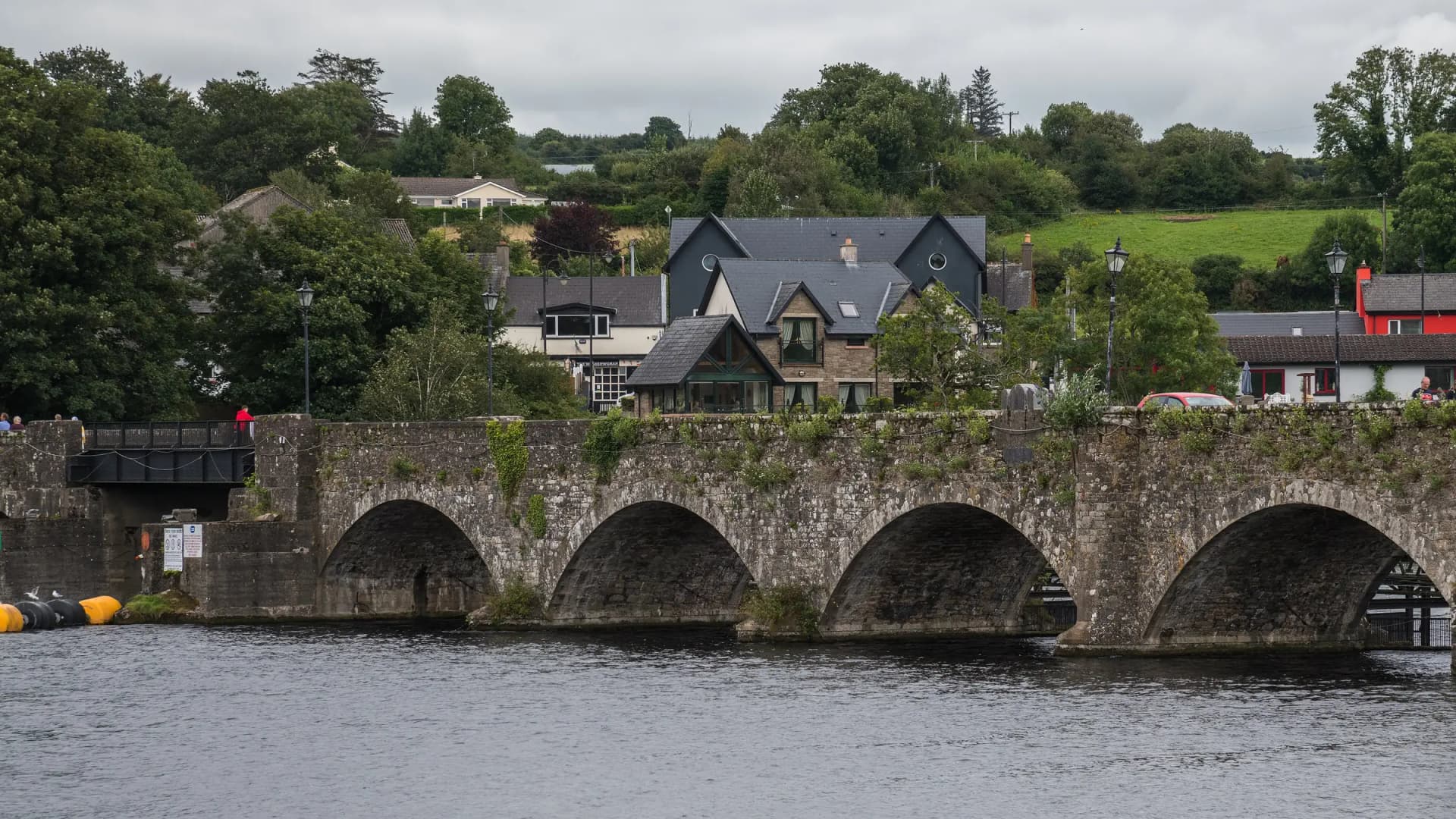
Killaloe, Co. Clare and Ballina, Co. Tipperary face each other across the Shannon at the point where Lough Derg narrows back into the river, joined by an old stone bridge that Waterways Ireland dates to the eighteenth century. The Clare side has the cathedral, the canal and the hill; the Tipperary side has the quay, the cruise boat and the road up into the Arra Mountains. Brian Ború ruled Ireland from here: Discover Ireland gives his headquarters as Kincora, in the town, and the ringfort tradition ties to him, Béal Ború, stands on a spur about 1.5km upriver.
History & Heritage
Cill Dalua
The town is named for St Molua, Cill Dalua, the church of Lua. St Flannan's Cathedral's own history describes him as a sixth-century contemporary of St Brendan whose church stood on Friar's Island in the Shannon. When the island was submerged in the 1930s for the Ardnacrusha power station, the church was moved to the grounds of the Catholic church on the hill, where it stands now as St Molua's Oratory.
Brian Ború and Kincora
Brian Ború was High King from 1002 until his death at the Battle of Clontarf in 1014. Discover Ireland gives his headquarters as Kincora, Ceann Cora, in Killaloe, and credits the folklorist Dáithí Ó hÓgáin with the view that he was born or reared at Béal Ború, the ringfort north of the town whose name it gives as the port of the cattle tribute. Nothing of Kincora survives above ground. His name is everywhere else: Féile Brian Ború, the twin towns' festival, held its 33rd edition from 1 to 5 July 2026.
St Flannan's Cathedral
The cathedral's own history says Donal Mór O'Brien built a church here early in the twelfth century and that the present building, dedicated to St Flannan, replaced it between 1195 and 1225. It is built of yellow and purple sandstone. Its Romanesque doorway, which may come from the earlier church, carries over 130 patterns of plants and animals, and the Thorgrim stone, found in 1916 and dated to about 1000 AD, is inscribed in both ogham and Norse runes. A stone-roofed oratory, also dedicated to St Flannan, stands in the graveyard.
Two towns, two counties
The river is the county boundary. Killaloe is in Co. Clare; Ballina, across the bridge, is in Co. Tipperary, and is not the Ballina in Co. Mayo. Several businesses on the Tipperary bank use Killaloe in their address, so check the county before you book or park. The cruise boat, the Lakeside Hotel, Goosers and Tuscany Bistro are all in Ballina, Co. Tipperary; the cathedral, the canal, the Sunday market and Killaloe Hotel & Spa are in Killaloe, Co. Clare.
Lough Derg
Waterways Ireland calls Lough Derg Ireland's quintessential pleasure lake, with over 160km of indented shoreline and a Blueway of 21 paddling journeys. Two Blue Flag lakeshore beaches were on the 2026 list on the Clare shore, Ballycuggeran just north of Killaloe and Mountshannon further up. Off Mountshannon lies Inis Cealtra, Holy Island, with a round tower and six ruined churches, where Gerard Madden's site says Brian Ború's brother Marcán was abbot.
Wildlife & Nature
Birdlife
White-tailed sea eagle
Waterways Ireland lists the white-tailed sea eagle among Lough Derg's birdlife, alongside cormorants, swans, ducks and terns.
Year-round; sightings are never guaranteed
Swans
Waterways Ireland names swans in Lough Derg's birdlife, and Geograph photographers have recorded them on the Killaloe Canal.
Year-round
Flora
Holy Island wildflowers
Gerard Madden's Holy Island site says the island is covered with narcissus in spring, with yarrow, cuckoo flower and bird's-foot trefoil.
Spring and early summer