About Galway
The history, geography, and character of Galway.
History & Heritage
The City of the Tribes
Galway began as a walled Anglo-Norman trading town in the thirteenth century, and for centuries it was run by fourteen merchant families who controlled the port, the trade and the city government. The names are still everywhere on streets, shopfronts and gravestones: Athy, Blake, Bodkin, Browne, D'Arcy, Deane, Font, Ffrench, Joyce, Kirwan, Lynch, Martin, Morris and Skerritt. They grew rich on wine and trade with Spain and France, and they kept the native Irish firmly outside the walls. The nickname "the Tribes" was actually a Cromwellian insult, flung at these families by the besieging forces in the seventeenth century to mock their clannishness. The families took it, kept it, and wore it as a badge of pride, which tells you a fair bit about Galway. Lynch's Castle on Shop Street, now a bank, is the best-preserved of their townhouses and worth a look as you pass.
The Claddagh and its Ring
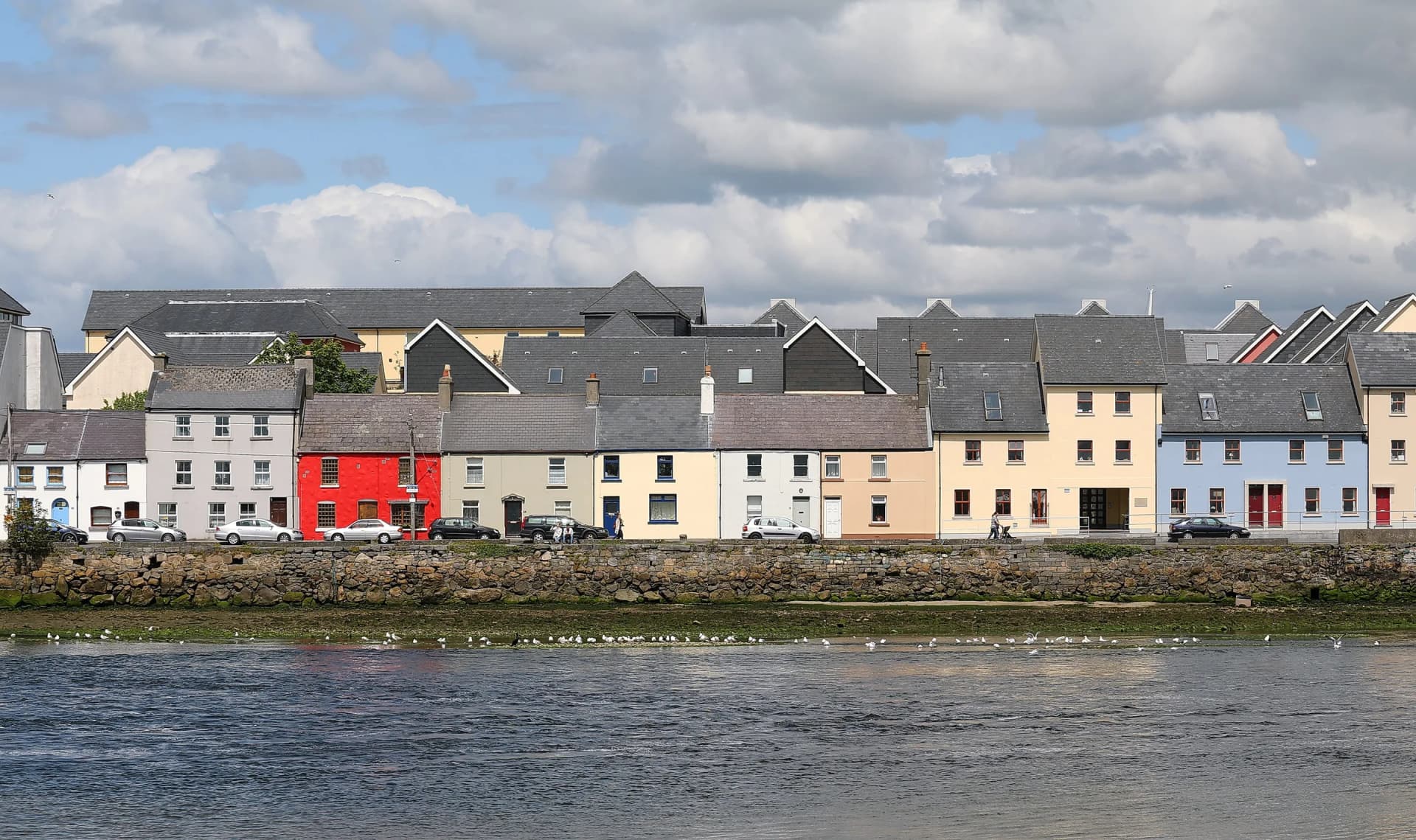
Across the river from the old walled town, where the Corrib meets the bay, the Claddagh was an Irish-speaking fishing village that predated the city and kept its own ways, its own king and its own fleet of hookers, the traditional sailing boats with the rust-red sails. The thatched cottages are long gone, cleared in the 1930s, but the name lives on and so does the Claddagh ring: two hands holding a crowned heart, standing for love, friendship and loyalty. Worn with the heart pointing outwards it says you are single; turned inwards it says your heart is taken. It is one of the few genuinely old Irish traditions that survived intact, and it came out of this one small huddle of fishermen's houses at the harbour mouth.
Ireland's Festival City
Galway is, by a clear margin, the arts and festival capital of Ireland, and a UNESCO City of Film into the bargain. The Galway International Arts Festival in July takes over the whole city for a fortnight, and Macnas, the spectacular street-theatre company, sends giant puppets and processions through the streets. There is the Film Fleadh, the Oyster Festival, the races at Ballybrit, the early-music festival, the comedy carnival and more besides, so that some weekend in the year there is nearly always something on. The buskers on Shop Street and Quay Street are part of the everyday fabric rather than a tourist add-on, and the trad sessions in the pubs are real ones. This is a city that genuinely lives by its culture, not one that performs it.
Bilingual City, Gateway to the West
Galway is the only city in Ireland with a Gaeltacht, an Irish-speaking region, on its doorstep, and Irish is a living language here rather than a school subject. TG4, the national Irish-language broadcaster, is based out in the Connemara Gaeltacht, and you will hear the language spoken in shops and on the street, especially out west. The city is the gateway to all of that: to Connemara with its mountains, bogs and the village of Roundstone; to the Aran Islands out in the bay, reached by ferry from Rossaveal; and down the coast to the Burren and the Cliffs of Moher. Galway is where most people base themselves before heading into the wild edge of the country, and it sends you off well fed and in good humour.
Wildlife & Nature
Marine Life
Atlantic salmon
The River Corrib runs one of Ireland's most famous salmon runs straight through the city. From spring into summer, shoals hold in the clear water below the Salmon Weir Bridge, visible from the bridge itself, on their way up to Lough Corrib to spawn.
Spring and early summer
Grey seals
Grey seals work the mouth of the Corrib and Galway Bay and are regularly seen from the Spanish Arch, the Claddagh quays and on the Corrib Princess cruise.
Year-round
Birdlife
The Claddagh swans
A resident herd of mute swans lives where the Corrib meets the bay at the Claddagh, one of the most photographed sights in the city. They gather along the Long Walk and the Claddagh quays and are present all year.
Year-round