About Enniscrone
The history, geography, and character of Enniscrone.
Enniscrone, Inis Crabhann in Irish and often written Inishcrone, is a coastal village on the eastern shore of Killala Bay in County Sligo, hard against the Mayo border and just eight kilometres north of Ballina. With a population of around 1,200 it punches well above its weight as a holiday town, drawing Irish families back generation after generation for its long strand, its surf, its links golf and, above all, for the seaweed baths that have been the heart of the place since 1912.
History & Heritage
The O'Dowds, the castle, and a thousand years on the ridge
Enniscrone lies in the old barony of Tireragh, which for centuries was the territory of the Ó Dubhda, anglicised as O'Dowd, the family the local genealogists called the hereditary keepers of the western seaways. Their power across north Mayo and west Sligo was held together by a network of fortifications that local tradition remembers as the twenty castles of the O'Dowds, and one of them stood on the ridge above the bay at Enniscrone. The ruin you can still see today, on the high ground in Carrowhubbuck South north-east of the village, is known locally as Nolan's Castle, Field Castle or simply O'Dowd's Castle. Two different buildings need to be kept apart on the site. There was a late-medieval O'Dowd fortification, traditionally dated to the close of the 14th century and documented at Enniscrone by 1417 in the Great Book of Lecan, the manuscript compiled under O'Dowd patronage by Giolla Íosa Mór Mac Fir Bhisigh. The walls that survive, however, belong to a later early 17th-century fortified house raised on the same ground. The castle changed hands repeatedly. It was taken by the Burkes of Tyrawley in 1512, then dislodged by the O'Donnells of Tír Chonaill the same year. In 1597 it was sold on to the New English settler John Crofton, then to Thomas Nolan of Ballinrobe, whose family name stuck. It passed through Coote, Gore and Orme hands before ownership came to the Irish State in the 1920s. The ridge itself is far older than any of this: it carries Neolithic tombs and an early medieval ringfort, so people have lived and buried their dead here for thousands of years. The castle is a Recorded Monument and is currently undergoing conservation work, supported by a Community Monuments Fund award in 2025.
Kilcullen's Seaweed Baths: a bath house since 1912
If Enniscrone has one defining experience, it is a hot seaweed bath at Kilcullen's. The bath house on the Pier Road opened for business in 1912, the year of the Titanic, on a site the Kilcullen family had acquired as far back as 1898. It has stayed in the same family ever since, now into the fifth generation, opening its doors every summer for over a hundred years. The Edwardian fittings are still in use: enormous glazed porcelain baths, solid brass taps and panelled wooden shower cisterns, so a bath here is as much a step back in time as it is a soak. Seaweed bathing is an old tradition along the west coast of Ireland, where it was long believed to ease the aches of rheumatism and arthritis. The science behind it is the iodine. Seaweed draws iodine out of the surrounding seawater and concentrates it in its fronds, in some species to thousands of times the level in the water around it. At Kilcullen's the bath is filled with hot seawater pumped straight in from the Atlantic, with bladderwrack seaweed added so that the natural oils released turn the water a deep amber and leave it with the silky feel of bath oil. The fuller treatment pairs the bath with a steam cabinet, where you sit enclosed with only your head out, before finishing with a cold seawater shower. The family connection to the sea runs deep. Cain Kilcullen, who harvests the seaweed for the baths, is the fourth generation of his family to do that work, gathering bladderwrack from the shore of Killala Bay just yards from the bath house. When the plug is pulled, nothing has been added and nothing taken away. It is one of the most distinctive things you can do anywhere in Ireland, and it is the reason a great many people first come to Enniscrone at all.
The strand and the surf
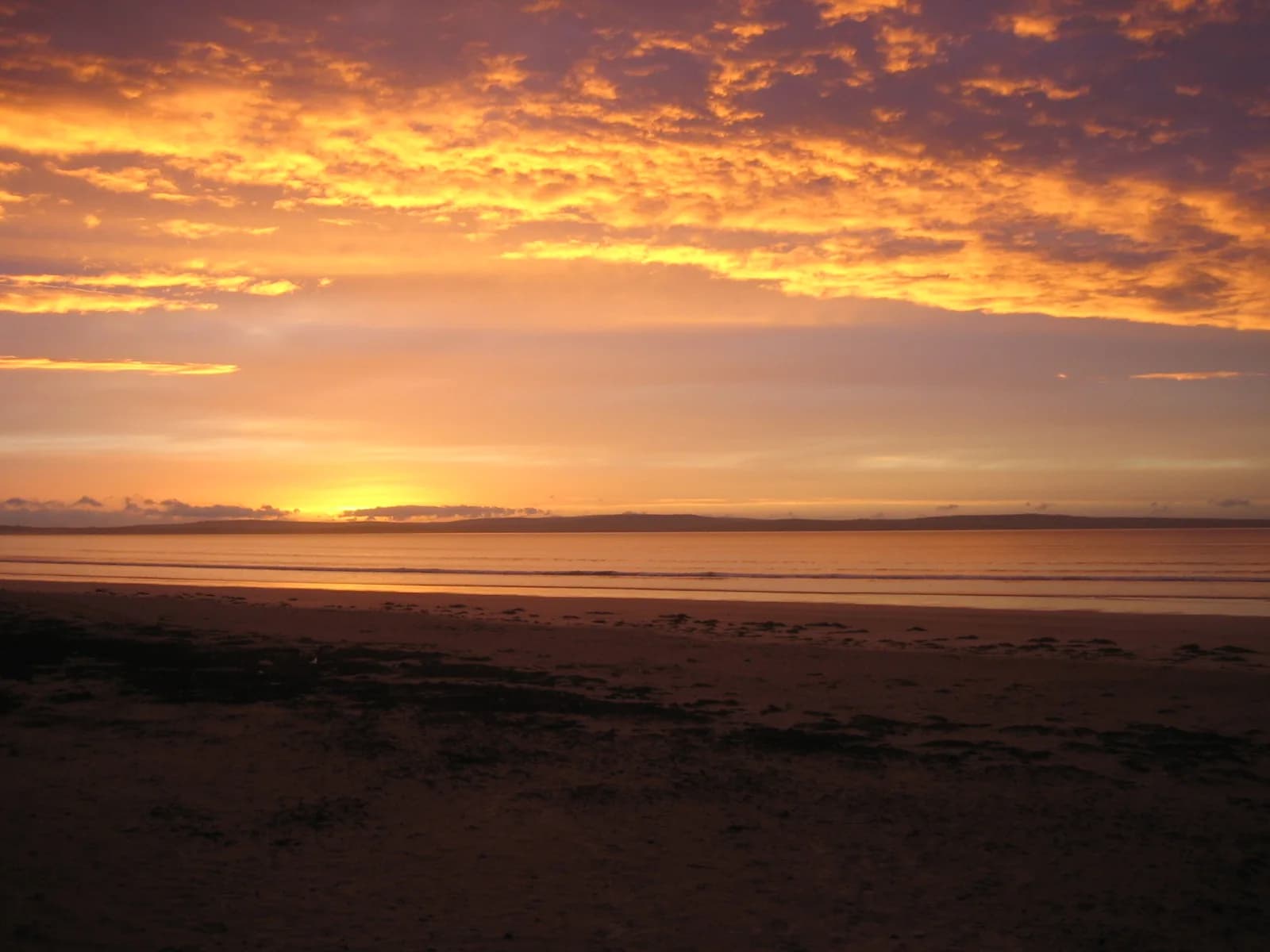
Enniscrone's beach is a long crescent of golden sand running roughly five kilometres along the shore of Killala Bay. It has held Blue Flag status year after year, and in summer it is exactly what an Irish family beach should be: shallow water for paddling, firm sand for walking and building castles, and a lifeguarded zone in front of the promenade during the bathing season, which runs roughly from June to August. The beach also happens to be an excellent place to learn to surf. The waves roll in over a clean sandy bottom with consistent peaks, which makes it forgiving for beginners while still offering plenty for improvers. Two long-established surf schools work the strand: North West Surf School, set up in 2006 and run by the Lavelle family with instructors from the locality, and 7th Wave Surf School, both approved by the Irish Surfing Association and offering lessons, camps and gear hire for all ages. Between the surfers, the swimmers and the walkers, the strand is the social spine of the village in summer.
A classic Irish holiday town
Enniscrone belongs to a particular kind of Irish place: the seaside resort that families have been returning to for decades, where the holiday is the beach, the chipper, the amusements, the caravan park and the long evenings on the strand. It has never tried to be anything fancier than that, and that is precisely its charm. Generations of inland families from Mayo, Sligo, Roscommon and beyond have made their summer here. Around the beach and the baths, the village offers the rest of what a holiday needs. There are pubs serving honest food, a couple of hotels, self-catering houses and a caravan park, an internationally rated links golf course in the dunes, and Killala Bay itself, which faces out toward Bartragh Island and the Mayo coast and is rich in seabirds and shore life. The Black Pig Festival each July fills the village with music, food and beach events. It is unpretentious, family-first, and genuinely well loved, which is more than can be said for a lot of better-known destinations.
Wildlife & Nature
Marine Life
Bladderwrack and shore seaweeds
The same bladderwrack that fills the baths grows thickly along the rocky stretches of the bay, part of a shoreline ecosystem that has shaped the village's identity.
Year-round
Marine mammals
The waters off the north Sligo and Mayo coast occasionally bring seals close to shore, and cetaceans are recorded further out in the bay, though sightings are a matter of luck rather than expectation.
Year-round
Birdlife
Shore and wading birds
The long strand and the estuary flats at the mouth of the Moy draw oystercatchers, ringed plover, sanderling and other waders that work the tideline, especially outside the busy summer months.
Year-round
Seabirds
Gulls, terns, gannets and cormorants are a regular sight over Killala Bay, fishing the shallows and the channels around Bartragh Island.
Year-round