About Enniscorthy
The history, geography, and character of Enniscorthy.
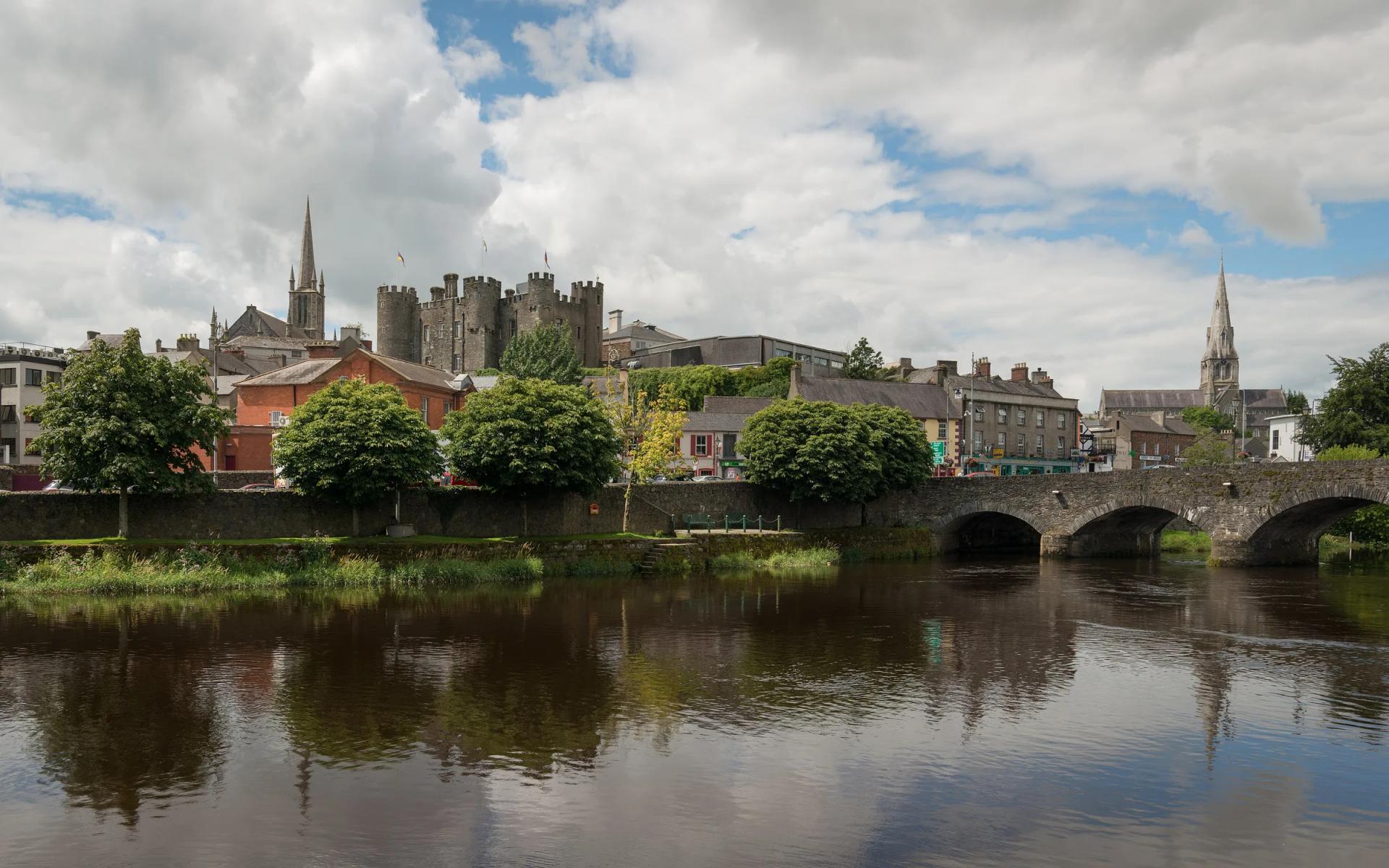
Enniscorthy, Inis Córthaidh, is a market town on the River Slaney in the middle of Co. Wexford, built on two steep banks with a bridge between them. The west bank has the Norman castle, Market Square and, at the top of the hill, Pugin's cathedral; the east bank, Templeshannon, has the railway station and, above it, Vinegar Hill, where the Wexford rising of 1798 had its main camp and its last great battle. A mural in the town centre reads Love 'Scorthy, which is the town's own short form.
History & Heritage
St Senan's side of the river
The town's own history begins on the east bank. Enjoy Enniscorthy, the town's visitor site, dates it to 510 AD, when St Senan from Co. Clare founded a monastic settlement in what is now Templeshannon. The district still carries his name, and the road that climbs out of it towards Vinegar Hill is simply called The Shannon.
The castle on the hill
The Normans came next. Strongbow granted the Duffry, the territory that takes in Enniscorthy, to Robert de Quency, and the castle on Castle Hill grew out of that grant. Its own history runs through Gaelic kings, English armies, rebels and prisoners, and ends with the Roche family, local maltsters, who were the last to live in it before it was sold in the mid-twentieth century. It is now the town museum, with a permanent exhibition on Eileen Gray, the modernist designer who was born at Brownswood just outside the town in 1878.
Two battles in 1798
On 28 May 1798 a rebel army of six or seven thousand took the town from a garrison of about three hundred, driving cattle into the defenders' lines at the Duffry Gate, and set up camp on Vinegar Hill. The camp became a refuge for families as well as an army. On 21 June General Lake's forces attacked the hill; the rebel army escaped towards Wexford, but the National 1798 Rebellion Centre puts the dead at about 1,500, most of them women and children. The bronze monument by Oliver Sheppard in Market Square went up in 1908.
Pugin's cathedral
St Aidan's Cathedral, seat of the Diocese of Ferns, was designed by Augustus Welby Pugin and built around the older church of 1809, which was taken down once the nave was finished in 1849. In 1970 its painted decoration was covered in white; in 1994 it was restored to Pugin's original colours.
1916 and the Athenaeum
The Athenaeum on Castle Street, built in 1892, was the headquarters of the Irish Volunteers in Easter 1916. Enniscorthy was the only urban centre outside Dublin to rise that week, and the last to surrender. The same building is where Micheál MacLiammóir and Hilton Edwards first met, in 1927, a year before they founded the Gate Theatre in Dublin.
The town now
Enniscorthy is a working market town and the centre of its own municipal district. The farmers' market fills Abbey Square every Saturday, the Rackard name on a Rafter Street pub is a reminder of the hurling brothers who won the All-Irelands of 1955 and 1956, and the Rockin' Food and Fruit Festival takes over the castle grounds and the pubs every May Bank Holiday. Colm Tóibín, Anthony Cronin and Éamonn Wall are among the writers the town claims.
Wildlife & Nature
Flora
Gorse on Vinegar Hill
The upper slopes of Vinegar Hill are rough grass and gorse, which turns the hill yellow in spring and early summer.
April to June