About Ennis
The history, geography, and character of Ennis.
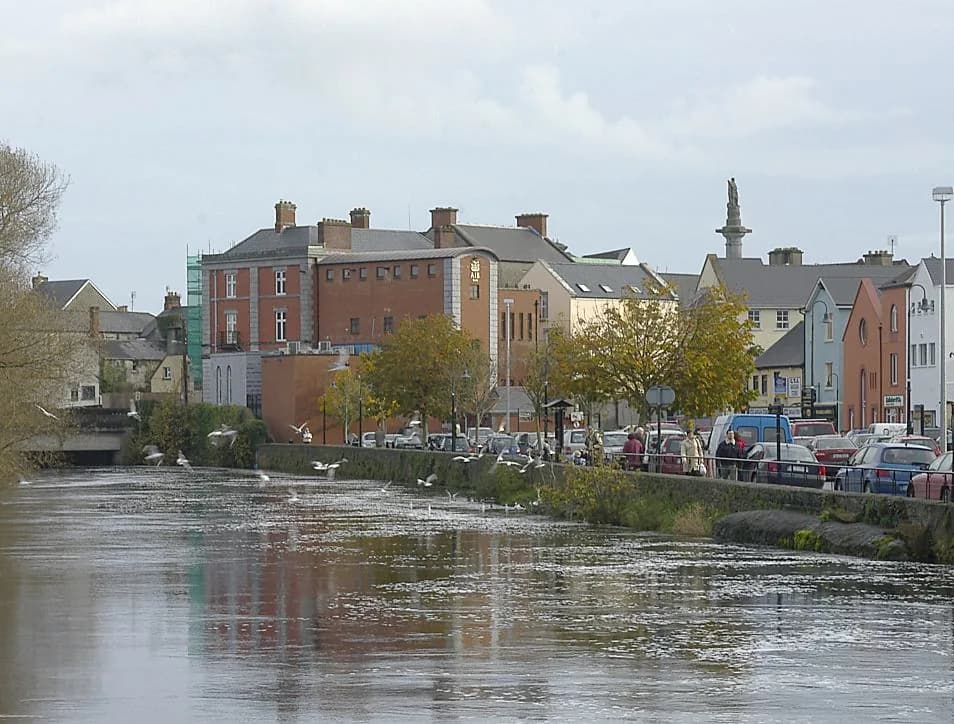
Ennis is the county town of Clare and its largest settlement, with around 27,900 people, built on an island in the River Fergus in the centre of the county. Its Irish name, Inis, means island, and the medieval town grew up in the loop of the river around the 13th-century Franciscan friary at its heart. It is a real, year-round traditional-music town, home to Cois na hAbhna, the regional base of Comhaltas, rather than a village or a summer show. Inland and central, with the M18 and Shannon Airport close at hand, it is also the natural base for exploring the rest of Clare, from the Burren to the Cliffs of Moher.
History & Heritage
A year-round trad-music town
Ennis sits in the trad-music heartland of Ireland, and unlike a summer-only tourist scene the music here runs the whole year through. It is home to Cois na hAbhna on the Galway Road, the regional resource centre of Comhaltas Ceoltóirí Éireann, which keeps the tradition of music, song and dance alive through classes, archives, seisiúns and céilís. In the town's pubs, rooms like Brogan's, Poet's Corner and Nora Culligan's carry regular sessions, and two festivals bookend the calendar: Fleadh Nua in late May, in the town since 1974, and Ennis Trad Fest in early November. The music is part of ordinary life in Ennis rather than a performance laid on for visitors, which is what marks it out.
The friary and the county town
The town owes its existence to Ennis Friary, a Franciscan house founded by the Ó Briain kings of Thomond in the 13th century, which became a major centre of medieval learning. Its 15th-century carved stonework, including the McMahon tomb, is among the finest medieval sculpture in Ireland, and the town grew around it in the river's loop. Ennis went on to become the county town and capital of Clare, tied into national history through Daniel O'Connell, whose landmark 1828 election here helped force Catholic Emancipation; his monument stands in O'Connell Square at the centre of town. In modern times Ennis was named Ireland's first Information Age Town in 1997 and has been a repeat Tidy Towns winner.
An island in the River Fergus
Ennis is built on a genuine island in the River Fergus, which loops around the medieval core, a fact locals know well and visitors rarely do. The river gives the town its name and its shape: the tight weave of narrow, cobbled laneways between O'Connell Street, Abbey Street and Parnell Street follows the old street pattern in the bend of the water. South of the town the Fergus opens into its estuary, a broad tidal expanse that meets the Shannon and is an important place for wildfowl and wading birds. The town itself is compact, flat and walkable, best explored on foot with the river never far away.
The base for exploring Clare
Ennis is inland, in the centre of the county, and its position makes it the practical base for touring Clare rather than a coastal destination in its own right. On the M18 motorway, it is about 20 minutes from Shannon Airport, 40 from Limerick and an hour from Galway. From here the county opens up: the Burren limestone country is about 15 minutes north, the Cliffs of Moher about 45 minutes west through Ennistymon and Lahinch, and Bunratty Castle and Folk Park about 15 to 20 minutes south. As the county town it has the full range of services the coastal villages lack, so many visitors sleep, eat and hear their music in Ennis and drive out to the coast by day.
Wildlife & Nature
Marine Life
Fergus Estuary wildfowl and waders
South of the town the River Fergus opens into a broad tidal estuary where it meets the Shannon, one of the most important wetlands in the country for wintering wildfowl and wading birds. Large numbers of ducks, geese, godwits and other waders feed on the mudflats, and the estuary is a protected site. It is a birdwatcher's landscape rather than a set-piece attraction, best in the winter months.
Autumn and winter for wintering wildfowl and waders
River Fergus otters, herons and swans
The River Fergus running through the town supports the ordinary but rewarding wildlife of an Irish river, with grey herons stalking the shallows, swans and moorhens on the water, and otters present along its banks. A slow walk by the river through the town is the easy way to see the herons and swans in particular.
Year-round, best early or late in the day along the river
Burren wildflowers (on the day trip north)
About 15 minutes north of Ennis, the Burren is famous for its flora, with Arctic, Alpine and Mediterranean plants growing together on the bare limestone, including spring gentians and several orchids. They are at their best from late April into the early summer, and are one of the reasons to time a day trip north from the town for late spring.
Late April to June, in the Burren north of the town